FORTILABS AI LAB · RETRIEVAL SYSTEMS
A retrieval system can find the right document in milliseconds and still give an AI agent the wrong answer. It can also spend several seconds reasoning through a document collection when a conventional search index could have returned the required evidence almost instantly.
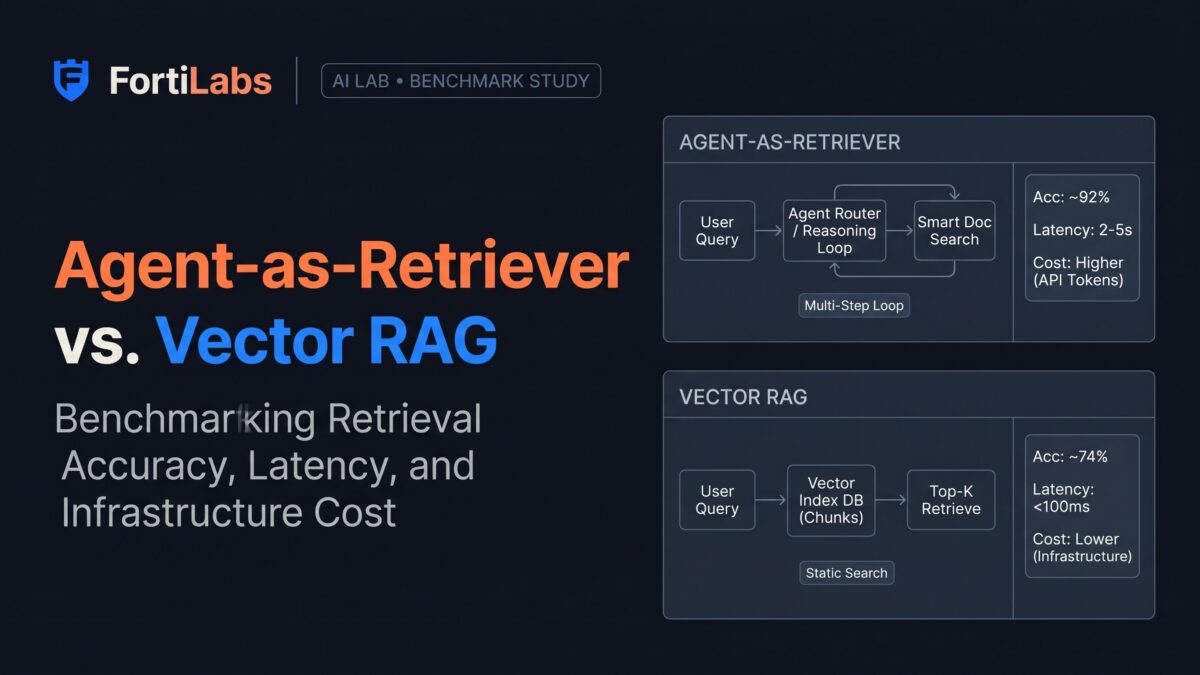
This is the engineering trade-off behind agent-as-retriever and vector RAG. One approach lets an AI agent decide how to search, which sources to inspect, and whether another retrieval step is necessary. The other uses an indexed retrieval pipeline to find relevant content through vector similarity, often combined with lexical search and reranking.
Neither architecture is universally better. Agent-driven retrieval can be useful when a question requires iterative investigation, navigation, or combining evidence from different sources. Indexed retrieval is generally more predictable for repeated queries over large, well-structured collections.
TL;DR
- Vector RAG: Usually offers predictable retrieval latency and amortizes indexing costs across many queries.
- Agent-as-retriever: Adds reasoning and tool selection to retrieval, which can help with multi-step questions but introduces additional model calls, token consumption, and execution variability.
- Accuracy: Must be measured using relevant-document labels and answer-level ground truth. A correct answer does not necessarily mean the retrieval strategy is consistently better.
- Cost: Includes ingestion, embeddings, indexing, storage, retrieval, model tokens, reranking, and operational infrastructure.
- Practical recommendation: Start with indexed hybrid retrieval, then introduce an agent when evaluation demonstrates that adaptive search improves difficult queries enough to justify its additional cost.
1. Understanding the two retrieval models
What is vector RAG?
Retrieval-Augmented Generation (RAG) connects a language model to an external knowledge source. Instead of relying exclusively on information encoded in model parameters, the application retrieves relevant material and supplies it as context for generation.
In a conventional vector RAG system, documents are processed before a user asks a question:
- Documents are collected and normalized.
- Content is divided into searchable chunks.
- An embedding model converts chunks into numerical vectors.
- The vectors and associated metadata are stored in an index.
- A user query is embedded and compared with indexed vectors.
- The most relevant chunks are retrieved, optionally reranked, and passed to the language model.
The central advantage is that much of the expensive preparation happens before query time. The system pays an ingestion and indexing cost, then reuses that work across subsequent searches.
Vector similarity is not the only retrieval method. Production systems often combine dense vector search with lexical search such as BM25, metadata filters, and a reranking stage. This is commonly called hybrid retrieval.
What is agent-as-retriever?
Agent-as-retriever describes an architecture in which an LLM-based agent actively controls the retrieval process. Rather than executing one fixed search operation, the agent can decide which retrieval tool to call, refine a query, inspect results, navigate documents, and perform additional searches when the available evidence is insufficient.
The agent may have access to:
- Vector search over an embedding index.
- Keyword or full-text search.
- Document metadata and structured database queries.
- File-system or document navigation tools.
- Knowledge graphs and relationship lookups.
- Specialized search services for different data sources.
The important distinction is that agent-as-retriever does not necessarily mean vectorless retrieval. An agent can use a vector database as one of its tools. The agent is the orchestration and decision-making layer; the retrieval mechanisms underneath it can be conventional indexes.
Terminology matters: This article uses agent-as-retriever to describe an LLM-driven retrieval controller. A vectorless agent that searches raw files without a vector index is a narrower implementation, not a synonym for every agentic RAG system.
2. How the architectures work
Conventional vector RAG request flow
                 DOCUMENT INGESTION
                         |
                         v
                DOCUMENT NORMALIZATION
                         |
                         v
                   CHUNKING
                         |
                         v
                  EMBEDDING MODEL
                         |
                         v
                  VECTOR INDEX
                         |
                         |
USER QUERY ------------+
                         |
                         v
                   QUERY EMBEDDING
                         |
                         v
                  VECTOR SEARCH
                         |
                         v
                 OPTIONAL RERANKING
                         |
                         v
                  CONTEXT ASSEMBLY
                         |
                         v
                   LLM GENERATION
                         |
                         v
                      ANSWER
This is a relatively fixed workflow. Retrieval behavior is controlled through configuration such as chunk size, top-k, similarity metric, filters, index parameters, and reranking.
It is efficient when query patterns are reasonably predictable and the collection can be prepared in advance.
Agent-driven retrieval request flow
USER QUERY
    |
    v
AGENT / PLANNER
    |
    v
SELECT RETRIEVAL STRATEGY
    |
    +----------------------+
    |          |           |
    v          v           v
 VECTOR     KEYWORD      DOCUMENT
 SEARCH     SEARCH       NAVIGATION
    |          |           |
    +----------+-----------+
               |
               v
        INSPECT RESULTS
               |
               v
       EVIDENCE SUFFICIENT?
          /          \
        NO            YES
        |              |
        v              v
   REFINE QUERY    BUILD CONTEXT
        |              |
        +---> SEARCH   v
                    LLM ANSWER
An agent can choose a different search strategy based on the question and intermediate evidence. For example, it might first locate a product specification, then inspect a related compatibility document, and finally verify a version-specific detail.
That flexibility is useful, but every additional reasoning or retrieval step introduces another opportunity for latency, cost, tool failure, or an incorrect decision.
The architectural difference
Vector RAG primarily optimizes the retrieval operation. Agent-as-retriever also introduces a policy for deciding what to retrieve next.
This means the real comparison is not simply vector search versus an LLM. It is a comparison between a mostly fixed retrieval pipeline and an adaptive retrieval controller that may invoke one or more retrieval mechanisms.
3. Agent-as-retriever vs. vector RAG
| Dimension | Vector RAG | Agent-as-retriever |
|---|---|---|
| Retrieval strategy | Usually configured in advance. | Selected or adjusted dynamically by an agent. |
| Indexing | Typically requires document preparation and indexing. | May use existing indexes, raw documents, or both. |
| Query execution | Usually one retrieval operation, possibly with reranking. | Can involve multiple sequential tool calls and iterations. |
| Multi-hop questions | May need query decomposition or additional retrieval stages. | Can plan and perform iterative searches. |
| Latency | Often more predictable. | More variable because of planning and repeated calls. |
| Query-time token use | Usually lower for a fixed retrieval pipeline. | Can increase with planning, tool descriptions, intermediate results, and repeated reasoning. |
| Infrastructure | Embedding, index, storage, and retrieval infrastructure. | Agent runtime, model orchestration, tools, and any underlying retrieval infrastructure. |
| Operational complexity | Mostly search and indexing operations. | Includes tool orchestration, agent state, loop limits, and failure recovery. |
| Best fit | Repeated searches over large, reusable collections. | Complex investigations across multiple sources or retrieval methods. |
Where vector RAG has an advantage
- Large document collections with frequent repeated queries.
- Customer support knowledge bases with known content boundaries.
- Product documentation and technical manuals.
- Search applications with strict latency budgets.
- Workloads where retrieval behavior must be easy to reproduce and monitor.
Where agent-driven retrieval has an advantage
- Questions requiring evidence from several independent sources.
- Research tasks where the next search depends on the previous result.
- Collections with different structures and search interfaces.
- Investigations involving relationships, references, and document hierarchies.
- Tasks where the system must decide whether another retrieval attempt is worthwhile.
Neither list is absolute. A well-designed vector pipeline can support multi-hop workflows, while an agent can be constrained to a single retrieval call. The workload and implementation determine the actual trade-off.
4. What published benchmarks actually show
A meaningful comparison needs evidence from controlled experiments. A benchmark that changes the corpus, model, prompt, hardware, or evaluation set between systems cannot isolate the effect of retrieval architecture.
Several recent studies illustrate why the decision is more nuanced than declaring one approach the winner.
Study 1: Agentic RAG versus vectorless retrieval
In an August 2026 benchmark, Dataworkz compared a vector-indexed retrieval pipeline with its DCI-Agent-Lite vectorless agent using the same 326-document corpus and 25 questions.
| Reported metric | Vector-indexed path | Vectorless agent |
|---|---|---|
| Correct answers | 22 / 25 | 22 / 25 |
| Reported response time | 3–10 seconds | 20–70 seconds |
| Tokens processed | 16,625 | 5,630,800 |
| Reported 25-query cost | $0.028 | $0.491 |
The two systems achieved the same number of correct answers but missed different questions. The vectorless path processed approximately 338 times as many tokens and was substantially slower in that experiment.
These are vendor-published results, not an independent FortiLabs benchmark. They compare one particular vectorless implementation with one indexed pipeline. They do not establish that every agentic retrieval architecture has these costs or that every vector RAG system will achieve the same performance.
The useful lesson is that removing the index does not automatically remove cost. If an agent repeatedly reads or searches a large corpus at query time, it can shift substantial work from ingestion to every individual request.
Read the Dataworkz benchmark and its methodology.
Study 2: Agentic RAG across retrieval paradigms
A 2026 scaling study titled Which RAG Paradigm Wins at Scale? compared lexical retrieval, dense retrieval, graph-based methods, and a file-system agent across 28 nested corpus sizes, ranging from roughly 1,000 to 512,000 documents.
Its reported results are particularly useful because they expose how architecture performance changes as the corpus grows:
- BM25 occupied the low-cost end of the measured cost-performance frontier and led accuracy from mid-scale onward in the tested setup.
- The file-system agent was competitive at the smallest corpus sizes but used 39 times more query tokens per answer at the study’s bedrock scale.
- At the largest scale, the raw file-system agent fell nearly 20 accuracy points behind BM25.
- Replacing its retrieval component with BM25 improved the agent’s full-scale score from 36.9 to 69.4, compared with 54.8 for native BM25 on the same 150 questions.
This is an important architectural result: the agent’s reasoning layer was not necessarily the problem. The retrieval mechanism it used was a major determinant of performance.
The study is available as a research preprint, so its results should be treated as evidence from a specific experimental setup rather than a universal production guarantee.
Read the corpus-scaling study.
Study 3: When does agentic retrieval pay off?
A 2026 University of Twente study compared a one-shot RAG pipeline with a ReAct-style agent wrapped around the same retrieval pipeline. It evaluated multi-hop question answering using MuSiQue and MultiHop-RAG.
The research examined answer quality, token cost, latency, and retrieval steps across different question complexities. Its framing is useful: the value of agentic retrieval should be evaluated against query difficulty, not assumed to be constant for every request.
The study does not justify a blanket claim that agents always improve accuracy. Its central engineering question is whether the extra reasoning steps produce enough quality improvement to justify their cost.
Read the controlled agentic retrieval comparison.
Benchmark conclusion: Published results show that raw agent-driven search can become expensive as collections grow, while agent orchestration can be valuable when it selects better retrieval strategies. The most defensible architecture is often an agent operating above efficient retrieval tools—not an agent replacing every index with repeated raw-document exploration.
5. Designing a fair benchmark
Comparing retrieval architectures requires more than sending the same question to two systems and judging which answer looks better.
A fair benchmark should hold the important variables constant and record the costs of each system from ingestion through answer generation.
Control the experimental variables
- Corpus: Use the same source documents, versions, metadata, and access permissions.
- Queries: Use an identical, versioned evaluation set.
- Ground truth: Establish relevant documents and expected answers before testing.
- Generation model: Use the same model and equivalent generation settings when comparing final answers.
- Context budget: Keep maximum retrieved context and model input limits comparable.
- Hardware and region: Record infrastructure configuration and network location.
- Concurrency: Test both isolated requests and realistic simultaneous workloads.
- Cache state: Separate cold-cache and warm-cache measurements.
Use multiple query categories
A retrieval benchmark should not consist entirely of straightforward semantic questions. That favors simple retrieval and tells very little about adaptive search.
| Query category | Example task | What it tests |
|---|---|---|
| Direct lookup | Find the documented API timeout. | Basic relevance and ranking. |
| Exact terminology | Find a specific error code or configuration key. | Lexical retrieval effectiveness. |
| Semantic search | Find documents describing a concept without using its exact name. | Embedding-based retrieval. |
| Multi-hop | Determine which product version introduced a feature and which later release changed its behavior. | Cross-document evidence gathering. |
| Hierarchical | Find a clause in a section referenced by another document. | Document navigation and structural reasoning. |
| Ambiguous | Identify which of several similarly named products a request refers to. | Clarification and search refinement. |
| Out of scope | Answer a question not supported by the corpus. | Abstention and evidence discipline. |
Compare equivalent architectures
A useful experiment should include at least three configurations:
- Baseline vector RAG: Dense retrieval, fixed top-k, and a shared answer-generation model.
- Enhanced indexed RAG: Hybrid retrieval, metadata filtering, and reranking.
- Agentic retrieval: An agent that can call the same underlying search tools, inspect evidence, and perform bounded additional searches.
This separation matters. If an agent uses a better search engine than the vector baseline, the experiment is comparing both orchestration and retrieval quality at once. It cannot establish which change produced the improvement.
If the goal is to test agent orchestration specifically, give the agent and fixed pipeline access to equivalent retrieval tools. Then measure whether adaptive tool selection and iterative searching improve results.
6. Measuring retrieval accuracy
Retrieval accuracy and answer accuracy are different measurements. A system may retrieve the right document but generate an incorrect answer. It may also produce a correct answer from incomplete evidence by relying on prior model knowledge.
Measure retrieval quality before evaluating the generated response.
Recall@k
Recall@k measures the proportion of known relevant documents that appear in the top k retrieved results.
Recall@k =
Relevant documents retrieved in top k
---------------------------------------
Total relevant documents for the query
It is useful when missing a supporting document is costly. For example, a compliance question may require several relevant policy sections rather than one approximately similar paragraph.
Precision@k
Precision@k measures the proportion of the top k results that are relevant.
Precision@k =
Relevant documents in top k
----------------------------
k
It helps identify retrieval systems that return too much irrelevant context. High recall with poor precision can increase context size and distract the generation model.
Mean Reciprocal Rank
Mean Reciprocal Rank (MRR) measures how highly the first relevant result appears.
MRR =
Average of (1 / rank of first relevant result)
across all evaluation queries
A first relevant result at rank one contributes 1.0; at rank four it contributes 0.25. MRR is useful when finding one highly relevant result quickly matters.
Normalized Discounted Cumulative Gain
nDCG@k evaluates ranking quality when relevance is graded rather than simply relevant or irrelevant. It rewards highly relevant documents appearing near the top of the result list.
This is useful when a document can be partially relevant, strongly relevant, or essential to answering a question.
Answer-level evaluation
After measuring retrieval, evaluate the final response:
- Answer correctness: Does the response match the expected answer?
- Groundedness: Are its claims supported by retrieved evidence?
- Completeness: Does it cover the important parts of the question?
- Relevance: Does it actually answer what was asked?
- Abstention quality: Does it avoid unsupported answers when evidence is insufficient?
Microsoft Foundry’s RAG evaluation guidance distinguishes document retrieval evaluation from system-level groundedness, relevance, and completeness. NVIDIA’s evaluation documentation similarly separates retrieval metrics such as Recall@k and nDCG from answer metrics such as faithfulness and correctness.
Microsoft RAG evaluation guidance · NVIDIA RAG evaluation metrics
7. Measuring real-world latency
A retrieval benchmark should measure more than the time taken by the vector database or the agent’s first search call. The user experiences the complete request, including planning, network communication, retrieval, reranking, context construction, and generation.
Break latency into stages
END-TO-END REQUEST LATENCY
    |
    +-- Request parsing
    |
    +-- Agent planning (if applicable)
    |
    +-- Query embedding (if applicable)
    |
    +-- Retrieval / tool execution
    |
    +-- Additional agent iterations
    |
    +-- Reranking
    |
    +-- Context assembly
    |
    +-- Answer generation
    |
    +-- Response serialization
Some stages can overlap, so simply adding all component durations may overestimate total wall-clock latency. Record both the end-to-end duration and the timing of individual stages.
Use percentile measurements
| Metric | Interpretation |
|---|---|
| p50 | Median request latency; half of requests finish faster. |
| p90 | 90% of requests finish within this duration. |
| p95 | Useful for understanding slower requests under normal operating conditions. |
| p99 | Exposes tail latency that can be hidden by average measurements. |
An agent may have an acceptable median while a small percentage of requests become extremely slow because the model performs several sequential tool calls. Percentiles reveal this behavior more clearly than a single average.
Separate cold and warm performance
Embedding caches, database caches, connection pools, model initialization, and index loading can change measured latency.
Report cold-start and warm-request results separately. Also record whether the benchmark includes document ingestion, index construction, and cache population. These are different workloads and should not be hidden inside one latency number.
Watch the sequential-call penalty
An agent that performs four searches in sequence cannot complete those searches faster than the combined time required by its dependent operations. If each search requires a model decision before the next begins, model round trips can become a significant part of the total latency.
Parallel searches can reduce wall-clock time when the tasks are independent, but they may increase total resource consumption. The benchmark should record both execution time and total work.
8. Calculating infrastructure and query cost
Comparing the price of a vector database with the price of an LLM API is not enough. Each architecture distributes its cost differently.
Vector RAG cost components
- Document ingestion and normalization.
- Embedding generation for new or changed content.
- Vector index construction and maintenance.
- Vector storage, memory, and database compute.
- Query embedding generation.
- Search and optional reranking.
- Generation model input and output tokens.
- Monitoring, backups, replicas, and operational support.
Agent-as-retriever cost components
- Agent planning and reasoning tokens.
- Tool descriptions and intermediate result tokens.
- Repeated retrieval operations.
- Document reading and parsing.
- Agent state, execution, and orchestration infrastructure.
- Any underlying vector, keyword, graph, or database services.
- Final answer generation and operational monitoring.
Agentic retrieval can also have indexing costs if it uses indexed retrieval tools. It should not be assumed to eliminate those costs.
Use a total-cost model
A practical monthly cost model is:
Total monthly cost =
    ingestion and preprocessing
  + embedding generation
  + index construction and maintenance
  + storage and database compute
  + retrieval and reranking
  + agent/model input tokens
  + model output tokens
  + tool execution and infrastructure
  + monitoring and operations
To compare architectures at different request volumes, calculate amortized cost per successful request:
Cost per successful request =
Total measured workload cost
----------------------------
Successful completed requests
This is more useful than cost per API call because it accounts for failed requests, repeated agent iterations, retries, and the cost of producing an acceptable result.
Indexing has an amortization advantage
A vector index requires an upfront investment in embedding generation and index construction. But that investment can be reused across many queries.
An agent that repeatedly explores raw documents may avoid some preprocessing, but it can repeat expensive reading and reasoning for every query. Whether that is cheaper depends on corpus size, query volume, document structure, and the cost of the model used for exploration.
At very low query volume over a small collection, avoiding a dedicated index may be reasonable. At high query volume, repeatedly processing the same content can become more expensive than preparing it once.
Vector indexes have their own trade-offs
Approximate nearest-neighbor indexes are not free performance improvements. They trade search quality, memory, and build time in different ways.
The pgvector documentation explains that exact nearest-neighbor search provides perfect recall, while approximate HNSW and IVFFlat indexes trade some recall for speed. HNSW generally offers a stronger speed-recall trade-off than IVFFlat in pgvector, but requires more memory and slower index construction.
That means an apparent agent-versus-vector accuracy difference could actually be caused by index configuration. Retrieval parameters must be tuned and recorded before comparing architectures.
9. A hybrid architecture for production
For many production systems, the strongest design is neither a fully fixed vector pipeline nor an unrestricted autonomous search agent. It is an indexed retrieval system with an agentic escalation path.
USER QUESTION
     |
     v
QUERY CLASSIFICATION
     |
     v
FAST HYBRID RETRIEVAL
(Vector + Lexical + Metadata)
     |
     v
RERANK TOP RESULTS
     |
     v
EVIDENCE SUFFICIENT?
     |
  +--+--+
  |     |
 YES    NO
  |     |
  v     v
ANSWER  AGENT ESCALATION
        |
        v
   QUERY DECOMPOSITION
        |
        v
   TARGETED TOOL CALLS
        |
        v
   EVIDENCE VALIDATION
        |
        v
   BOUNDED RETRIEVAL LOOP
        |
        v
   FINAL ANSWER / ABSTAIN
How escalation should work
- Run a fast, deterministic retrieval path first.
- Check whether the returned evidence covers the required question.
- Escalate only if the question is complex or the evidence is incomplete.
- Give the agent access to narrow retrieval tools rather than unrestricted system access.
- Set maximum iterations, tool-call limits, token budgets, and deadlines.
- Require the final answer to cite or identify the evidence supporting its claims.
- Return an explicit uncertainty or insufficient-evidence result when retrieval fails.
Why this architecture is practical
Most ordinary queries do not need an agent to investigate the entire corpus. They need a relevant document retrieved quickly and passed to the generation model.
Difficult questions are different. If a question requires comparing several documents, following references, or discovering information that the first retrieval did not expose, an adaptive retrieval controller can be worth its additional work.
The escalation path makes the expensive behavior conditional instead of paying for agent reasoning on every request.
10. Implementation and operational controls
Start with a retrieval interface
Keep retrieval mechanisms behind a common application interface. This lets a fixed pipeline and an agent use the same tools, which also makes controlled benchmarking easier.
search_documents(query, filters, limit)
search_by_keyword(query, filters, limit)
get_document(document_id)
get_document_section(document_id, section_id)
search_related_documents(document_id, relation_type)
The agent should receive only the operations required for the task. It should not be given unrestricted database access merely because it may need to investigate several documents.
Enforce tenant and access boundaries
Retrieval must respect document permissions. A semantic match is not permission to expose a document.
- Apply tenant filters in the trusted backend, not only in model instructions.
- Check document-level permissions before returning content.
- Do not trust tenant IDs or user IDs generated by the model.
- Keep tool credentials and database secrets outside model context.
- Record which documents were accessed for each request.
With approximate vector indexes, filtering also has performance and recall implications. For example, pgvector documents that filtering after an HNSW index scan can return fewer results than expected when a filter matches a small proportion of rows. Iterative scans, partial indexes, or partitioning may be needed depending on the workload.
Bound agent execution
Every agentic retrieval workflow should have explicit limits:
- Maximum tool calls per request.
- Maximum agent iterations.
- Maximum retrieved documents and context tokens.
- Maximum wall-clock execution time.
- Per-tenant and per-user concurrency limits.
- Explicit handling for tool errors and unavailable sources.
A system that keeps searching until the model feels confident is not a production retrieval strategy. It is an uncontrolled cost and latency risk.
Instrument the complete workflow
Capture enough information to explain why a query was slow, expensive, or inaccurate:
- Request and trace identifiers.
- Retrieval architecture and configuration version.
- Query category and complexity class.
- Selected tools and number of retrieval iterations.
- Retrieved document identifiers and ranking scores.
- Embedding, search, reranking, and generation durations.
- Input and output token counts.
- Estimated and actual infrastructure costs where available.
- Final evaluation outcome and failure category.
Avoid logging confidential document contents or secrets unnecessarily. Document identifiers, access decisions, and redacted diagnostics are often sufficient for operational investigation.
11. Choosing the right architecture
| Workload | Recommended starting point | Reason |
|---|---|---|
| Product documentation search | Hybrid vector RAG | Repeated queries and stable content favor indexed retrieval. |
| Internal company knowledge base | Hybrid RAG with metadata filters | Predictable retrieval and access control are important. |
| Multi-document research | Agent over retrieval tools | Questions may require iterative evidence gathering. |
| Small, rarely queried document collection | Direct search or lightweight agent | Indexing overhead may not be justified. |
| Large-scale repeated queries | Indexed retrieval | Preparation costs can be amortized across requests. |
| Research across heterogeneous sources | Agent with specialized retrieval tools | Different sources may require different search strategies. |
| Latency-sensitive support assistant | Hybrid RAG with conditional escalation | Most requests can use the fast path. |
A practical decision rule
Do not introduce an agent simply because the application uses an LLM. First identify a measurable weakness in the existing retrieval pipeline.
- If relevant documents are missing, improve retrieval coverage.
- If relevant documents appear too low in the ranking, improve ranking or reranking.
- If the query requires several dependent searches, evaluate agentic orchestration.
- If retrieval is accurate but generation is wrong, investigate context assembly and answer generation instead of changing the retriever.
- If latency is the problem, inspect sequential calls, model overhead, index configuration, and network distance before selecting a new architecture.
The right architecture is the least expensive system that satisfies the required accuracy, latency, security, and availability targets for the actual workload.
12. Production evaluation checklist
- Define agent-as-retriever separately from vectorless retrieval.
- Use the same corpus and evaluation questions for every architecture.
- Include direct, semantic, exact-term, multi-hop, and out-of-scope queries.
- Maintain ground-truth relevant document labels.
- Measure Recall@k, Precision@k, MRR, and nDCG.
- Evaluate answer correctness, groundedness, and completeness separately.
- Compare baseline vector RAG, enhanced hybrid RAG, and agentic retrieval.
- Keep model, context budget, hardware, and test conditions controlled.
- Report p50, p95, and p99 end-to-end latency.
- Separate cold-start, warm-cache, and concurrent workloads.
- Include ingestion, embedding, index, storage, model, and tool costs.
- Measure cost per successful request, not just cost per search.
- Set explicit agent iteration, tool-call, token, and time limits.
- Enforce document permissions and tenant isolation in the backend.
- Run evaluations after changing models, indexes, prompts, or retrieval tools.
Final engineering verdict
Vector RAG and agent-as-retriever solve different parts of the retrieval problem. Indexed retrieval provides reusable search infrastructure. Agentic retrieval adds the ability to decide how and when to search again.
The published evidence does not support replacing every vector index with an autonomous agent. Raw-document exploration can become expensive at scale, while agent orchestration can improve complex retrieval when it selects better tools and gathers evidence deliberately.
For most production knowledge systems, a strong starting architecture is hybrid indexed retrieval with an optional agentic escalation path. It keeps ordinary requests efficient while preserving the ability to investigate difficult questions.
Benchmark the complete system against real queries before making the architectural decision. Retrieval accuracy without latency and cost is incomplete; low latency without evidence quality is equally misleading.
Frequently asked questions
Is agent-as-retriever the same as agentic RAG?
The terms overlap. Agent-as-retriever describes an agent controlling the retrieval process, while agentic RAG is a broader term for RAG workflows where an agent plans or coordinates retrieval and other steps. Exact usage varies between implementations.
Does agent-as-retriever eliminate the need for a vector database?
No. An agent can use a vector database as one of its retrieval tools. Some implementations search raw documents without an embedding index, but this is a specific architecture rather than a requirement of agentic retrieval.
Is vector RAG faster than agentic retrieval?
A fixed indexed retrieval pipeline often has more predictable query latency because it avoids repeated planning and tool calls. However, actual performance depends on the corpus, index configuration, infrastructure, model, and agent execution strategy.
Can an AI agent improve retrieval accuracy?
It can when a question requires query refinement, multi-hop searching, or selecting among different retrieval tools. It can also reduce accuracy if it selects the wrong tool, follows irrelevant results, or stops before finding sufficient evidence.
What is the difference between vector RAG and hybrid RAG?
Vector RAG uses embedding similarity to retrieve semantically related content. Hybrid RAG combines dense retrieval with lexical search, often using ranking fusion and reranking to improve coverage for both semantic and exact-term queries.
How should retrieval accuracy be benchmarked?
Use a versioned evaluation dataset with known relevant documents and expected answers. Measure retrieval metrics such as Recall@k, Precision@k, MRR, and nDCG, then separately evaluate answer correctness, groundedness, and completeness.
What is more expensive: an agent or a vector database?
There is no universal answer. Vector systems have embedding, index, storage, and database costs. Agents have model reasoning, tool execution, and orchestration costs. A fair comparison includes both preparation and query-time expenses, amortized over successful requests.
What is the best architecture for production RAG?
For many applications, hybrid indexed retrieval with conditional agentic escalation is a practical starting point. It provides predictable performance for common questions while allowing more complex requests to use iterative search when the measured quality improvement justifies the additional cost.
Technical references and further reading
- Retrieval-Augmented Generation for Knowledge-Intensive NLP Tasks — foundational RAG research.
- Dataworkz — Agentic RAG vs. Vectorless Retrieval: A 25-Query Benchmark.
- Which RAG Paradigm Wins at Scale? A Scaling Study of Retrieval-Augmented Generation Paradigms.
- ACL Anthology — Is Agentic RAG Worth It? An Experimental Comparison of RAG Approaches.
- University of Twente — When Does Agentic Retrieval Pay Off?.
- pgvector — Vector similarity search and index configuration.
- Microsoft — Retrieval-Augmented Generation Evaluators.
- NVIDIA — RAG Evaluation Metrics.