FORTILABS TECH LAB
High-Throughput Event Streaming: Redpanda C++ Engine vs Apache Kafka Benchmarks
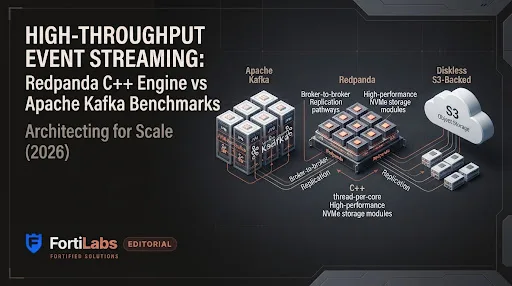
Redpanda, Apache Kafka with KRaft, and diskless streaming architectures take different approaches to throughput, tail latency, storage, and cloud infrastructure costs. Here is how to evaluate them when your platform moves beyond 100,000 events per second.
The short answer
Redpanda is worth evaluating when predictable low tail latency and efficient use of local NVMe storage are priorities. Its C++ and Seastar-based thread-per-core architecture is designed to reduce scheduling overhead and make efficient use of CPU and disk resources.
Apache Kafka remains a strong choice when ecosystem maturity, operational familiarity, and open-source flexibility matter most. KRaft simplifies Kafka’s metadata architecture, but Kafka still requires careful broker, partition, JVM, replication, and storage sizing.
WarpStream is a different architectural choice when cost-efficient retention and high-throughput ingestion matter more than the lowest possible latency. Its stateless Agents use object storage as the durable system of record rather than relying on replicated local broker disks.
There is no universal winner. The right choice depends on the latency SLA, event size, retention period, consumer fan-out, failure model, and the cost of moving data between availability zones.
Why streaming architecture matters beyond 100,000 events per second
Crossing 100,000 events per second is not, by itself, an extraordinary workload for a modern distributed streaming platform. The architectural challenge is sustaining that rate while preserving predictable latency, handling consumer backlogs, surviving broker failures, and retaining enough capacity for traffic spikes.
A streaming cluster can appear healthy at average load while quietly accumulating risk in its tail latency. Disk queues grow, replication falls behind, consumer fetches become slower, and recovery operations compete with normal traffic. The result is often a platform that meets its throughput target but violates application latency objectives during peak periods.
Architects should therefore evaluate more than messages per second. A meaningful assessment includes:
- Ingress throughput: sustained bytes and events written per second.
- Consumer throughput: the combined read rate across all consumer groups.
- Tail latency: p95, p99, p99.9, and, where the sample size supports it, p99.99.
- Replication overhead: the network and disk work required to protect acknowledged writes.
- Storage efficiency: the cost of hot data, historical retention, and object-storage operations.
- Recovery behavior: the time and data-loss exposure associated with broker, availability-zone, and regional failures.
Kafka KRaft vs Redpanda’s C++ engine
Apache Kafka and Redpanda expose Kafka-compatible client interfaces, but their internal implementations are substantially different. This distinction matters because the broker’s execution model influences how it schedules work, manages memory, performs disk I/O, and responds to resource contention.
Apache Kafka: JVM brokers with KRaft metadata management
Apache Kafka is implemented primarily in Java and runs on the Java Virtual Machine. Its architecture uses brokers to host partition replicas, with producers writing to partition leaders and consumers fetching data from brokers.
KRaft replaces ZooKeeper with Kafka’s own metadata quorum. Dedicated or combined controller roles manage cluster metadata through a Raft-based consensus mechanism. This removes a separate ZooKeeper deployment from modern Kafka architectures, but it does not change Kafka’s fundamental partition-replication and broker-storage model.
The JVM is not automatically a performance weakness. It provides mature runtime tooling, garbage collection, extensive observability, and a large ecosystem. However, heap sizing, garbage-collection behavior, page-cache pressure, CPU scheduling, and network buffers all need to be considered when tuning a heavily loaded broker.
Redpanda: C++ and Seastar’s thread-per-core model
Redpanda is a C++ implementation of the Kafka protocol. It uses the Seastar framework and a thread-per-core model, assigning application work to dedicated CPU cores to reduce cross-core coordination, context switching, and unnecessary synchronization.
Rather than relying on the Linux page cache in the same way as traditional file-based broker designs, Redpanda manages its memory and I/O around its log-structured workload. This gives the broker more direct control over its resource allocation and can make disk behavior more predictable when the system is correctly sized.
The trade-off is not simply C++ versus Java. Hardware selection, CPU frequency, NVMe performance, replication topology, partition count, producer batching, and the actual workload remain decisive.
| Dimension | Apache Kafka with KRaft | Redpanda |
|---|---|---|
| Implementation | Primarily Java, running on the JVM | C++ with Seastar |
| Execution model | JVM threads, network and request-processing pools | Thread-per-core architecture |
| Metadata | KRaft controller quorum | Built-in Raft-based cluster and partition coordination |
| Storage path | Partition logs on broker storage, with optional tiered-storage capabilities depending on distribution | Local broker storage, with optional object-storage-backed features |
| Memory management | JVM heap plus operating-system page cache and native memory | Application-managed memory and I/O model |
| Operational ecosystem | Very broad open-source ecosystem and established tooling | Kafka-compatible ecosystem with product-specific operational tooling |
Throughput, p99 latency, and disk saturation
Peak throughput is an incomplete performance metric. A cluster can process a large volume of messages while a small but important percentage of events experiences severe delays. For real-time fraud detection, operational telemetry, order processing, and event-driven services, those slow events can be more damaging than a modest reduction in average throughput.
Why p99 and p99.9 matter
If a system processes 100 million events, the slowest one percent represents one million events. At p99.9, one hundred thousand events still fall beyond the measured threshold. This is why engineers should track multiple percentiles rather than relying on averages.
Disk saturation is particularly important because brokers do more than append producer data. They also serve consumer reads, maintain replicas, perform segment operations, recover partitions, and handle background storage work. A saturated disk can therefore affect several parts of the streaming pipeline at once.
What happens to Kafka under disk pressure?
Kafka’s performance depends on the available storage throughput, operating-system page cache, broker request handling, replication traffic, and the rate at which consumers fetch data. When storage or network resources approach their limits, queues can grow and tail latency can become unstable.
KRaft improves metadata management and removes ZooKeeper as an external dependency, but it does not make a saturated broker disk faster. A well-tuned Kafka cluster can achieve excellent performance; the point is that its storage and JVM resource behavior must be measured under the intended workload.
What changes with Redpanda?
Redpanda’s execution and I/O model is designed to reduce avoidable scheduling and memory-management overhead. Its thread-per-core design and direct control over the log workload can help maintain predictable performance when the CPU and storage layout are appropriate.
That does not make Redpanda immune to saturation. An undersized NVMe device, excessive partition count, insufficient CPU, slow replication links, or an overloaded consumer workload can still push the system beyond its capacity.
What the published benchmark evidence actually says
Redpanda has published comparisons against Kafka, including a KRaft-era test using Redpanda 23.1 and Kafka 3.4.0. In that test, the vendor reported that Redpanda sustained a 1 GB/sec workload with three brokers, while Kafka required additional broker and controller nodes on the tested configurations. The published p99.9 results also favored Redpanda on the tested instance types.
These results are useful evidence of what the tested versions and configurations achieved. They are not a universal prediction for every Kafka 3.x or 4.x deployment, every storage device, every event size, or every replication configuration. They should not be presented as a fresh independent benchmark.
The correct conclusion is that Redpanda’s architecture can offer a meaningful tail-latency and hardware-efficiency advantage in some workloads. A production decision still requires a controlled test using the actual software versions, security settings, hardware, and durability requirements.
Memory efficiency and partition scaling
Memory consumption is not determined by programming language alone. It depends on the number of partition replicas, active connections, producer and consumer buffers, request sizes, retention settings, metadata, compression, and the amount of data being served from memory.
Kafka’s JVM heap and page cache
Kafka brokers use JVM heap for runtime objects and metadata, while the operating system’s page cache is important for efficient log reads and writes. Allocating more memory to the Java heap does not necessarily improve broker performance: it can reduce the memory available for the page cache and may increase garbage-collection costs.
The right configuration depends on workload and runtime behavior. Monitor heap occupancy, garbage-collection pauses, page-cache availability, direct memory, network buffers, and disk utilization together.
Redpanda’s application-managed memory
Redpanda manages memory and I/O around its streaming workload rather than relying on the same page-cache strategy. Its official sizing guidance recommends at least 2 GB of memory per core, with additional memory where workload characteristics require it.
This is a sizing recommendation, not a universal minimum for every deployment. A broker serving many active partitions, large messages, and high consumer fan-out may need a different memory profile from one handling a small number of high-throughput partitions.
Partition count is a resource decision
Partitions create parallelism, but every partition replica has a resource cost. Excessive partition counts can increase metadata overhead, file descriptors, recovery work, leadership activity, and the complexity of rebalancing.
Redpanda’s current manual sizing guidance recommends staying at or below approximately 1,000 partitions per core and below 50,000 partitions per cluster for stability. These are recommendations, not hard universal limits; actual safe capacity depends on hardware, partition activity, memory, and latency requirements.
Kafka partition limits are similarly workload- and deployment-dependent. There is no single partition-per-broker number that applies across all broker sizes and workloads. Validate the maximum practical count through load tests and recovery exercises rather than treating a vendor or community rule of thumb as a guaranteed limit.
| Resource | Kafka | Redpanda |
|---|---|---|
| CPU | JVM broker, request processing, compression, replication, and background tasks | Pinned core-based execution, replication, storage, and application work |
| Memory | Heap, native memory, buffers, and operating-system page cache | Application-managed memory, buffers, and partition state |
| Partition overhead | Replica metadata, log segments, file descriptors, and controller metadata | Replica state, CPU-core resources, memory, and file descriptors |
| Scaling strategy | Add brokers, rebalance replicas, and manage controller capacity | Add cores or brokers and balance partition replicas |
Local disks, tiered storage, and diskless streaming
Storage architecture is where Redpanda, Kafka, and WarpStream become particularly different. The important question is not simply whether a platform supports S3. It is whether object storage is a secondary retention tier or the primary durable write path.
Kafka: broker storage and optional tiering
Traditional Kafka brokers store partition logs on local or attached storage. The platform’s performance depends on the storage device, replication factor, network topology, and consumer read pattern.
Object-storage tiering is available in some Kafka distributions and managed offerings, but its exact implementation and licensing depend on the product. It should not be assumed that every Apache Kafka installation has a built-in, identical S3 tiering feature.
Redpanda: local hot storage plus object storage
In the conventional Redpanda tiered-storage model, new data is written to broker-local storage. Eligible log segments are then uploaded to object storage, allowing older data to be retained without keeping the entire history on expensive local disks.
This is a hot-and-cold storage architecture. Local storage remains important for the active write path and recent reads, while object storage reduces the cost of longer retention.
Redpanda’s tiered storage is an Enterprise feature in self-managed deployments. Architects should include the license cost in their TCO rather than assuming that the object-storage feature is available without a commercial license.
Redpanda Cloud Topics: a distinct object-storage-backed model
Redpanda also documents Cloud Topics, which use durable object storage as the primary backing store rather than conventional local-disk replication. This is a different storage model from simply enabling tiered storage on a traditional broker-backed topic.
The distinction matters when comparing Redpanda with a diskless service. A comparison must identify the exact topic type, product edition, and deployment model being evaluated.
WarpStream: object storage as the system of record
WarpStream uses stateless Agents that speak the Kafka protocol and write directly to object storage. The object store is the durable system of record; Agents do not maintain the same replicated local broker-disk architecture as Kafka or conventional Redpanda clusters.
This design can remove a major source of infrastructure cost: copying every write across broker replicas in multiple availability zones. It also avoids managing persistent broker disks and partition leadership in the traditional way.
The trade-off is latency. Object-storage-backed writes have a different request and durability path from local NVMe writes. WarpStream’s published pricing page lists a regular-topic latency profile in the hundreds of milliseconds, while its Lightning Topics offering is designed for lower latency with a different storage configuration. These are vendor-published profiles, not guarantees for every workload.
| Storage characteristic | Kafka | Redpanda | WarpStream |
|---|---|---|---|
| Primary write path | Broker log on local or attached storage | Broker-local storage for conventional topics | Object storage through stateless Agents |
| Local broker disks | Normally required | Required for conventional broker-backed topics | Not part of the durable data path |
| Object storage | Depends on distribution or external architecture | Tiered storage and Cloud Topics, depending on feature and edition | Primary durable storage |
| Hot-data latency | Can be low with suitable disks and tuning | Designed for low-latency local-disk streaming | Generally higher on regular object-storage-backed topics |
| Historical retention | Broker storage or product-specific tiering | Local retention plus optional object-storage tiering | Object-storage-backed retention |
Cloud cost model: compute, storage, and networking
A streaming platform’s monthly bill is more than the number of broker instances. At scale, cross-availability-zone replication, storage capacity, disk performance, consumer traffic, object-storage requests, and commercial licensing can materially change the total.
The main cost categories
- Compute: broker or Agent instances, CPU capacity, memory, and reserved headroom.
- Persistent storage: local NVMe or block volumes, provisioned IOPS, and throughput.
- Object storage: retained data, request volume, retrieval, and lifecycle operations.
- Networking: inter-AZ replication, consumer traffic, cross-region replication, and egress.
- Licensing: commercial features, managed service plans, and enterprise support.
- Operations: engineering time for upgrades, rebalancing, monitoring, recovery, and incident response.
Illustrative workload: 100,000 events per second
Consider a continuous workload with the following assumptions. This is a financial model, not a claim that every 100,000-event/sec cluster has the same cost.
| Input | Assumption |
|---|---|
| Event rate | 100,000 events/sec |
| Average event size | 1 KiB, before compression |
| Logical write rate | Approximately 97.7 MiB/sec |
| Monthly uncompressed writes | Approximately 247 TiB over 30 days |
| Retention example | 7 days |
| Kafka/Redpanda replication example | Replication factor 3 across three availability zones |
Why replication creates a networking bill
With a replication factor of three, each logical write is stored on three replicas. In a simplified three-zone model, the leader sends two additional copies to followers. That creates approximately two times the logical ingress volume in replica traffic, before accounting for protocol overhead, retries, consumer reads, or other network activity.
At approximately 247 TiB of logical monthly writes, that is roughly 494 TiB of replica-copy traffic in this simplified model. The actual chargeable amount depends on replica placement, producer locality, cloud-provider billing rules, compression, and whether the managed service waives particular network charges.
Illustrative inter-AZ transfer calculation
If the effective charge for the relevant cross-zone transfer is assumed to be $0.01 per GiB, then:
- Approximate replica traffic: 494 TiB × 1,024 = 505,856 GiB.
- Illustrative transfer cost: 505,856 GiB × $0.01 = $5,058.56 per month.
This is a scenario calculation, not a quoted cloud-provider bill. Replace the $0.01/GiB assumption with the actual chargeable transfer rate for the chosen region and service. Some managed Kafka services include or waive particular inter-AZ replication charges, so the same calculation must not be applied blindly to every Kafka deployment.
WarpStream’s published usage pricing: an example
WarpStream publishes a BYOC pricing model based on uncompressed write volume, retained storage, and cluster minutes. Its published rate card lists tiered write pricing, storage pricing, and cluster tiers. Customer-managed Agent compute and the cloud resources used by the data plane must also be included in a complete customer TCO calculation.
Using the approximate 247 TiB monthly write volume above, the published write tiers of $0.01/GiB for the first 50 TiB and $0.0075/GiB for the next 250 TiB produce this illustrative calculation:
- First 50 TiB: 50 × 1,024 × $0.01 = $512.
- Remaining approximately 197 TiB: 197 × 1,024 × $0.0075 = approximately $1,513.
- Estimated write-metering subtotal: approximately $2,025/month.
For a seven-day retention window, the logical retained dataset is approximately 57.6 TiB. At an illustrative $0.01/GiB-month storage rate, that represents approximately $590/month. A $500/month Fundamentals cluster tier would bring those three listed components to approximately $3,115/month, before customer-managed Agent compute and any additional cloud costs.
This is an indicative application of the published rate card, not a final quote. Actual billing depends on the pricing schedule in effect, exact metered bytes, retention, cluster tier, and any additional features. The figures also should not be treated as a direct price comparison with Kafka or Redpanda: the products meter different resources and provide different latency and operational characteristics.
Where the savings can come from
A diskless architecture can reduce or remove the cost of replicated broker disks and inter-AZ replica traffic. That can be valuable when a workload is primarily ingesting logs, telemetry, analytics events, or machine-learning data that does not require consistently low-millisecond delivery.
Redpanda can produce savings in a different way: if it sustains the required workload with fewer or smaller brokers than a Kafka configuration, the compute and operational footprint may fall. However, the financial model must include any Enterprise license required for features such as tiered storage, as well as the cost of local NVMe and replication.
Apache Kafka can remain cost-effective when an organization already operates it efficiently, uses managed-service pricing that absorbs some infrastructure charges, or benefits from its broad ecosystem without requiring paid enterprise extensions.
Disaster recovery, replication, and RPO
A platform can have excellent local availability and still have a weak disaster-recovery posture. Replication factor, availability-zone placement, cross-region replication, object-store durability, and failover procedures protect against different failure classes.
Understand RPO before comparing products
Recovery Point Objective (RPO) defines how much data an organization can afford to lose after a failure. An RPO of zero means acknowledged data must not be lost within the stated failure model. An asynchronous cross-region replica generally has an RPO greater than zero because it can lag behind the source.
Recovery Time Objective (RTO) is different: it describes how long recovery and service restoration can take. A platform may have a small RPO but still require a lengthy manual failover process.
Kafka: in-sync replicas and acknowledgements
Kafka’s durability configuration commonly combines producer acknowledgements, replication factor, and minimum in-sync replicas. With acks=all and a suitable min.insync.replicas setting, producers can require writes to be acknowledged by the current in-sync replica set before success is returned.
This can protect acknowledged writes against a broker failure within the configured replication model. It does not automatically provide zero-loss regional disaster recovery. Cross-cluster replication, lag monitoring, offset handling, and failover procedures must be designed separately.
Redpanda: Raft quorum and shadowing
Redpanda uses Raft-based replication and a majority quorum to commit writes. With replicas distributed across independent failure zones, synchronous replication can provide strong availability and zero-data-loss behavior within the documented cluster failure model.
For regional disaster recovery, Redpanda Shadowing asynchronously replicates data between distinct clusters while preserving offsets. Because replication is asynchronous, the effective RPO depends on replication lag at the moment of failure. A secondary cluster should not be described as zero-RPO simply because it is continuously receiving data.
WarpStream: durable object storage and regional recovery
WarpStream’s design makes object storage the durable system of record. This removes the need to replicate every write between stateful broker Agents in the conventional way, but object-store durability within a region is not the same thing as a tested cross-region disaster-recovery plan.
Architects must verify the chosen object store’s regional and cross-region replication configuration, the product’s multi-region capabilities, metadata recovery behavior, and the procedure for restoring producers and consumers after a regional outage.
| Failure scenario | Kafka | Redpanda | WarpStream |
|---|---|---|---|
| Single broker or Agent loss | Replica failover if sufficient in-sync replicas remain | Raft leader election and quorum-based operation | Stateless Agent replacement; durable data remains in object storage |
| Availability-zone loss | Requires correctly distributed replicas and healthy ISR | Synchronous quorum design across failure zones | Depends on Agent placement and object-storage availability design |
| Regional outage | Requires cross-cluster replication and tested failover | Asynchronous Shadowing can provide regional recovery; RPO follows replication lag | Requires a supported multi-region design and verified object-store recovery path |
| RPO | Configuration and replication-model dependent | Zero loss within supported synchronous quorum model; greater than zero for asynchronous Shadowing | Depends on the object-store and multi-region replication design |
| RTO | Depends on failover automation, metadata, and recovery procedures | Automatic for supported local failures; runbook-dependent for asynchronous regional failover | Depends on Agent recovery, service control plane, and regional restoration procedures |
How to benchmark Kafka, Redpanda, and WarpStream fairly
A useful benchmark should answer a production question, not produce an attractive throughput chart. Use the same event payload, producer behavior, consumer fan-out, retention period, security settings, and durability requirements wherever the products support an equivalent configuration.
1. Define the workload
- Test several event sizes, such as 512 bytes, 1 KiB, and 10 KiB.
- Test steady ingestion and sudden bursts separately.
- Use realistic producer counts, batching, compression, and acknowledgements.
- Measure one consumer group and multiple consumer groups.
- Include realistic retention and replay workloads.
2. Match durability and security
Use equivalent replication and acknowledgement guarantees. Enable TLS and authentication consistently. If one platform uses synchronous replication and another uses object-store acknowledgement, document the difference instead of presenting their latency numbers as identical durability outcomes.
3. Measure the full latency distribution
- Producer acknowledgement latency.
- End-to-end produce-to-consume latency.
- p50, p95, p99, p99.9, and p99.99 where sample size is adequate.
- Latency during disk saturation, CPU pressure, and consumer backlog growth.
- Recovery and catch-up latency after a node or zone failure.
4. Track resource utilization and cost
- CPU utilization per broker or Agent.
- Memory consumption, heap behavior, and page-cache usage where applicable.
- Disk throughput, IOPS, queue depth, and utilization.
- Replication bytes, cross-zone transfer, and object-store requests.
- Cost per million events and cost per retained TiB-month.
5. Test failure and recovery behavior
Kill a broker, remove an availability zone from service, slow storage, and interrupt replication links in a controlled environment. Record acknowledged data loss, replication lag, leader-election time, consumer interruption, and the time required to return to normal operating capacity.
Recommended scorecard
| Metric | What to record | Why it matters |
|---|---|---|
| Sustained ingress | Events/sec and MiB/sec | Confirms the platform can handle normal production load |
| Tail latency | p99 and p99.9 | Exposes slow events hidden by averages |
| Disk headroom | IOPS, throughput, queue depth, and saturation | Identifies storage bottlenecks before they become outages |
| Memory efficiency | Memory per broker, core, and active partition | Helps predict scaling and partition limits |
| Network overhead | Replica traffic and cross-zone GiB | Reveals hidden cloud costs |
| Cost efficiency | Monthly cost per million events and retained TiB | Connects performance to business economics |
| Recovery | Measured RPO, RTO, and catch-up time | Validates resilience claims |
Which streaming platform should you choose?
Choose Apache Kafka when ecosystem maturity is the priority
Kafka is a sensible choice when the organization already has experienced Kafka operators, depends on its mature ecosystem, needs broad integration support, and can operate the broker and storage footprint efficiently. KRaft makes modern Kafka deployments simpler than the older ZooKeeper-based model.
Choose Redpanda when low tail latency and broker efficiency matter
Redpanda is worth shortlisting when the workload is latency-sensitive, the team wants to maximize local NVMe and CPU efficiency, and predictable performance under load is a primary requirement. Its thread-per-core architecture is especially relevant when the team wants to reduce the overhead associated with a general-purpose JVM broker.
Include the required commercial features and license terms in the cost model. In particular, do not assume that self-managed tiered storage, Shadowing, or other Enterprise capabilities are included in the free Community Edition.
Choose WarpStream when storage and networking economics dominate
WarpStream is worth evaluating when the main workload is high-volume ingestion, observability, analytics, or machine-learning data and the application can tolerate the latency profile of object-storage-backed streaming. Stateless Agents and object storage can simplify scaling and reduce the need for replicated local broker infrastructure.
It is a less natural fit when the application depends on consistently low-millisecond produce-to-consume latency or requires a regional recovery guarantee that has not been validated in the chosen deployment.
| Requirement | Best platform to evaluate first | Reason |
|---|---|---|
| Mature open-source ecosystem | Apache Kafka | Broad adoption, tooling, and integration ecosystem |
| Low tail latency with local NVMe | Redpanda | Thread-per-core C++ architecture and direct storage management |
| Lower broker and replication overhead | WarpStream | Stateless Agents and object-storage-backed durability |
| Long retention at high ingest volume | WarpStream or Redpanda tiered storage | Compare object-storage economics against latency and licensing requirements |
| Existing Kafka operational expertise | Apache Kafka | Avoid unnecessary migration and retraining costs |
| Regional recovery with explicit RPO | All three require validation | The actual recovery design and replication lag determine the outcome |
The strongest architecture is the one that meets the application’s latency and durability requirements at the lowest sustainable total cost. Redpanda optimizes the broker path, Kafka offers a mature and flexible ecosystem, and WarpStream changes the storage and replication economics. Benchmark the actual workload before committing to a migration.
Frequently asked questions
Is Redpanda faster than Apache Kafka?
Redpanda can deliver lower tail latency and higher hardware efficiency in certain workloads because of its C++ and Seastar-based thread-per-core architecture. However, results depend on versions, hardware, replication, batching, security settings, and workload shape. Benchmark both platforms under equivalent durability requirements.
Does Kafka KRaft eliminate Kafka’s performance overhead?
No. KRaft replaces ZooKeeper with Kafka’s own metadata quorum, simplifying cluster metadata management. It does not replace Kafka’s JVM broker implementation or remove the need to tune partition replication, storage, memory, and network capacity.
Does Redpanda tiered storage eliminate local disk costs?
No. Conventional Redpanda tiered storage keeps active data on local broker storage and uploads eligible older segments to object storage. Redpanda Cloud Topics are a separate object-storage-backed model and should be evaluated independently.
Can WarpStream replace Kafka without changing Kafka clients?
WarpStream supports the Kafka protocol and is designed to work with Kafka-compatible clients and integrations. However, protocol compatibility does not guarantee that every connector, operational workflow, or advanced Kafka feature behaves identically. Validate the specific clients and features used by your applications.
Is WarpStream suitable for real-time applications?
It can be suitable for real-time ingestion and processing where the application’s latency budget accommodates its object-storage-backed architecture. Applications requiring consistently low-millisecond delivery should test the exact topic type and latency profile before adopting it.
How many partitions can a Redpanda broker support?
There is no single safe number for every broker. Redpanda’s current sizing guidance recommends staying at or below approximately 1,000 partitions per core and below 50,000 partitions per cluster for stability. Hardware, active partition count, memory, throughput, and latency objectives can lower the practical limit.
Does replication factor three guarantee zero data loss?
Not by itself. Durability depends on acknowledgement settings, in-sync replica or quorum behavior, replica placement, and the failure scenario. Regional disaster recovery also requires a separate replication and failover design.
Which platform is cheapest for 100,000 events per second?
There is no universal answer. WarpStream may reduce broker-disk and inter-zone replication costs for workloads that tolerate its latency profile. Redpanda may need fewer resources for some local-disk workloads, while Kafka can be economical when existing operations and managed-service pricing are favorable. Compare full monthly cost at the same event size, retention, consumer fan-out, and availability target.