WEB LAB / AD TECH ARCHITECTURE
Google Protected Audience API (FLEDGE) in Production: On-Device Programmatic Bidding
Google’s Protected Audience API—originally known as FLEDGE—was designed to support remarketing without exposing a user’s cross-site browsing history to advertising platforms. It moved audience membership into the browser and executed programmatic bidding inside isolated worklets. But its production status has fundamentally changed: Chrome has announced deprecation and planned removal of Protected Audience and related Privacy Sandbox APIs. This guide explains the original architecture, its execution paths, Bidding and Auction Services (B&A), and the reporting limitations engineers need to understand before maintaining or replacing an existing implementation.
Do not select Protected Audience as a new production dependency without verifying the target browser’s current implementation and removal schedule. Chrome’s published roadmap lists Protected Audience and related technologies, including Fenced Frames and Private Aggregation, for deprecation and removal. The API documentation remains useful as a technical reference, but documentation availability does not mean the technology is a supported long-term investment.
Chrome release notes: Protected Audience deprecation · Privacy Sandbox feature status
Quick answer: What did Protected Audience change?
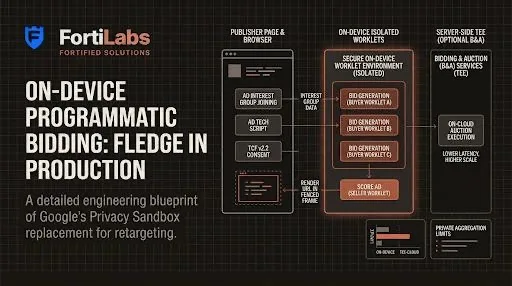
Protected Audience replaced the traditional retargeting model’s central dependency on third-party-readable browsing identifiers with browser-managed interest groups. An advertiser or DSP could ask the browser to join an interest group through joinAdInterestGroup(). Later, when the user visited a publisher, the seller could initiate runAdAuction(). Buyer worklets generated bids through generateBid(), the seller’s worklet evaluated them through scoreAd(), and the winning creative could be rendered through a Fenced Frame.
The central architectural change was the location of audience information and auction computation: instead of exporting a reusable cross-site audience identifier to ad-tech servers, the browser retained interest-group membership and executed much of the auction locally. B&A offered an alternative execution model, moving sensitive auction computation into attested Trusted Execution Environments (TEEs).
Important distinction: Protected Audience was not a universal replacement for every third-party-cookie use case. It primarily addressed remarketing and custom-audience advertising. It did not automatically solve identity, attribution, measurement, frequency management, or every form of cross-site targeting.
On this page
1. Is Protected Audience still a production option?
Not as a recommended greenfield dependency. Chrome’s current direction is to deprecate and remove Protected Audience and several connected Privacy Sandbox technologies. This follows Google’s decision to maintain its existing approach to third-party cookies rather than proceed with the previously proposed ecosystem-wide cookie deprecation plan.
The distinction matters because Protected Audience was designed as part of a larger browser advertising system. Its architecture depended on more than one API:
- Protected Audience: browser-managed interest groups and private ad auctions.
- Fenced Frames: privacy-oriented ad rendering.
- Private Aggregation: privacy-preserving aggregate measurement.
- Aggregation Service: processing of aggregatable reports into summary reports.
- Trusted Key/Value services: real-time bidding and scoring signals.
- Bidding and Auction Services: an optional server-side execution environment for auction computation.
When a foundational component is being retired, engineering teams cannot assess the risk by looking only at whether joinAdInterestGroup() still appears in browser documentation. They must assess the entire dependency chain, supported browser versions, API availability, reporting requirements, and migration path.
Separate historical architecture knowledge from current platform support. Existing implementations may need maintenance or migration, but new advertising systems should not assume that Protected Audience, Fenced Frames, or Private Aggregation will remain available.
2. How did Protected Audience replace cookie-based retargeting?
Traditional retargeting often relied on a third-party advertising platform recognizing the same browser across multiple websites. A user might visit an online store, view a product, and later see an advertisement for that product on an unrelated publisher site.
In a conventional cookie-based flow, an ad-tech provider could use a third-party cookie or another identifier to associate activity from different sites with a browser profile. The audience relationship was effectively available to infrastructure outside the browser.
Traditional cookie-based retargeting
- A user visits an advertiser’s website.
- An advertising platform records an identifier and associates it with a product or audience segment.
- The user visits a publisher that works with the same advertising platform.
- The platform recognizes the identifier and selects an eligible retargeting campaign.
- The publisher displays the selected advertisement.
Protected Audience’s alternative
- The advertiser or DSP asks the browser to join a named interest group.
- The browser stores that membership locally, subject to browser controls and API rules.
- On a later publisher visit, the seller invites eligible interest-group owners into an auction.
- Buyer bidding logic executes inside browser-controlled worklets.
- The seller scores the bids and selects a winning advertisement.
- The browser renders the winning creative using the configured rendering mechanism.
The advertising platform could still receive auction and reporting information. The privacy change was not that advertising servers disappeared; it was that the browser controlled access to interest-group membership and restricted how auction participants could communicate information out of the execution environment.
| Architecture area | Traditional retargeting | Protected Audience model |
|---|---|---|
| Audience membership | Often represented through an identifier or server-side audience record | Stored in browser-managed interest groups |
| Audience selection | Advertising platform evaluates the recognized identifier | Browser invites eligible interest-group buyers into an auction |
| Bid computation | Typically performed on advertising infrastructure | Buyer worklets execute locally, or through B&A TEEs |
| Seller decision | Ad server or exchange evaluates bids | Seller worklet executes scoreAd() |
| Audience visibility | Identifier-based systems may expose reusable cross-site recognition | Interest-group membership is not directly readable by the publisher |
| Measurement | Often event-level server reporting | Multiple restricted reporting mechanisms, including aggregate reporting |
3. What was the end-to-end Protected Audience architecture?
The architecture separated advertiser-side audience enrollment, buyer-side bidding, seller-side scoring, rendering, and measurement. This separation was important because the buyer and seller had different responsibilities and were not supposed to gain unrestricted access to each other’s private data.
joinAdInterestGroup()
runAdAuction()
generateBid() creates bids
scoreAd() evaluates bids
Real-time campaign and policy data could be retrieved through trusted bidding and scoring signal services. The browser orchestrated the auction and controlled the isolated worklet environments. This meant the architecture still needed reliable network services, creative hosting, auction configuration, and operational monitoring.
Official technical reference: Protected Audience API developer guide.
4. How did joinAdInterestGroup() work?
navigator.joinAdInterestGroup() asked the browser to add the user to an interest group owned by a specific buyer. It was the enrollment stage of the retargeting workflow.
For example, an online retailer could work with a DSP to define an interest group for visitors interested in a particular product category. The group configuration included the buyer’s origin, group name, candidate advertisements, bidding logic URL, and optional trusted bidding signal configuration.
Example interest-group configuration
const interestGroup = {
  owner: "https://dsp.example",
  name: "outdoor-camera-interest",

  biddingLogicUrl:
    "https://dsp.example/pa/generate-bid.js",

  trustedBiddingSignalsUrl:
    "https://dsp.example/pa/trusted-signals",

  trustedBiddingSignalsKeys: [
    "campaign-budget",
    "campaign-active"
  ],

  ads: [
    {
      renderUrl:
        "https://ads.example/creatives/camera.html",
      metadata: {
        campaignId: "camera-launch-2026"
      }
    }
  ]
};

await navigator.joinAdInterestGroup(
  interestGroup,
  30 * 24 * 60 * 60
);
This is an illustrative historical API example, not a recommendation to deploy a new integration.
What did the browser store?
- Owner: the origin responsible for the interest group.
- Name: the interest-group identifier.
- Bidding logic URL: the buyer’s JavaScript entry point.
- Ads: candidate creative render URLs and optional metadata.
- Trusted bidding signals: configuration for retrieving selected real-time data.
- Expiration: how long the browser should retain membership.
The browser stored group membership rather than exposing a general-purpose API for advertisers to enumerate all interest groups. Membership could be removed through browser controls, site-data clearing, or expiration. Users could also disable participation through supported browser settings.
Reference: Protected Audience developer guide.
5. How did generateBid() execute inside an isolated buyer worklet?
When a seller initiated an auction, the browser identified eligible interest groups belonging to invited buyers. For each participating group, it invoked the buyer’s bidding logic through generateBid().
The buyer’s worklet could use the interest-group configuration, browser-provided signals, seller-provided auction data, and eligible trusted bidding signals to determine whether to bid and which creative to offer.
What did generateBid() return?
Conceptually, the buyer returned:
- A numeric bid value.
- A currency value where applicable.
- The candidate creative’s render URL.
- Optional ad metadata and component-ad information.
- Optional reporting and modeling signals supported by the API.
Illustrative bidding worklet
function generateBid(
  interestGroup,
  auctionSignals,
  perBuyerSignals,
  trustedBiddingSignals,
  browserSignals
) {
  const campaignIsActive =
    trustedBiddingSignals?.["campaign-active"];

  if (!campaignIsActive) {
    return null;
  }

  const ad = interestGroup.ads?.[0];

  if (!ad) {
    return null;
  }

  const bid = 1.25;

  return {
    bid,
    bidCurrency: "USD",
    render: ad.renderUrl,
    ad: ad.metadata
  };
}
The example demonstrates the decision-making structure. Real implementations had to follow the exact API version’s required return shape, available signals, currency rules, and browser execution constraints.
Why use an isolated worklet?
The browser executed buyer logic in a restricted JavaScript environment rather than as unrestricted page JavaScript. Worklets could not freely access the publisher’s page, arbitrary browser storage, or unrestricted network APIs. They were designed to expose only the signals and controlled services permitted by the auction model.
This isolation reduced the ability of a buyer to turn auction execution into a general cross-site tracking channel. It also introduced engineering constraints: bidding code had to be deterministic enough for its environment, efficient under auction timeouts, and designed around limited data access.
What caused buyer-side latency?
- Fetching and compiling bidding JavaScript.
- Creating isolated execution environments.
- Loading eligible interest groups.
- Fetching trusted bidding signals.
- Executing bidding logic for multiple groups.
- Processing candidate bids before the seller’s timeout.
Google’s latency guidance specifically recommends reducing unnecessary interest-group owners, reusing bidding scripts, caching script responses, minimizing trusted-signal requests, prioritizing likely-to-win groups, and starting auctions early enough to overlap work with page activity.
Reference: Protected Audience auction latency best practices.
6. How did scoreAd() execute in the seller worklet?
Buyer bidding was only half of the auction. The seller—typically an SSP or publisher-side ad platform—had to evaluate candidate bids and determine which advertisement best satisfied its commercial and policy requirements.
The browser invoked the seller’s scoreAd() logic for candidate bids. The seller could evaluate the bid amount, creative metadata, publisher rules, contextual competition, and trusted scoring signals.
Illustrative seller scoring worklet
function scoreAd(
  adMetadata,
  bid,
  auctionConfig,
  trustedScoringSignals,
  browserSignals
) {
  const isApproved =
    trustedScoringSignals?.approved === true;

  if (!isApproved) {
    return 0;
  }

  const minimumBid = 0.50;

  if (bid < minimumBid) {
    return 0;
  }

  // Simplified desirability score.
  return bid;
}
The returned desirability score was not simply a billing amount. It represented the seller's assessment of the candidate. A seller could reject a bid by returning an ineligible or noncompetitive score, depending on the auction's configured rules.
How did contextual advertising fit into the auction?
Protected Audience could be integrated with a broader programmatic auction. A seller could first identify a contextual winner, then compare Protected Audience candidates against that result. The seller's scoring logic could reject a remarketing bid that failed to beat the contextual alternative.
This mattered commercially: an interest-group bid was not automatically entitled to win merely because the browser found a matching audience. The seller retained control over inventory eligibility and bid desirability.
Reference: Seller guide: run ad auctions.
7. How did Fenced Frames render the winning advertisement?
After the auction completed, the browser returned a representation of the winning creative. In the fenced-frame rendering path, the seller could request a FencedFrameConfig by enabling resolveToConfig.
The publisher could then navigate a Fenced Frame to that configuration without receiving the winning creative's ordinary URL as a readable value.
Illustrative rendering flow
const auctionResult =
  await navigator.runAdAuction({
    seller: "https://ssp.example",

    decisionLogicUrl:
      "https://ssp.example/pa/score-ad.js",

    interestGroupBuyers: [
      "https://dsp.example"
    ],

    resolveToConfig: true
  });

if (auctionResult) {
  const frame = document.createElement(
    "fencedframe"
  );

  frame.config = auctionResult;

  document.body.appendChild(frame);
}
This is a simplified illustration of the original API model. Browser support, policy permissions, auction configuration, and the Fenced Frame implementation all affected whether this flow was available.
Why was the creative URL hidden?
The privacy goal was to limit information flowing between the publisher page and the ad creative. If the publisher could freely inspect the creative URL and associate it with auction-level data, that could undermine the separation the system was intended to provide.
Fenced Frames also restricted communication between the embedder and the rendered content. This affected ordinary ad-tech integrations, including event reporting, click measurement, and creative-level analytics. Special reporting mechanisms were needed to bridge selected events without giving the publisher unrestricted access to the ad's internal state.
Historical API reference: Fenced Frames documentation.
8. How did Bidding and Auction Services move execution into TEEs?
Running every buyer and seller computation on a user's device introduced practical constraints. Some devices had limited CPU and memory, and a large auction could require multiple worklet initializations, script downloads, and trusted-signal requests.
Bidding and Auction Services (B&A) proposed moving important auction computation into cloud-hosted Trusted Execution Environments. The idea was to retain the privacy controls around sensitive auction data while moving CPU-intensive bidding and scoring away from the client device.
A TEE is a hardware-backed execution environment intended to protect code and data while processing them. In the B&A architecture, encrypted auction inputs could be sent to attested services, where buyer and seller logic ran inside their respective trusted environments.
Original on-device auction flow
- The browser loads eligible interest groups.
- The browser fetches buyer bidding scripts and trusted bidding signals.
- Buyer worklets execute
generateBid(). - The browser passes candidate bids into seller scoring.
- The seller worklet executes
scoreAd(). - The browser resolves the winner and returns a render configuration.
B&A execution flow
- The device collects eligible audience and auction data.
- The device encrypts the Protected Audience input for the trusted auction flow.
- The seller's external ad service sends contextual auction data and encrypted audience data to the seller-side infrastructure.
- The SellerFrontEnd (SFE) service communicates with configured BuyerFrontEnd (BFE) services.
- Buyer services execute bidding logic and retrieve permitted buyer-side signals inside the TEE environment.
- The seller-side TEE retrieves scoring signals and evaluates candidate bids.
- The winning result is encrypted and returned through the seller's ad service.
- The device processes the result and completes ad selection.
The key architectural point is that B&A did not simply move all advertising activity to an ordinary cloud server. The design split the workflow between device-side data collection and result processing, external ad-tech services, and attested buyer/seller execution environments.
Official architecture reference: Bidding and Auction Services documentation. The detailed service topology differs across platform implementations; verify the relevant web or Android specification rather than treating them as identical.
9. Which model had better latency: on-device bidding or B&A?
There is no universally faster model. On-device auctions reduce the need to send sensitive auction inputs to a remote execution service, but they consume device resources and can involve several script and signal-fetch operations. B&A can reduce client-side computation, but it introduces network round trips, service orchestration, encryption, and TEE execution.
| Performance factor | On-device auction | B&A in TEEs |
|---|---|---|
| Bid computation | Runs in browser worklets | Runs in buyer-side trusted services |
| Seller scoring | Runs in the seller worklet | Runs in seller-side trusted services |
| Device CPU usage | Higher as buyer and seller logic execute locally | Lower for the computation moved into cloud services |
| Network dependency | Script and trusted-signal fetches still matter | Additional request/response path to seller and buyer services |
| Execution overhead | Worklet setup, script loading, and local execution | Encryption, service routing, attestation, and TEE execution |
| Device constraints | More sensitive to low-powered devices and browser resource limits | Can offload much of the intensive computation |
| Infrastructure ownership | Less auction compute infrastructure for ad tech to operate | Requires deployed and operated trusted services |
| Primary bottleneck | Worklet setup, signal fetching, and device execution | Network RTT, service fan-out, TEE capacity, and response processing |
Where on-device execution can win
- The buyer and seller scripts are already cached.
- There are relatively few eligible interest groups.
- Trusted-signal requests are small and reusable.
- The device has sufficient CPU and memory.
- The seller starts the auction early and overlaps work with page loading.
Where B&A can win
- The device has limited processing capacity.
- The auction contains substantial buyer-side or seller-side computation.
- Trusted services are geographically close to the user and ad infrastructure.
- The TEE service has enough capacity to handle auction fan-out.
- Encryption and service orchestration overhead is lower than the local computation being offloaded.
Do not compare these architectures using an invented fixed millisecond benchmark. Actual auction latency depends on the number of interest groups, buyer count, script caching, signal-fetch performance, device class, network conditions, auction timeouts, and B&A deployment topology.
A meaningful benchmark should separately measure:
- Time to load buyer and seller scripts.
- Trusted bidding and scoring signal latency.
- Buyer execution time per interest group.
- Seller scoring time per candidate.
- Device-side orchestration and encryption time.
- TEE service processing time.
- Network time from device to seller service and back.
- End-to-end auction completion and ad-render start.
Google's original auction latency guidance emphasizes measurement and tuning rather than a universal performance guarantee.
10. What could Private Aggregation actually report?
Private Aggregation was designed to report statistical information without exposing individual users' event histories. Instead of sending a conventional event-level record for every impression or interaction, the API allowed worklets to contribute values to aggregation buckets. Reports could later be collected, batched, and processed by an Aggregation Service to produce noisy summary results.
For example, a buyer might want to estimate how many times a campaign was shown. A worklet could contribute a value to a bucket representing that campaign. The resulting summary could estimate aggregate reach or performance without exposing a row-by-row list of individual users.
How did a contribution work?
The basic operation was privateAggregation.contributeToHistogram(). A caller supplied an aggregation key (bucket) and an aggregatable value.
function reportResult(
  auctionConfig,
  browserSignals
) {
  const campaignBucket =
    convertCampaignToBucket("campaign-2026");

  privateAggregation.contributeToHistogram({
    bucket: campaignBucket,
    value: 1
  });
}
This example is conceptual. Production code had to construct valid bucket values and comply with the applicable contribution budget, reporting context, and aggregation rules.
What were the actual reporting limitations?
| Limitation | Engineering consequence |
|---|---|
| Aggregate rather than raw event output | It could estimate counts and distributions, not return a user-by-user impression or click log. |
| Noise in summary reports | Reported values were approximate; small buckets could be particularly difficult to interpret. |
| Contribution budget | Contributions were subject to a privacy budget. Exceeding it could prevent a report from being created. |
| Contribution count limits | Protected Audience callers were documented with a maximum of 100 contributions per report. |
| Bucket design | Campaign, creative, and event dimensions had to be encoded into aggregation keys; overly granular buckets reduced useful signal. |
| Delayed processing | Aggregatable reports had to be collected and batched before the Aggregation Service produced summary reports. |
| Limited event payload | Frame-triggered event contributions could identify a predefined event type, but could not attach an arbitrary event-level payload in the same way as a conventional analytics request. |
| Not a direct conversion log | Conversion measurement required a separate measurement design, such as Attribution Reporting, rather than assuming Private Aggregation alone provided deterministic attribution. |
1. Aggregate reports were not event-level logs
Private Aggregation could answer questions such as, "Approximately how many users saw campaign X?" It was not designed to provide an ordinary event stream like "user 123 saw creative A at 14:03 and clicked at 14:05."
This distinction affected billing reconciliation, fraud analysis, campaign debugging, and advertiser reporting. Systems that depended on exact per-impression logs could not simply replace their event pipeline with aggregate histograms.
2. Noise affected precision
Noise was deliberately introduced to protect privacy. A summary report was therefore not guaranteed to equal the exact number of underlying events. Reporting systems needed to treat small counts cautiously and avoid presenting noisy measurements as exact billing records.
3. Contribution budgets restricted measurement volume
Google's documented Private Aggregation fundamentals described an L1 contribution budget of 65,536 per ten-minute window, with a backstop of 1,048,576, scoped to a worklet origin and a rolling period. The documentation also specified a 100-contribution-per-report cap for Protected Audience callers.
These are implementation-specific documented limits, not timeless guarantees. Teams maintaining historical integrations should verify the exact Chrome version and reporting implementation rather than hardcoding old limits into a new system.
4. Event-triggered reporting had limited payload flexibility
The API supported event-triggered contributions through contributeToHistogramOnEvent(). A worklet could associate a predefined event with a bucket and contribution. A frame could later trigger that event through the permitted reporting mechanism.
However, the event trigger was not a general-purpose analytics endpoint. It did not allow the creative to attach an arbitrary payload containing every interaction detail, user property, timestamp, and campaign attribute. The reporting model was deliberately constrained.
5. Aggregation required a backend processing stage
Calling the browser API did not immediately produce a dashboard-ready report. Aggregatable reports had to be collected and batched, then processed by the Aggregation Service. This introduced operational responsibilities around report ingestion, batching, service availability, and interpretation of noisy summary output.
6. Private Aggregation did not replace every reporting mechanism
The original Protected Audience reporting design used multiple mechanisms:
- Private Aggregation: aggregate auction and event measurements.
- Ads Reporting API: associate permitted frame events with auction signals.
- Temporary event-level reporting: mechanisms such as
sendReportTo()supported auction-win reporting during the transition. - Attribution Reporting: a separate mechanism for connecting ad interactions and conversion events.
Google's documentation explicitly described some event-level mechanisms as transitional. A system should not assume that an API intended as a migration bridge was a permanent measurement contract.
References: Private Aggregation fundamentals · Protected Audience auction reporting.
11. What did a production Protected Audience architecture require?
For teams that built or maintained an implementation, the auction APIs were only one part of the production system. A reliable architecture needed enrollment, creative management, buyer and seller execution, policy enforcement, measurement, observability, and browser compatibility controls.
Recommended historical architecture blueprint
- Audience enrollment and expiration policy
- Interest-group configuration
- Creative approval and render URL management
- Buyer bidding logic deployment
- Trusted bidding signal service
- Inventory and auction configuration
- Eligible buyer selection
- Contextual auction integration
- Seller scoring logic
- Trusted scoring signal service
- Interest-group storage
- Buyer worklet execution
- Seller worklet execution
- Auction timeout enforcement
- Winning creative rendering
- Permitted auction reporting
- Aggregate report collection and processing
- Campaign reconciliation
- Latency and failure monitoring
- Browser support and lifecycle monitoring
Production checklist
- Define a clear interest-group ownership model.
- Use a small number of buyer origins and reusable bidding scripts.
- Set cache headers for buyer and seller decision logic.
- Keep trusted bidding and scoring responses small.
- Prioritize likely-to-win interest groups.
- Set buyer and overall auction timeouts based on measured performance.
- Validate creative render URLs and approved creative origins.
- Test contextual and Protected Audience auction competition.
- Define fallback behavior when no eligible bid is returned.
- Track buyer execution, seller scoring, and network latency separately.
- Design aggregate measurement before choosing reporting bucket dimensions.
- Document how noisy reports affect billing and campaign optimization.
- Verify browser support, user controls, and API availability.
- Maintain a migration plan for deprecating browser-specific dependencies.
12. What should engineering teams build instead?
For a new advertising platform, the sensible response to Protected Audience's deprecation is not to recreate its browser APIs in application code. It is to separate the business requirements from the retired implementation.
Start by identifying which capabilities the original system was expected to deliver:
- Audience activation: use consented first-party data, authenticated customer relationships, and publisher-defined audience segments where legally and contractually permitted.
- Contextual targeting: use page, content, placement, and campaign context rather than assuming an individual-level browsing history is available.
- Programmatic bidding: use established auction and exchange integrations with explicit data contracts and supply-path controls.
- Privacy-preserving computation: evaluate applicable clean-room, confidential-computing, or other privacy-enhancing approaches against the actual threat model.
- Measurement: define event-level and aggregate reporting requirements separately, including consent, retention, attribution, and reconciliation rules.
- Frequency management: use identifiers and publisher or platform controls that are permitted for the relevant environment; do not assume browser-local interest groups provide a universal cross-device identity solution.
For teams with existing Protected Audience deployments, inventory every dependency before migration. Identify where interest-group enrollment occurs, which scripts generate bids, which sellers score them, how winning creatives are rendered, and how reporting data reaches billing and analytics systems.
Preserve business outcomes, not retired API assumptions. The durable requirements are audience eligibility, fair auction decisions, creative safety, measurement integrity, frequency controls, and user privacy. The implementation should be replaceable without tying the entire ad stack to a browser feature that is scheduled for removal.
13. Frequently asked questions
Is FLEDGE the same as Protected Audience API?
Yes. FLEDGE was the earlier name for Google's Protected Audience API proposal. The name changed as the proposal evolved into the Privacy Sandbox advertising API.
Does Protected Audience eliminate third-party cookies?
No. It was designed to support remarketing without relying on third-party cookies for audience membership. It was not a universal replacement for every cookie use case, and Chrome later announced that its existing third-party-cookie approach would be maintained while Protected Audience was scheduled for deprecation and removal.
What does joinAdInterestGroup() do?
joinAdInterestGroup() asks the browser to store membership in an interest group owned by a buyer. The configuration can include the bidding logic URL, candidate ads, and trusted bidding signal settings.
What is the difference between generateBid() and scoreAd()?
generateBid() is buyer-side logic that decides whether to bid and returns a candidate bid and creative. scoreAd() is seller-side logic that evaluates candidate bids and assigns desirability scores to determine which ad should win.
Why did Protected Audience use isolated worklets?
Worklets restricted buyer and seller code from freely accessing the surrounding page and communicating arbitrary information outside the auction. The isolation was intended to reduce cross-site data leakage while allowing controlled bidding and scoring computation.
What is the difference between on-device auctions and B&A?
On-device auctions run buyer and seller bidding logic inside browser worklets. B&A moves key computation into cloud-hosted Trusted Execution Environments, while device-side components still participate in collecting and processing auction inputs and results.
Is B&A always faster than on-device bidding?
No. B&A can reduce device-side CPU work, but it introduces network round trips, encryption, service orchestration, and TEE processing. Actual performance depends on device capability, auction size, service location, and implementation quality.
Can Private Aggregation report individual ad impressions?
Not as an ordinary user-level event log. Its purpose was to produce privacy-preserving aggregate reports with noise. It could support statistical campaign measurement, but it was not a drop-in replacement for exact per-impression records.
Can Private Aggregation report clicks?
It could support limited event-triggered aggregate contributions, including predefined click events. However, it did not provide a general-purpose mechanism for attaching arbitrary event-level payloads to those contributions.
Should a new ad-tech platform implement Protected Audience today?
No—not as a new long-term platform dependency. Chrome has announced deprecation and planned removal of Protected Audience and related APIs. Teams should verify current browser status and design around durable privacy, targeting, auction, and measurement requirements instead.
Conclusion: understand the architecture, but avoid a retired dependency
Protected Audience introduced an important architectural experiment: audience membership remained browser-managed, buyers generated bids in isolated worklets, sellers evaluated those bids through scoreAd(), and privacy-oriented rendering and reporting mechanisms attempted to limit cross-site information leakage.
B&A extended that model by moving bidding and scoring computation into attested cloud environments, trading local device processing for service orchestration and network overhead. Private Aggregation addressed a different challenge: how to measure auction outcomes statistically without turning the reporting pipeline into a user-level event log.
These concepts remain useful when evaluating privacy-preserving advertising systems. But the current platform lifecycle changes the implementation decision. With Protected Audience and related APIs scheduled for deprecation and removal, engineering teams should use this architecture as a reference for understanding the trade-offs—and build new systems around supported, privacy-conscious technologies with an explicit migration path.
Technical references: Protected Audience developer guide · Auction latency guidance · Bidding and Auction Services · Auction reporting · Private Aggregation fundamentals · Privacy Sandbox feature status · Chrome release notes.