ADTECH · PROGRAMMATIC IDENTITY
Universal ID Implementation: UID2 vs ID5 vs RampID Module Performance in Prebid
Third-party cookie restrictions have made audience addressability a major challenge for programmatic publishers. Universal identifiers such as Unified ID 2.0 (UID2), ID5, and LiveRamp RampID offer alternative ways to connect eligible ad impressions with demand. But they differ in identity generation, consent requirements, storage, encryption, and downstream bidder support. This guide compares their Prebid.js integrations, explains how to measure real CPM uplift, and explores what publishers should prioritize across Safari and Chrome.
Why universal IDs matter to programmatic publishers
Programmatic advertising has historically relied on third-party cookies and other browser-accessible identifiers to recognize audiences across websites. These signals helped demand-side platforms (DSPs) support audience targeting, frequency management, measurement, and campaign optimization.
As browser privacy restrictions and user choices reduce access to traditional identifiers, publishers face a growing addressability problem. An ad opportunity may still be available for auction, but fewer buyers may be able to associate it with a recognizable audience.
This is particularly relevant to Safari and other environments where third-party cookie availability is restricted. Chrome also requires careful consideration: its privacy behavior, user settings, and available identity signals should not be treated as equivalent to Safari.
Universal IDs attempt to provide alternative identity signals that participating publishers and advertising platforms can use within permitted privacy and consent frameworks.
Three commonly evaluated solutions are:
- Unified ID 2.0 (UID2): An open identity framework based on encrypted tokens generated from permitted email or phone-number information.
- ID5: A shared identity solution designed to support recognition across environments where third-party cookies are unavailable.
- LiveRamp RampID: A pseudonymous identifier supported by LiveRamp’s identity-resolution and authenticated traffic infrastructure.
These systems are not interchangeable. They have different input requirements, identity-resolution mechanisms, partner ecosystems, privacy controls, and technical integrations.
For publishers, the relevant question is not simply which identifier is most popular. It is which identifier creates incremental addressable demand on their own inventory without introducing unacceptable latency, storage, privacy, or operational costs.
How UID2, ID5, and RampID establish identity
Understanding how an identifier is generated is important because the identity model affects which users can be recognized, how the identifier is refreshed, and which demand partners can use it.
UID2: deterministic identity from email or phone
UID2 is built around deterministic identity inputs. A publisher or an integrated sign-on provider can provide permitted direct identifiers (DII), such as an email address or phone number, to the UID2 system.
The UID2 Operator processes that information and generates a raw UID2, an encrypted UID2 token, and associated refresh-token information. The publisher can then make the eligible token available in the advertising bidstream.
The important distinction is that the publisher does not simply hash an email address in JavaScript and call the result a UID2. UID2 uses its defined token-generation and refresh process, including operator-side encryption and key management.
UID2 is particularly relevant to authenticated publisher audiences because a user can provide an email address or phone number through a login, subscription, or other permitted interaction.
ID5: a shared identifier with identity-resolution capabilities
ID5 provides a shared identifier designed to support recognition across publishers and participating advertising platforms, including environments without third-party cookies.
Its approach is not limited to a publisher hashing an email address. ID5 operates an identity framework that can use available signals and partner integrations to generate or resolve an identifier.
Depending on the implementation and available signals, the system can support recognition beyond a straightforward authenticated-email match. This is why ID5 should not be described as simply another deterministic hashed-email identifier.
ID5 also applies encryption and key-rotation mechanisms to the identifier delivered to Prebid. Downstream platforms with the appropriate rights can process it for supported advertising use cases.
For publishers with substantial anonymous traffic, ID5 may offer a route to increase addressability even when a user has not logged in. Actual recognition and monetization depend on available signals, partner coverage, consent, and browser conditions.
RampID: authenticated identity and identity-graph resolution
RampID is LiveRamp’s pseudonymous identifier, supported by its identity-resolution ecosystem. In publisher implementations, authenticated first-party information can be used through LiveRamp’s Authenticated Traffic Solution (ATS) to establish or resolve a RampID.
A publisher may collect a user’s email address through a login or subscription process and pass it through an authorized LiveRamp integration. The system resolves the permitted input within its identity infrastructure and returns a pseudonymous envelope that can be made available to supported advertising partners.
This is different from sending a raw email address in a bid request. The RampID envelope is a controlled advertising identifier, and the participating ecosystem determines which platforms can resolve and use it.
RampID should not be characterized as purely probabilistic. Authenticated input can support deterministic identity resolution, while LiveRamp’s broader identity graph can support additional identity relationships. The publisher’s actual result depends on the input signal and the applicable integration.
Deterministic versus probabilistic identity
| Identity approach | How it works | Typical strength | Important limitation |
|---|---|---|---|
| Deterministic | Uses a directly supplied identifier or a reliable authenticated relationship. | Strong identity linkage when the input and matching process are valid. | Depends on access to permitted source information and matching coverage. |
| Probabilistic | Uses signals and statistical relationships to estimate whether records belong to the same user or household. | Can extend recognition where direct identifiers are unavailable. | Less certain than a verified deterministic relationship and subject to model and privacy constraints. |
| Hybrid identity graph | Combines direct identifiers with additional resolved relationships and available signals. | Can extend reach beyond the directly authenticated population. | Coverage and permitted use depend on the provider’s graph, inputs, and controls. |
UID2 is primarily associated with deterministic email or phone-based identity. ID5 provides a shared identity framework that can use multiple signals. RampID supports authenticated deterministic resolution within a broader identity ecosystem.
These distinctions matter when comparing addressability. A publisher with a high login rate may value deterministic authenticated identity differently from a publisher whose audience is predominantly anonymous.
UID2 vs ID5 vs RampID: publisher comparison
| Evaluation factor | UID2 | ID5 | RampID |
|---|---|---|---|
| Core model | Open identity framework using encrypted tokens. | Shared identity and recognition framework. | Authenticated identity and LiveRamp identity resolution. |
| Common input | Permitted email or phone DII. | Available identity and partner signals. | Authenticated first-party information and authorized integrations. |
| Anonymous audience reach | Limited without a suitable identity input or integrated source. | Can support recognition beyond logged-in users where signals and coverage permit. | Depends on available identity signals and graph resolution. |
| Prebid module | uid2IdSystem |
id5IdSystem |
identityLinkIdSystem |
| Prebid identity field | uid2 |
id5id |
idl_env |
| Storage | Token and refresh information managed according to UID2 integration. | HTML5 local storage with the required ID5 storage name. | Cookie or HTML5 storage for the identity envelope. |
| Refresh model | Uses UID2 token and refresh-token lifecycle. | Uses refresh intervals and rotating encryption keys. | Uses envelope expiry and refresh configuration. |
| Best initial fit | Publishers with authenticated email or phone collection. | Publishers seeking broader shared identity coverage. | Publishers with authenticated audiences and LiveRamp partner demand. |
| Primary consideration | Token generation, consent eligibility, and refresh management. | Signal availability, partner coverage, and ID refresh. | ATS integration, authenticated traffic, and ecosystem participation. |
No provider wins every category. The strongest solution depends on the publisher’s audience composition, commercial relationships, geographic mix, and demand partners’ ability to consume each identifier.
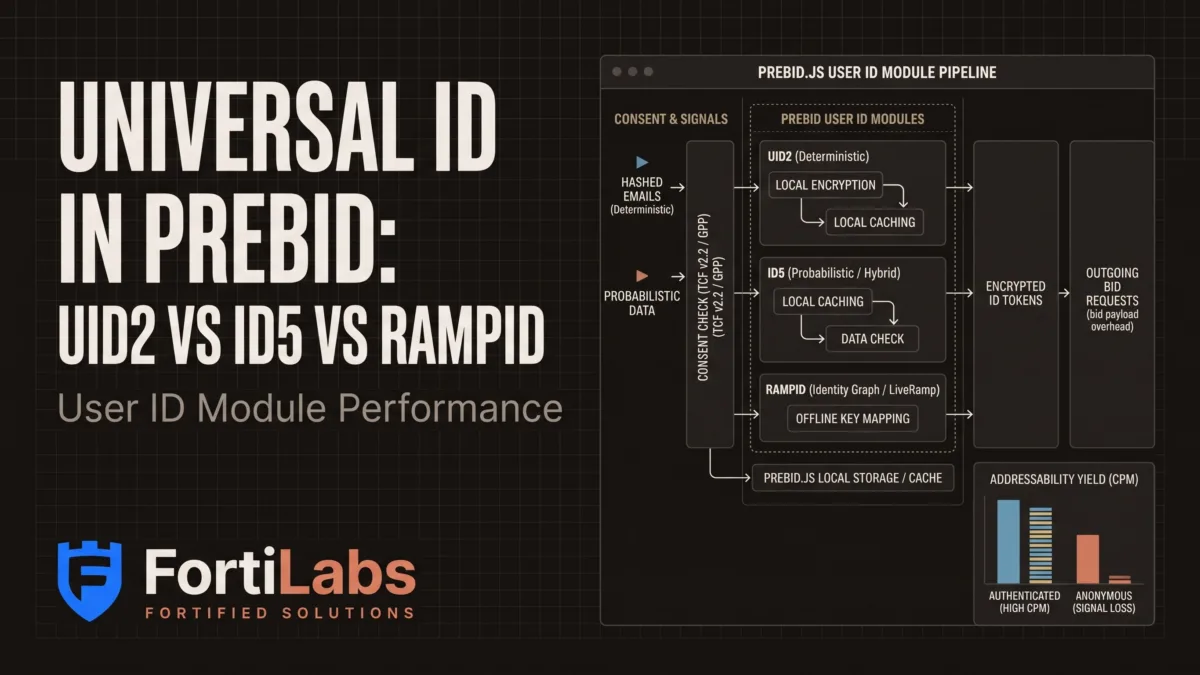
How Prebid.js User ID modules work
Prebid.js includes a User ID module that coordinates identity sub-modules. Publishers add the required modules to their Prebid build and configure them through pbjs.setConfig().
At a high level, the process is:
- The publisher includes the Prebid User ID module and selected provider sub-modules in the build.
- The publisher configures the identity provider, its required parameters, and storage settings.
- The Consent Management Platform (CMP) provides applicable privacy signals.
- Prebid determines whether the identity module is allowed to execute.
- The module obtains or refreshes the identifier where necessary.
- Prebid stores the permitted value according to the configured storage mechanism.
- The resulting identity can be made available to compatible bidder adapters as user ID data and Extended IDs (EIDs).
Publisher page
      |
      v
  CMP / Consent signals
      |
      v
  Prebid.js User ID module
      |
      +------> UID2 sub-module
      |
      +------> ID5 sub-module
      |
      +------> RampID sub-module
      |
      v
  Identity storage / refresh
      |
      v
  bidRequest.userId
  bidRequest.userIdAsEids
      |
      v
  Compatible bidder adapters
      |
      v
  Eligible demand partners
Why bidder compatibility matters
An identifier being present in a Prebid request does not mean every bidder can use it. Individual adapters and downstream demand partners must support the relevant identifier and have the necessary rights and configuration to process it.
Prebid exposes user IDs and EIDs to supported adapters, but the publisher should verify actual bidder-level support before assuming that a particular identifier will improve every auction.
The User ID module also supports bidder-specific restrictions through the bidders configuration option. This is useful when an identifier should only be shared with selected demand partners.
Implementing UID2 in Prebid.js
The UID2 Prebid sub-module is named uid2IdSystem. It supports the UID2 token workflow and can make eligible UID2 information available to the bidstream.
Build requirements
The publisher’s Prebid.js build must include the User ID module and UID2 sub-module. A typical build command is:
gulp build --modules=userId,uid2IdSystemPublishers must also obtain the appropriate UID2 access and configure token generation through a supported UID2 integration. In the server-generated-token model, the publisher generates UID2 tokens outside the browser and provides them to the Prebid integration.
Token generation and refresh
UID2 token generation is not equivalent to creating a SHA-256 hash in the browser. The UID2 Operator generates an encrypted token and associated refresh information from permitted direct identifiers.
The publisher must protect the underlying direct identifier and the credentials used to access UID2 services. Refresh tokens and operator credentials should not be exposed as unrestricted client-side secrets.
The Prebid UID2 integration supports token generation, token refresh, browser storage, and passing the eligible token into the bidstream. Publishers should follow the current UID2 integration guide for the selected client-side or server-side generation model.
UID2 configuration considerations
- Confirm publisher access and operator integration requirements.
- Choose the supported token-generation approach.
- Ensure refresh tokens are protected and handled through the correct workflow.
- Pass only identifiers permitted by the user’s privacy choices.
- Verify that participating bidders can consume UID2.
- Measure token availability, refresh failures, and downstream bid participation.
Important regional limitation: UID2’s published Prebid integration guidance states that UID2 is not designed for use where GDPR applies and that the module does not operate when the GDPR-applies flag is true. Publishers serving European traffic must not assume UID2 is automatically available in GDPR-scoped auctions. Evaluate the appropriate regional identity options, including EUID where relevant, and obtain legal and technical guidance before implementation.
Implementing ID5 in Prebid.js
The ID5 Prebid sub-module is named id5IdSystem. It provides an ID5 identifier to compatible bidders through Prebid’s User ID infrastructure.
Build requirements
gulp build --modules=userId,id5IdSystemPublishers need to register with ID5 and obtain the required partner configuration. The module also has specific storage requirements.
Illustrative configuration
pbjs.setConfig({
  userSync: {
    userIds: [{
      name: "id5IdSystem",

      params: {
        partner: {
          partnerId: "YOUR_ID5_PARTNER_ID"
        }
      },

      storage: {
        type: "html5",
        name: "id5id",
        expires: 90,
        refreshInSeconds: 7200
      }
    }]
  }
});
This is an illustrative configuration structure. Confirm the current parameter names and required partner settings with the latest ID5 module documentation before deployment. The ID5 integration requires HTML5 storage using the designated id5id name.
Why ID5 recommends frequent refresh
ID5 encrypts the identifier delivered to Prebid with a rotating key. Its documentation recommends setting storage.refreshInSeconds to two hours (7,200 seconds) or less so downstream demand partners receive a current identifier and associated privacy information.
This refresh interval is not the same as the maximum storage lifetime. A publisher can configure a longer storage expiry while still refreshing the identifier more frequently.
Use ID5’s built-in A/B testing
ID5 supports an optional control-group mechanism in its Prebid integration. This allows publishers to compare traffic where the ID is exposed with a user-based control group where it is not.
A user-based control group is important because a user should remain in the same treatment group across page views. Randomly switching the same user between enabled and disabled requests can contaminate the experiment.
Publishers should also avoid combining overlapping ID5 control-group mechanisms with other enrichment experiments unless the testing design explicitly accounts for them.
Implementing RampID in Prebid.js
LiveRamp’s RampID integration is represented in Prebid’s documentation through the IdentityLink User ID sub-module. The legacy module name is identityLinkIdSystem, and the identifier is commonly exposed through idl_env.
LiveRamp documentation may still use older IdentityLink or IDL terminology in code examples and product references. Publishers should verify the current naming and configuration requirements in the ATS documentation.
Build requirements
gulp build --modules=userId,identityLinkIdSystemIllustrative Prebid configuration
pbjs.setConfig({
  userSync: {
    userIds: [{
      name: "identityLinkIdSystem",

      params: {
        pid: "YOUR_LIVERAMP_PLACEMENT_ID"
      },

      storage: {
        type: "html5",
        name: "idl_env",
        expires: 15,
        refreshInSeconds: 1800
      }
    }]
  }
});
The placement ID must come from the publisher’s authorized LiveRamp setup. The example uses HTML5 storage and a 30-minute refresh interval to illustrate a configurable implementation. Actual envelope expiry and refresh settings should follow the current ATS deployment requirements.
What the RampID integration does
- Uses an authorized LiveRamp placement and integration.
- Obtains or refreshes the identity envelope through the supported workflow.
- Stores the envelope in the configured publisher-side storage.
- Makes the eligible identifier available to supported Prebid adapters.
- Allows compatible demand partners to process the signal through the LiveRamp ecosystem.
Authenticated Traffic Solution considerations
Publishers evaluating ATS should review the full implementation rather than treating RampID as a standalone Prebid module. ATS integrations can involve identity resolution, publisher authentication, partner compatibility, and additional deployment options.
LiveRamp also documents integrations that can reduce additional page-side execution. Publishers should compare the actual ATS deployment architecture and its measured latency with the alternative of adding more browser-side identity code.
TCF 2.2, GPP, and consent enforcement
Identity availability must be governed by the publisher’s privacy and consent framework. Adding a User ID module does not grant permission to collect, store, or transmit an identifier.
Prebid’s Consent Management modules can retrieve consent information from a compatible CMP and make it available to adapters and identity sub-modules.
IAB TCF 2.2
The TCF Consent Management module supports compatible TCF v2.x CMP integrations, including v2.2. It retrieves the consent string and relevant vendor and purpose information.
Publishers should review the permissions relevant to each activity, including:
- Accessing or storing information on a user’s device.
- Using personal data for advertising purposes.
- Creating or selecting advertising profiles where applicable.
- Measuring advertising performance.
- Sharing data with the relevant identity provider and participating vendors.
The applicable legal basis and vendor permissions must be evaluated for each provider and activity. Consent to local storage is not automatically consent to every downstream advertising use.
IAB Global Privacy Platform
The GPP provides a standardized framework for communicating privacy choices across supported jurisdictions. Prebid’s GPP Consent Management module can retrieve the applicable encoded privacy string through a compatible CMP and expose it to participating adapters.
GPP should not be treated as a replacement for TCF in every environment. A publisher’s CMP and implementation must provide the relevant signals for the applicable jurisdiction and regulatory framework.
What happens when consent is unavailable?
Prebid’s User ID documentation describes how consent management affects identity sub-modules. When the relevant consent information is unavailable or the user has not permitted the required storage activity, the module may not call the external identity provider or store the identifier.
Since Prebid.js 11.14, when a configured TCF or GPP CMP lookup fails—for example, because no CMP is found or the CMP returns an error—User ID sub-modules do not run. A CMP timeout is treated differently: the module can run using the consent data available at that time.
Publishers should test both normal consent responses and CMP failure scenarios. An identity integration that only works when the CMP is healthy is not fully production-ready unless its failure behavior is understood.
Consent changes must refresh identity state
Consent is not a one-time page-load decision. A user may change their preferences after the initial page view. Prebid’s User ID module supports refreshing identity sub-modules when consent information changes.
Publishers should ensure that consent revocation and preference changes are reflected in subsequent identity processing, storage, and bid requests.
Neither TCF nor GPP should be implemented as a decorative string added to the bid request. They are privacy signals that need to be enforced throughout the identity and auction workflow.
Encryption, key rotation, and identity security
Universal IDs are pseudonymous identifiers, not permission to expose raw personal information. Publishers should understand where identifiers are generated, which parties can resolve them, and how keys and credentials are protected.
UID2 encryption and key management
UID2 tokens are generated through the UID2 Operator’s token-generation process. The operator returns an encrypted token and associated refresh information. The token is intended to be opaque to the publisher and should be handled according to UID2’s defined lifecycle.
Publishers should protect operator credentials, refresh tokens, and any direct identifiers used during token generation. Do not hardcode operator secrets into public JavaScript or expose them in browser network responses.
ID5 rotating encryption keys
ID5 encrypts the identifier delivered to Prebid using a rotating key mechanism. Its documentation recommends refreshing the stored ID at least every two hours to help ensure downstream partners receive a current value and privacy information.
A stale identifier can create a mismatch between the encrypted value, the applicable key, and the current privacy state. This is why refresh configuration is an operational requirement rather than a cosmetic optimization.
RampID envelope protection
RampID is delivered through a pseudonymous envelope and authorized LiveRamp integration. Publishers should preserve the envelope format, use the supported retrieval and storage process, and avoid exposing the underlying authenticated information in bid requests.
The envelope’s expiry and refresh lifecycle should follow the current ATS documentation.
Security controls for all three systems
- Keep provider credentials and operator secrets on protected server infrastructure.
- Do not expose raw email addresses or phone numbers in auction requests.
- Use HTTPS for provider communication and publisher endpoints.
- Restrict identifiers to compatible and authorized bidders.
- Apply consent and opt-out requirements before reading or storing identity data.
- Refresh encrypted identifiers according to provider requirements.
- Limit access to identity storage and avoid unnecessary server-side logging.
- Review data retention and deletion behavior with each identity provider.
Local storage, refresh, and payload overhead
Identity storage influences both performance and identifier availability. Prebid’s User ID module supports cookie storage, HTML5 local storage, or both, subject to the individual sub-module’s requirements.
How Prebid storage works
When an identity module obtains a value, Prebid can store it using the configured storage mechanism. On a later page view, Prebid can retrieve the stored identifier rather than making a new provider request immediately.
The common storage options include:
- Cookie: A browser cookie with a configured name and expiry.
- HTML5: Browser local storage with a configured key.
- Cookie and HTML5: Both storage mechanisms, where supported and permitted.
The common Prebid storage configuration includes:
storage: {
  type: "html5",
  name: "provider-id",
  expires: 30,
  refreshInSeconds: 7200
}
This is a generic example, not a universal configuration for all three providers. ID5, UID2, and RampID have different module-specific requirements.
Storage expiry versus refresh interval
These settings solve different problems:
- Expiry: How long the stored value can remain available before it expires.
- Refresh interval: How long Prebid waits before asking the provider for a potentially updated identifier.
A long storage expiry does not mean a publisher should keep using an encrypted identifier indefinitely. Some providers require much more frequent refreshes to keep the value current.
Payload size overhead
Each identifier adds data to the auction request. The size depends on the identifier’s representation, associated metadata, Extended ID structure, and the number of bidders receiving it.
A publisher should not assume that every identifier adds the same number of bytes. UID2 tokens are opaque strings, ID5 values can include extension metadata, and RampID envelopes have their own format.
Payload overhead can become significant when several identifiers are passed to many bidders. Larger requests may increase network transfer, serialization, processing, and logging costs.
Measure actual request growth
Compare representative OpenRTB bid requests with identity modules disabled and enabled. Record:
- Request size before and after identity enrichment.
- Number of EID sources included in each request.
- Number of bidders receiving each identifier.
- Additional provider requests required for identity retrieval.
- Storage reads, writes, and refresh frequency.
- Bidder response time and request rejection rates.
Where supported, use the Prebid bidders restriction to limit an identifier to demand partners that can actually use it. This reduces unnecessary data sharing and can help control request size.
Safari storage considerations
Safari’s Intelligent Tracking Prevention (ITP) and other privacy protections can affect cookie access, storage lifetimes, and cross-site identity workflows. A publisher should not assume that an identifier stored in a browser will remain available for the same period across all browsers.
First-party storage can improve continuity within the publisher’s own domain, but it does not guarantee cross-site recognition or bypass browser privacy controls.
Real-world CPM uplift: Safari vs Chrome
The commercial case for universal IDs is strongest when publishers can demonstrate that addressable impressions attract more competitive demand than comparable anonymous impressions.
However, CPM uplift is not a fixed property of an identity provider. It varies by publisher, geography, content category, audience, buyer participation, consent rates, and the quality of the comparison group.
Published ID5 results
A Czech Publisher Exchange (CPEx) test compared ad opportunities where an ID5 identifier was present with a control group where it was not. The test assigned 90% of consented users to the ID5 group and 10% to the control group.
The published results reported:
The cookieless comparison included environments such as Safari, Firefox, and Edge. The 39% figure is not a Safari-only result and should not be represented as one.
A separate Italian publisher test reported an 8% average bid CPM increase across all environments and a 25% increase in cookieless browsers such as Safari and Firefox.
Published RampID results
LiveRamp reported results from publishers using its Authenticated Traffic Solution during H2 2023. The analysis compared RampID inventory with non-RampID inventory.
The published results included:
LiveRamp also published a Reach PLC case study reporting a 46% increase in average winning CPM and a 17% increase in average bid CPM. Its browser-specific findings included improved fill rates in Safari and higher bid and win rates in Chrome.
What these figures actually tell publishers
| Provider / publisher study | Published result | Metric | Important qualification |
|---|---|---|---|
| ID5 / CPEx | +11% | Average bid CPM | All browsers; ID5-present versus no-ID5 comparison. |
| ID5 / CPEx | +39% | Average bid CPM | Cookieless environments grouped together, not Safari alone. |
| ID5 / Adasta | +8% | Average bid CPM | All environments in the reported test. |
| ID5 / Adasta | +25% | Average bid CPM | Cookieless environments including Safari and Firefox. |
| LiveRamp ATS | +45%+ | Average CPM | RampID inventory compared with non-RampID inventory, H2 2023. |
| LiveRamp ATS | +21% | Average CPM | Safari-specific reported result. |
| LiveRamp ATS | +16% | Average CPM | Chrome-specific reported result. |
Why these results are not a head-to-head comparison
The ID5 and LiveRamp figures come from different studies, publisher populations, time periods, and measurement designs. They do not prove that one identifier produces a higher CPM than another.
They also measure different metrics. Bid CPM, average CPM, and winning CPM are not interchangeable. A higher bid CPM does not necessarily produce the same percentage increase in publisher revenue.
There is no comparable public, independently controlled UID2-versus-ID5-versus-RampID test covering the same publishers, bidders, geographies, and browser segments that would support a defensible universal ranking.
Why Safari and Chrome can show different outcomes
Safari’s restrictions on third-party tracking can make alternative identity signals more valuable for eligible impressions that would otherwise be difficult for buyers to recognize. This can create an opportunity for identity-enabled demand to compete more effectively.
Chrome has historically supported more third-party-cookie-based advertising workflows, although actual availability depends on browser behavior, user settings, and the evolving privacy environment. A universal ID may still add value in Chrome by connecting first-party authenticated audiences to participating buyers.
The commercial opportunity therefore depends on the gap between the addressability of the control group and the addressability of the identity-enabled group—not simply the browser name.
For publishers, the correct interpretation is:
- Safari may show a larger relative benefit where identity restores otherwise unavailable demand.
- Chrome can still benefit from authenticated and alternative identity signals.
- Absolute CPMs vary by geography, audience, seasonality, and demand mix.
- Identity presence does not guarantee a bid, a win, or a higher net payout.
How to run an identity A/B test
A publisher should not choose an identity provider based solely on a vendor’s reported CPM uplift. The most reliable approach is to test the identifier on the publisher’s own inventory using a controlled experiment.
Use a persistent user-level control group
Assign eligible users to an identity-enabled treatment group or a control group without the tested identifier. Keep that assignment consistent across page views.
A user-level test is preferable to randomly enabling and disabling an identifier on individual impressions because repeated exposure to different treatments can distort measurement.
Segment the results
- Browser: Safari, Chrome, Firefox, Edge, and other relevant environments.
- Device: desktop, mobile, and tablet.
- Geography: country and region.
- Authentication: logged-in versus anonymous users.
- Consent: eligible versus non-eligible traffic.
- Inventory: placement, ad size, content category, and format.
- Demand partner: bidder-level response and revenue contribution.
Measure the full monetization funnel
| Metric | What it reveals |
|---|---|
| Identity availability rate | How often an eligible identifier is available in the auction. |
| Bidder acceptance rate | How often downstream partners receive and accept the identity signal. |
| Bid response rate | How frequently eligible opportunities receive bids. |
| Average bid CPM | Whether identity-enabled requests attract higher bids. |
| Bid density | Whether more demand partners compete for the impression. |
| Win rate | Whether the additional bids translate into auction wins. |
| Winning CPM | Whether the winning price improves. |
| Net revenue per thousand impressions | The commercial result after applicable fees and costs. |
| Fill rate | Whether more eligible impressions are successfully monetized. |
| Page performance | Whether identity scripts and refresh requests introduce measurable overhead. |
Control for measurement bias
A valid experiment should account for more than the presence of an identifier. The treatment and control groups should be comparable in traffic quality, browser mix, geography, inventory, and demand conditions.
Avoid comparing logged-in users against anonymous users and attributing the entire CPM difference to the identity provider. Authenticated users may already have different engagement, content preferences, or advertiser value.
Where possible, test the incremental value of each identifier among the same eligible population. Use the same consent criteria and preserve bidder, ad-server, and price-granularity settings across groups.
Recommended experiment report
Publisher:
Experiment period:
Identity provider:
Prebid.js version:
Traffic allocation:
Geographies:
CMP / consent configuration:

Browser:
Device:
Authentication status:

Identity availability:
Bidder acceptance rate:
Bid response rate:
Average bid CPM:
Bid density:
Win rate:
Winning CPM:
Net revenue per 1,000 impressions:
Fill rate:
INP / LCP impact:
Identity refresh failures:
Request payload overhead:

Treatment vs control:
Confidence interval:
Operational cost:
Conclusion:
Next experiment:
The winning solution should improve incremental net revenue and addressability without creating unacceptable latency, privacy, or operational risk.
Building a multi-ID Prebid strategy
Publishers do not necessarily need to select one identity provider and exclude every other option. Multiple identifiers can coexist in a Prebid configuration when the publisher has a clear purpose for each integration and downstream partners support the relevant signals.
A multi-ID approach can improve coverage across different audience types, but it can also increase payload size, provider requests, storage requirements, and privacy-management complexity.
Example identity architecture
                 Publisher website
                        |
                        v
                 Consent Management
                        |
                        v
                Prebid User ID module
                        |
          +-------------+-------------+
          |             |             |
          v             v             v
         UID2          ID5          RampID
          |             |             |
          v             v             v
     Token flow    Shared ID       ATS envelope
          |             |             |
          +-------------+-------------+
                        |
                        v
               Eligible identity data
                        |
                        v
                Bidder-specific EIDs
                        |
                        v
              Compatible demand partners
                        |
                        v
                   Ad auction
Do not send every identifier to every bidder
Prebid supports bidder-specific identity restrictions. Use them to limit the distribution of each ID to partners that have the technical capability and commercial authorization to process it.
This reduces unnecessary data sharing and can help limit request size. It also makes it easier to measure the incremental contribution of each identity provider.
Recommended rollout order
- Audit the publisher’s authenticated audience and existing identity signals.
- Map current bidder support for UID2, ID5, and RampID.
- Identify the highest-value browser and geographic segments.
- Integrate one identity provider and establish a control group.
- Measure availability, bidder acceptance, CPM, and net yield.
- Introduce a second provider only where it adds incremental addressability.
- Evaluate the combined payload and overlap between identity solutions.
- Expand gradually while monitoring consent, storage, and refresh behavior.
Which identity solution should publishers choose?
Choose UID2 when authenticated first-party data is available
UID2 is a logical candidate for publishers with a meaningful authenticated audience and a suitable email or phone collection workflow. Its token-based model provides a defined way to make permitted identity available to participating demand partners.
Publishers must account for token generation, refresh-token security, regional limitations, and bidder compatibility. Its published Prebid integration guidance also requires particular care for GDPR-scoped traffic.
Choose ID5 when broader shared identity coverage is the priority
ID5 is worth testing when the publisher wants to improve addressability beyond its logged-in population and has demand partners capable of consuming ID5. Its encrypted identifier and built-in testing support can help publishers measure incremental value.
The most important operational requirements include the correct HTML5 storage configuration, partner registration, rotating-key refresh, and consent enforcement.
Choose RampID when authenticated traffic and ecosystem access are valuable
RampID is particularly relevant when a publisher has authenticated first-party data and can benefit from LiveRamp’s identity-resolution and ATS ecosystem.
Its commercial value depends on the publisher’s authentication rate, available integration, and participating demand partners. Publishers should evaluate ATS as a broader deployment rather than comparing only the Prebid sub-module.
Decision matrix
| Publisher situation | Initial solution to evaluate | Reason |
|---|---|---|
| Large logged-in audience with email or phone | UID2 and RampID | Both have authenticated identity workflows, subject to regional and partner support. |
| Large anonymous audience | ID5 | Evaluate its broader shared identity capabilities and coverage. |
| Strong LiveRamp relationships | RampID | Existing ecosystem participation can improve practical demand compatibility. |
| Strong UID2-compatible buyer demand | UID2 | Token-based identity may add value where the relevant demand partners support it. |
| High Safari traffic | Test ID5 and RampID, then evaluate other eligible IDs | Measure incremental addressability in cookie-restricted environments. |
| Multiple identity partners and bidder support | Controlled multi-ID strategy | Use bidder-specific distribution and measure overlap and incremental yield. |
Final recommendation
There is no universal winner between UID2, ID5, and RampID. The strongest implementation is the one that creates incremental addressable demand on the publisher’s own traffic, with valid consent and compatible downstream buyers.
Start with the publisher’s authenticated audience, map bidder support, and run a controlled identity experiment. Measure Safari and Chrome separately, distinguish bid CPM from winning CPM and net revenue, and add further identifiers only when they provide measurable incremental value.
Universal IDs are not a replacement for privacy compliance, first-party audience strategy, or sound ad operations. They are components of a broader identity architecture—and their success depends on the quality of the entire publisher-to-buyer workflow.
Production implementation checklist
- Document the publisher’s authenticated and anonymous audience mix.
- Confirm provider registration, commercial access, and implementation requirements.
- Include only the required Prebid User ID sub-modules in the build.
- Verify exact module names, parameters, and storage requirements against current documentation.
- Map downstream bidder compatibility for each identity provider.
- Configure TCF and GPP consent management appropriately.
- Test CMP errors, timeouts, opt-outs, and consent changes.
- Keep provider credentials and token-generation secrets off the public page.
- Configure expiry and refresh intervals according to each provider’s requirements.
- Restrict identity distribution to compatible and authorized bidders.
- Measure EID payload size and identity-provider network requests.
- Test Safari and Chrome separately.
- Use persistent user-level treatment and control groups.
- Measure bid CPM, winning CPM, fill rate, and net revenue separately.
- Account for authenticated-user selection bias and demand variation.
- Roll out gradually and maintain a tested rollback path.
Frequently asked questions
What is the difference between UID2, ID5, and RampID?
UID2 uses encrypted tokens generated from permitted email or phone information. ID5 provides a shared identity framework that can use multiple available signals. RampID is a pseudonymous identifier supported by LiveRamp’s authenticated identity and resolution ecosystem. Their input requirements, coverage, and partner support differ.
Which universal ID works best in Safari?
There is no universal winner. Safari’s privacy protections can make alternative identity signals valuable, but results depend on publisher authentication, available signals, consent, and downstream bidder support. Test each provider on comparable Safari traffic.
Does UID2 require a hashed email address?
UID2 can use hashed or unhashed email addresses and phone numbers as direct identifier inputs in its defined token-generation workflow. A publisher should not simply hash an email in JavaScript and treat that hash as a UID2 token.
Is ID5 a deterministic or probabilistic identifier?
ID5 should not be reduced to either a simple hashed-email identifier or a purely probabilistic graph. It is a shared identity framework that can use available signals and partner integrations. The identity result depends on the information and resolution mechanisms available.
Is RampID based on hashed email?
Authenticated email can be an input to LiveRamp’s identity-resolution workflow, but RampID is not simply the raw hash of an email address. It is a pseudonymous identifier returned through an authorized LiveRamp integration.
Can UID2, ID5, and RampID run together in Prebid.js?
Multiple User ID sub-modules can be configured in Prebid.js, provided their configuration, consent requirements, and downstream bidder support are compatible. Publishers should measure overlap, payload size, and incremental yield before enabling every identifier.
Does UID2 work in GDPR-scoped traffic?
UID2’s published Prebid integration guidance states that UID2 is not designed for use where GDPR applies and that its Prebid module does not operate when the GDPR-applies flag is true. Publishers should evaluate the appropriate regional options and obtain current provider guidance.
Does ID5 require local storage?
The ID5 Prebid.js module requires HTML5 storage using the designated id5id storage name. Publishers should follow the current module documentation and ensure the required storage permission is available before the module runs.
How often should ID5 refresh in Prebid?
ID5 recommends a refresh interval of two hours (7,200 seconds) or less because its delivered identifier uses rotating encryption keys and updated privacy information. Follow the current provider guidance for the publisher’s exact configuration.
Does a universal ID guarantee higher CPM?
No. An identifier can improve addressability, but a higher CPM depends on whether participating demand partners can use it and whether they value the impression. Publishers must measure incremental bid CPM, winning CPM, and net revenue.
How much CPM uplift can publishers expect from universal IDs?
Published case studies report positive results, including ID5 bid CPM increases and LiveRamp RampID CPM increases. These results vary by publisher and browser and should not be used as guaranteed forecasts. Run a controlled experiment on your own inventory.
Can a universal ID replace third-party cookies completely?
No. Universal IDs can provide alternative addressability for eligible users and participating demand partners, but they do not offer universal recognition. Coverage depends on identity availability, browser behavior, consent, and ecosystem adoption.
Technical references
The following primary documentation and published case studies provide the implementation details and commercial evidence discussed in this article.
- Prebid — User ID Module
- Prebid — Unified ID 2.0 Sub-module
- UID2 — Integration Overview for Prebid
- UID2 — Tokens and Refresh Tokens
- Prebid — ID5 Sub-module
- ID5 — Prebid User ID Module
- LiveRamp — Configuring Prebid.js for ATS
- LiveRamp — Configure Prebid.js for ATS
- Prebid — TCF Consent Management
- Prebid — GPP Consent Management
- IAB UK — Exploring Future-Proofed Identity Solutions
- LiveRamp — Reach PLC ATS Case Study
- LiveRamp — RampID Publisher CPM Results
- IAB Europe — ID5 Universal ID Publisher Research
- ID5 — Universal IDs in Numbers