Programmatic Advertising · Supply Chain Transparency
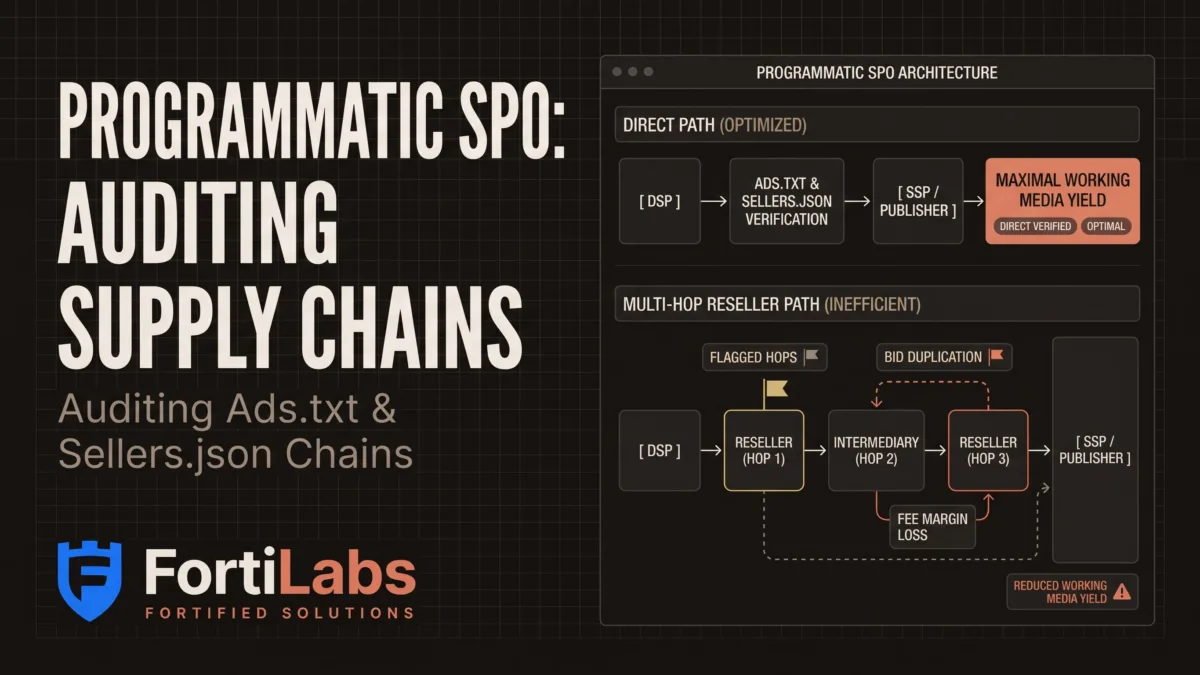
Programmatic supply path optimization (SPO) helps advertisers and publishers identify the most efficient, transparent routes through which ad inventory is bought and sold. By auditing ads.txt, sellers.json, and the OpenRTB SupplyChain object (schain), media buyers can identify unauthorized sellers, redundant intermediaries, and duplicated auction paths—while publishers can make their premium inventory easier for buyers to access directly.
The key principle: the shortest supply path is not automatically the best one. A reseller may provide legitimate sales representation, incremental demand, or access to buyers that a publisher cannot reach directly. Effective SPO removes unnecessary costs and duplication while preserving partners that demonstrably add value.
What is programmatic supply path optimization (SPO)?
Programmatic supply path optimization is the process of evaluating and improving the routes through which advertising inventory travels from a publisher to an advertiser’s demand-side platform (DSP).
An impression can be offered through several exchanges, SSPs, resellers, and intermediary platforms. Some routes provide unique demand or valuable services. Others create additional fees, duplicate access to the same impression, or make it harder to establish who actually owns and sells the inventory.
SPO evaluates these routes using evidence such as:
- Authorization: Is the seller explicitly authorized by the publisher?
- Ownership: Does the seller account belong to the publisher, an intermediary, or another entity?
- Path transparency: Can the buyer identify every payment-related participant?
- Commercial efficiency: What fees, margins, and other costs are incurred along the route?
- Incremental value: Does the route provide unique demand, better fill, improved competition, or premium inventory access?
- Inventory quality: Does the path deliver viewable, brand-safe, measurable impressions with acceptable invalid-traffic levels?
The objective is not simply to reduce the number of SSPs. It is to prioritize transparent, authorized, competitive routes that deliver measurable value to both buyers and publishers.
Why do multiple routes exist for the same impression?
Publishers often connect their inventory to multiple monetization platforms to increase demand competition. A single ad impression might be available through a publisher’s direct SSP integration, a header-bidding wrapper, an exchange reseller, and a separate managed-sales partner.
These connections can be legitimate. However, when several platforms expose substantially the same inventory to the same DSP, buyers may encounter duplicate bid opportunities. They may also pay for intermediary services that do not create additional demand or improve the transaction.
SPO is a value audit, not a hop-count contest. A two-hop path with strong publisher authorization, competitive demand, and transparent fees can be better than a direct-looking route with poor quality or limited competition.
What are ads.txt, sellers.json, and the SupplyChain object?
Three IAB Tech Lab standards work together to improve programmatic supply-chain transparency. Each answers a different question.
| Standard | Published by | Main question | What it reveals |
|---|---|---|---|
ads.txt |
Publisher | Who is authorized to sell this inventory? | Authorized advertising-system domains, seller account IDs, and relationship types. |
sellers.json |
SSP, exchange, or intermediary | Who owns or operates this seller account? | Seller identity, business domain, and seller classification. |
schain |
Participating supply platforms | Which entities participated in this transaction? | The ordered supply-chain nodes and whether the chain is declared complete. |
Why is one file not enough?
An ads.txt entry can confirm that a seller account is authorized, but it does not independently establish the identity of the entity operating that account. A sellers.json file helps identify that entity, while schain shows which selling entities were involved in a particular bid request.
For example, a publisher may authorize an SSP as a reseller. The entry is legitimate, but it does not prove that the reseller is providing incremental demand or that its fees are commercially justified. That requires transaction-level and contractual analysis.
Likewise, a complete schain does not automatically prove that every seller is authorized. Each node must still be checked against the relevant publisher authorization record and seller identity.
How to audit ads.txt and identify unauthorized resellers
The ads.txt file is a publisher-controlled public record of companies authorized to sell its digital inventory. Buyers typically retrieve it from the publisher’s root domain, for example:
https://www.example.com/ads.txtEach standard seller record contains four comma-separated fields:
<ad-system-domain>, <seller-account-id>, <relationship-type>, <certification-authority-id>A simplified example:
google.com, pub-1234567890123456, DIRECT, f08c47fec0942fa0
exchange-one.com, 4821, RESELLER
exchange-two.com, 99104, RESELLER, abcdef1234567890
The values above are illustrative only. They do not represent verified seller accounts or real authorization relationships.
What do DIRECT and RESELLER actually mean?
- DIRECT: The publisher has a direct business relationship with the advertising system and controls the relevant seller account.
- RESELLER: The publisher has authorized another entity to sell its inventory through that advertising system.
A DIRECT entry is not simply a statement that the SSP has a technical connection to the publisher. It represents a specific account-control relationship. Publishers should not label an account DIRECT unless the relationship meets the specification’s requirements.
Step 1: Retrieve the publisher’s ads.txt file
Start with the canonical publisher domain. Check the file’s availability, HTTP response, redirects, and whether the content is publicly crawlable. Do not assume that a file hosted on a subdomain or an unrelated sales partner’s domain is the publisher’s authoritative file.
For large audits, collect files for every publisher in the campaign’s inventory list and record the retrieval timestamp. This creates a reproducible snapshot for later comparison.
Step 2: Parse and normalize seller records
Normalize the data before comparing it:
- Trim whitespace around each field.
- Normalize advertising-system domains to lowercase.
- Preserve seller account IDs as strings. Do not convert them into numbers or remove leading zeros.
- Normalize relationship values to uppercase.
- Retain the certification authority ID when present.
- Handle comments and blank lines without treating them as seller records.
- Preserve the original line and source file for audit evidence.
Do not silently discard malformed records. Flag them for review because a parsing mistake can create a false authorization result.
Step 3: Match the seller account against the bid request
For each transaction, extract the advertising-system identifier and seller account ID from the relevant supply-chain node. Compare both values with the publisher’s ads.txt records.
A domain match without an account-ID match is insufficient. The seller account is part of the authorization check.
Example: If a bid request claims the publisher is example.com, the selling system is exchange-one.com, and the seller account is 4821, the buyer should verify that exchange-one.com, 4821 appears in the publisher’s authorized seller records with the correct relationship type.
Step 4: Investigate questionable entries
Flag records for investigation when:
- The seller account appears in a bid request but not in the publisher’s current
ads.txtfile. - The advertising-system domain does not match the expected canonical domain.
- The same seller account is represented inconsistently across publisher records.
- A seller is declared
DIRECTeven though the publisher does not control that account. - A reseller relationship has no identifiable commercial purpose or supporting agreement.
- The file is inaccessible, stale, malformed, or inconsistent with the publisher’s documented sales relationships.
An absent record is a strong reason to investigate, but it is not sufficient by itself to conclude fraud. Check for domain migrations, newly onboarded integrations, regional seller records, caching delays, and file-update timing before blocking traffic.
Step 5: Review ads.txt 1.1 ownership and management declarations
Ads.txt 1.1 introduces two useful variables:
OWNERDOMAIN: Identifies the business domain of the entity that owns the inventory or property.MANAGERDOMAIN: Identifies an entity that manages the publisher’s advertising inventory under the applicable relationship.
These declarations help buyers connect publisher ownership and management relationships with seller identities in sellers.json.
Publishers should declare OWNERDOMAIN accurately, including when the website domain and ownership domain are the same. Use MANAGERDOMAIN carefully: it should reflect a genuine management relationship, not be added indiscriminately to make every reseller appear equivalent.
Where a publisher’s authorized account is classified as PUBLISHER in the corresponding sellers.json, its seller domain should align with the declared OWNERDOMAIN as specified by the IAB implementation guidance.
OWNERDOMAIN=example.com
MANAGERDOMAIN=ad-management-company.com

google.com, pub-1234567890123456, DIRECT
exchange-one.com, 4821, RESELLER
This is a simplified illustration. The actual declarations and seller records must reflect the publisher’s verified ownership and management arrangements.
How to audit sellers.json and verify intermediary identities
While ads.txt tells buyers which seller accounts a publisher authorizes, sellers.json helps identify the entity behind an account.
SSPs, exchanges, and other relevant selling systems publish their own files, commonly at:
https://www.exchange-one.com/sellers.jsonA seller record commonly includes:
seller_id: The account identifier used by the advertising system.seller_type: Whether the account is classified asPUBLISHER,INTERMEDIARY, orBOTH.name: The legal or business name associated with the seller, when disclosed.domain: The seller’s business domain, when disclosed.is_confidential: Indicates whether identifying information is withheld.
What do the seller types mean?
| Seller type | Meaning | Audit interpretation |
|---|---|---|
PUBLISHER |
The entity monetizes inventory it owns and is paid directly by the advertising system. | Check its identity and domain against the publisher’s ownership declaration. |
INTERMEDIARY |
The entity sells inventory on behalf of another entity. | Identify its role, authorization, commercial contribution, and place in the payment chain. |
BOTH |
The entity acts as both a publisher and an intermediary. | Determine which role applies to the specific seller account and transaction. |
Step 1: Locate the sellers.json file for every supply-chain node
Use the asi domain from the relevant schain node to identify the advertising system. Retrieve that system’s published sellers.json and look up the exact sid value.
Do not assume that the legal entity name is the same as the platform brand. Compare the seller’s published domain, legal name, and account documentation where available.
Step 2: Match seller_id to the correct entity
For each node, perform an exact match between:
- The node’s
asivalue and the advertising-system domain. - The node’s
sidvalue and theseller_idinsellers.json. - The returned seller type, name, and domain and the expected commercial relationship.
A valid seller ID does not prove that the seller is authorized to represent a particular publisher. That authorization must still be checked against the publisher’s ads.txt file.
Step 3: Investigate confidential and missing seller records
A confidential seller record does not automatically mean that the inventory is fraudulent. It does, however, reduce the buyer’s ability to verify the entity independently.
Record confidential, missing, and mismatched identities as separate audit outcomes. Ask the SSP or intermediary for supporting documentation when the commercial value of the inventory justifies further investigation.
Step 4: Check OWNERDOMAIN and MANAGERDOMAIN consistency
Compare the seller’s published business domain with the publisher’s declared ownership and management domains. This helps identify whether a seller account represents the inventory owner or a legitimate management intermediary.
Where the declarations conflict, ask the publisher and SSP to reconcile the records. Do not automatically rewrite the publisher’s file or classify a legitimate management company as unauthorized based on a domain mismatch alone.
How to inspect the OpenRTB SupplyChain object
The OpenRTB SupplyChain object, commonly called schain, provides transaction-level visibility into the entities involved in the direct flow of payment for an impression.
Unlike a static ads.txt or sellers.json file, schain is carried in the bid request. It allows buyers to inspect the declared route for an individual opportunity.
Understand the important schain fields
| Field | Purpose | Audit question |
|---|---|---|
ver |
SupplyChain specification version. | Is the declared version supported by the integration? |
complete |
Indicates whether the chain is complete back to the inventory owner. | Is the complete flag set correctly? |
nodes |
Ordered list of participating selling entities. | Are all payment-related nodes represented? |
asi |
Advertising-system identifier, usually a canonical domain. | Does the system match the relevant ads.txt record? |
sid |
Seller account identifier within that system. | Is this exact account authorized? |
hp |
Indicates whether the node participates in the payment flow. | Is the payment responsibility represented correctly? |
rid |
Request identifier issued by the seller, when supplied. | Can requests be correlated across systems? |
What does complete: 1 mean?
A complete supply chain indicates that the declared chain contains all relevant nodes involved in the payment flow back to the owner of the site, app, or other inventory source.
When complete is 0, the chain is incomplete. It identifies the first known node, but the buyer cannot assume that earlier selling relationships are visible.
Do not interpret an incomplete chain as automatic proof of fraud. Treat it as a transparency limitation and investigate the missing upstream relationships.
Example: a simple supply chain
The following example shows a publisher account sold through one exchange:
{
  "schain": {
    "ver": "1.0",
    "complete": 1,
    "nodes": [
      {
        "asi": "exchange-one.com",
        "sid": "4821",
        "hp": 1
      }
    ]
  }
}
The node’s advertising-system domain and seller account must be reconciled against the publisher’s ads.txt file and the exchange’s sellers.json.
Example: a multi-hop supply chain
Consider an impression that passes through two selling systems:
{
  "schain": {
    "ver": "1.0",
    "complete": 1,
    "nodes": [
      {
        "asi": "exchange-one.com",
        "sid": "4821",
        "hp": 1
      },
      {
        "asi": "exchange-two.com",
        "sid": "99104",
        "hp": 1
      }
    ]
  }
}
This example contains two payment-related nodes. The audit should establish the identity of each seller, confirm authorization, and determine why the second system is involved.
The presence of two nodes is not inherently problematic. If the second entity provides exclusive demand or legitimate publisher representation, the route may be commercially justified. If it merely duplicates access to the same inventory and adds cost, it becomes a stronger SPO candidate.
Important: understand node order
The nodes are ordered from the initial advertising system and seller involved in the transaction toward the entity sending the bid request. The final node is the system that sends the request downstream. Do not reverse the chain when building your audit report.
Also distinguish payment-related supply-chain nodes from technical infrastructure. A system that processes, measures, or routes a request is not necessarily a payment participant and should not automatically be added to the payment chain.
How to conduct a systematic programmatic SPO audit
A reliable audit combines static authorization files, transaction-level bid-request data, seller identity records, and commercial evidence. Reviewing only the public files will not reveal the actual cost or performance of every route.
Phase 1: Build a publisher and seller inventory
- Export the campaign’s publisher domains, app identifiers, and inventory sources.
- Retrieve each publisher’s current
ads.txtor applicableapp-ads.txt. - Parse all authorized advertising-system domains, seller IDs, and relationship types.
- Collect the corresponding SSP and intermediary
sellers.jsonfiles. - Store the retrieval timestamp, file version or hash, and source URL.
This creates a baseline authorization dataset. Keep historical snapshots so you can identify when a seller was added, removed, or reclassified.
Phase 2: Capture bid-request supply-chain data
Collect representative OpenRTB bid requests from each major supply route. Capture the publisher domain, inventory identifiers, SSP, seller account, schain, bid-request ID, timestamp, and relevant auction metadata.
Where permitted, retain the associated DSP bid, SSP clearing-price data, and publisher revenue records. Make sure identifiers can be reconciled across the participating systems.
Phase 3: Reconcile all three transparency layers
For every sampled impression:
- Read the publisher or inventory domain.
- Extract the ordered
schainnodes. - Match every node’s
asiandsidagainst the relevant publisher authorization records. - Look up every seller account in the corresponding
sellers.json. - Compare seller identities and domains with the publisher’s
OWNERDOMAINandMANAGERDOMAINdeclarations where applicable. - Flag incomplete chains, missing accounts, incorrect relationship labels, confidential identities, and inconsistent records.
Keep technical validation results separate from commercial conclusions. A route can pass all authorization checks and still be inefficient.
Phase 4: Identify redundant supply paths
Group transactions by publisher, placement, format, geography, device, and time window. Then compare the supply routes through which substantially identical inventory reaches the same DSP.
Look for:
- The same publisher inventory exposed through several exchanges without meaningful incremental reach.
- Multiple reseller routes that lead to the same underlying publisher account.
- Intermediaries with no identifiable incremental demand or operational role.
- Repeated auctions for the same impression that create avoidable competition or duplicate bids.
- Routes with consistently higher fees and no corresponding improvement in win rate, quality, or publisher yield.
Phase 5: Reconcile commercial fees
For each route, compare the advertiser’s cost with the amount paid to the publisher and the documented fees retained by each participant.
Do not assume that the difference between a DSP bid and publisher revenue is entirely intermediary margin. The difference may also include auction-price mechanics, data charges, platform fees, currency conversion, post-auction adjustments, rebates, and other contractual arrangements.
Use reconciled financial records wherever possible. If a fee cannot be attributed to a specific participant, label it as an unexplained difference rather than assigning it to a reseller without evidence.
Phase 6: Rank routes by value, not just cost
Build a route scorecard that combines:
- Authorization and identity confidence.
- Number of payment-related intermediaries.
- Documented fees and net publisher proceeds.
- Incremental reach and unique demand.
- Bid density, win rate, and fill rate.
- Viewability, invalid traffic, and brand-safety performance.
- Deal access, including private marketplace and programmatic guaranteed opportunities.
Prioritize unauthorized or unverifiable routes for investigation. For authorized routes, test whether removing or reducing access changes reach, competition, quality, or revenue before making permanent changes.
Phase 7: Apply controlled changes
Do not remove every reseller in one deployment. Use a controlled test with a defined baseline, a limited set of inventory, and a rollback plan.
Monitor the impact on:
- Eligible bid requests and unique reach.
- Bid rate and bid density.
- Win rate and clearing price.
- Publisher net revenue and effective CPM.
- Advertiser cost per quality-adjusted impression.
- Deal delivery, fill, and campaign pacing.
A route should be removed only when the evidence shows that its cost or risk exceeds its incremental value.
How does bid duplication waste programmatic media spend?
Bid duplication occurs when substantially the same advertising opportunity is made available to a buyer through multiple supply paths. It can happen when a publisher connects the same inventory to multiple SSPs, when resellers redistribute that inventory, or when parallel integrations expose overlapping opportunities.
Duplication does not mean that every repeated bid request is a fraudulent impression. It means the buyer may be evaluating multiple routes to access the same underlying opportunity.
Why is duplicate supply inefficient?
- Repeated auction participation: A DSP may receive multiple opportunities associated with the same impression.
- Unnecessary competition: Duplicate paths can create internal competition or complicate bid optimization.
- Additional fees: Different routes may carry different platform and intermediary charges.
- Reduced transparency: Buyers may struggle to identify which path actually delivered the impression.
- Measurement complexity: Overlapping request IDs and inconsistent identifiers can make reconciliation harder.
How can buyers detect duplicated paths?
Compare bid opportunities using stable, privacy-compliant identifiers and contextual attributes. Depending on the integration, useful signals may include publisher domain, placement or global placement ID, ad size, timestamp, device context, auction identifiers, and request-correlation data.
Do not rely on a single field to declare two opportunities identical. Some publishers intentionally expose the same placement through separate demand integrations, and identifiers may differ between platforms. Use multiple signals and validate the methodology with the DSP and SSP partners.
When the DSP supports it, use duplicate-detection reports and supply-path analytics to identify overlapping inventory. Then compare the incremental reach and performance of each route before excluding one.
How do DSP routing algorithms and The Trade Desk OpenPath work?
Modern DSPs use supply-path optimization to prioritize inventory sources based on factors such as price, auction outcomes, inventory quality, transparency, reach, and commercial relationships.
These systems may reduce bids through redundant or low-value routes, prioritize preferred supply partners, and compare multiple paths to similar inventory. The exact algorithms and weighting are platform-specific and are not necessarily disclosed publicly.
What is The Trade Desk OpenPath?
The Trade Desk OpenPath is a direct integration approach that connects The Trade Desk’s demand with participating publishers’ inventory. It is designed to reduce intermediary complexity, improve supply transparency, and provide buyers with more direct access to publisher inventory.
OpenPath is not an SSP or a publisher yield-management platform. The Trade Desk describes it as a direct connection that can work alongside publishers’ preferred transparent demand solutions, including OpenRTB integrations and Prebid.
How does a direct integration affect the supply path?
A publisher participating in OpenPath can make inventory available through a direct connection to The Trade Desk. This can create another route for advertiser demand while giving the publisher visibility into bid data and the value buyers place on its inventory.
The publisher should still evaluate the integration against its existing monetization setup. A direct connection does not automatically guarantee higher publisher revenue, lower total costs, or better campaign performance. The result depends on demand, auction mechanics, pricing, integration quality, and the routes it replaces or complements.
What should publishers verify before integrating?
- Whether the integration represents a genuinely distinct and documented selling route.
- How the publisher’s inventory and seller accounts are represented in its authorization files.
- Whether the bid request carries accurate publisher, placement, and supply-chain information.
- How the direct demand competes with existing header-bidding and exchange integrations.
- Whether the integration introduces additional operational, reporting, or reconciliation requirements.
- Whether the new demand produces incremental revenue rather than simply shifting existing spend from another path.
For platform-specific requirements, consult The Trade Desk’s OpenPath inventory policies and its OpenPath supply-path best practices.
How can publishers verify direct-sold versus resold inventory?
Publishers need to make their inventory ownership, seller-account control, and authorized management relationships easy for buyers to verify. A clean authorization file can improve buyer confidence, but it must accurately represent the commercial arrangements behind each account.
1. Separate owned inventory from managed inventory
Review every DIRECT and RESELLER entry. Confirm that direct accounts are controlled by the publisher and that reseller accounts represent legitimate authorized selling relationships.
Where practical, maintain separate seller accounts for distinct integration types. This makes it easier for buyers to distinguish inventory sold through direct integrations, header bidding, managed sales, or other monetization arrangements.
2. Keep OWNERDOMAIN and MANAGERDOMAIN accurate
Publish the correct ownership domain and identify the relevant manager when the inventory is genuinely managed by a qualifying entity. Ensure that the corresponding seller records use consistent business domains.
3. Publish accurate sellers.json information
Work with SSPs and exchanges to confirm that their seller records identify the correct legal entity, seller type, and domain. Ask partners to correct stale or inaccurate account information.
4. Make the SupplyChain object complete
Ask each supply partner to preserve the correct payment-related nodes when forwarding bid requests. Confirm that the complete flag accurately represents the chain and that each node has the correct advertising-system domain and seller account ID.
5. Provide buyers with a clear route explanation
For each major integration, document:
- The publisher account and the platform through which it is sold.
- Whether the relationship is direct or reseller-based.
- The legal entity responsible for the selling account.
- The services provided by any intermediary.
- How the route differs from other available paths.
- How buyers can validate the corresponding authorization and supply-chain records.
How does this help publishers access premium PMP budgets?
Private marketplace (PMP) buyers often require confidence in the identity, quality, and provenance of the inventory they purchase. Clear ownership declarations, accurate seller records, complete supply-chain data, and consistent placement identifiers make it easier for buyers to validate a publisher’s inventory and evaluate a deal.
Publishers should also provide buyers with reliable placement-level reporting, deal IDs, audience and contextual information, viewability metrics, and transparent pricing. These operational signals can strengthen the commercial case for a direct private marketplace relationship.
However, a clean ads.txt file does not automatically create PMP demand. Buyers still evaluate audience relevance, inventory quality, campaign objectives, pricing, scale, and deal performance.
How should teams measure SPO performance?
A successful SPO initiative should improve the economics and quality of media transactions, not merely reduce the number of supply partners.
| Metric | What it measures | Why it matters |
|---|---|---|
| Supply-path fee rate | Documented intermediary and platform fees relative to the relevant spend base. | Shows the transaction cost of each route. |
| Publisher net CPM | Publisher proceeds per thousand impressions. | Measures monetization after applicable deductions. |
| Bid rate | Share of eligible bid requests receiving bids. | Indicates demand participation. |
| Win rate | Share of eligible bids won, using a consistent denominator. | Shows how effectively a route converts bids into impressions. |
| Unique reach | Distinct users or opportunities reached under a consistent measurement method. | Helps detect whether a route adds incremental reach. |
| Duplicate opportunity rate | Estimated share of opportunities repeated across supply paths. | Highlights potential auction duplication. |
| Viewability and IVT | Media quality and invalid-traffic performance. | Prevents cost savings from degrading inventory quality. |
| Authorized supply rate | Share of sampled transactions that pass authorization checks. | Measures supply-chain validation coverage. |
| Complete schain rate | Share of sampled bid requests declaring a complete chain. | Measures transaction-level transparency. |
Use a controlled test instead of a simple before-and-after comparison
Campaign mix, seasonality, auction competition, audience composition, and pricing changes can all affect performance. A simple comparison between last month’s results and this month’s results may incorrectly attribute those changes to SPO.
Where possible, use a randomized holdout or controlled test with comparable inventory, geography, device, placement, time period, buyer demand, and deal conditions. Keep the baseline and test groups consistent and define the primary success metric before making changes.
Calculate the actual financial impact
Use a consistent financial definition for every route. One useful publisher-side measure is:
Publisher Net CPM =
  (Publisher Net Revenue / Impressions) * 1000
For the buyer, compare the cost of quality-adjusted impressions rather than relying only on gross CPM:
Cost per 1,000 Viewable, Valid Impressions =
  (Eligible Media Cost / Viewable, Valid Impressions) * 1000
Define the eligible cost and impression population consistently. If measurement coverage differs between routes, disclose that limitation rather than treating missing data as zero cost or zero invalid traffic.
Example: why the cheapest route may not win
Suppose Route A has lower intermediary fees but delivers less unique reach and a lower viewability rate. Route B costs more but provides exclusive publisher inventory and higher-quality impressions. Removing Route B simply because it has more hops could reduce campaign performance and publisher revenue.
The correct decision depends on incremental value after costs—not on the number of intermediaries alone.
Programmatic SPO implementation checklist
Use this checklist before approving a supply-path change or launching a recurring transparency audit.
- Collect current publisher ads.txt and applicable app-ads.txt files.
- Normalize and validate seller domains, account IDs, and relationship labels.
- Confirm every DIRECT account is genuinely controlled by the publisher.
- Retrieve sellers.json from each relevant SSP and intermediary.
- Match every seller account to its published identity and seller type.
- Validate OWNERDOMAIN and MANAGERDOMAIN declarations where applicable.
- Capture bid requests and inspect the ordered SupplyChain nodes.
- Flag incomplete chains, missing seller accounts, and inconsistent identities.
- Identify duplicate access to the same publisher inventory.
- Reconcile DSP spend, SSP clearing prices, publisher proceeds, and documented fees.
- Evaluate incremental reach, demand, quality, and deal access for each route.
- Test route changes with controlled measurement and a rollback plan.
- Maintain dated audit snapshots and recurring partner reviews.
Frequently asked questions about programmatic SPO
What is supply path optimization in programmatic advertising?
Supply path optimization (SPO) is the process of evaluating and selecting efficient, transparent routes for buying publisher inventory. It considers seller authorization, intermediary fees, duplicate auctions, inventory quality, unique reach, and the value each supply partner contributes.
How do ads.txt and sellers.json work together?
ads.txt identifies the seller accounts a publisher authorizes to sell its inventory. sellers.json helps buyers identify the entities behind those accounts. Together, they help buyers verify both the authorization relationship and the seller’s identity.
What is the difference between DIRECT and RESELLER in ads.txt?
DIRECT indicates that the publisher has a direct business relationship with and control over the relevant seller account. RESELLER indicates that the publisher has authorized another entity to sell its inventory through that advertising system.
Does a reseller entry mean inventory is fraudulent?
No. A reseller can be a legitimate and authorized sales partner. Buyers should investigate whether the reseller is authorized, correctly identified, commercially justified, and adding incremental value. An unnecessary reseller is an optimization concern, not automatically a fraud finding.
What is the OpenRTB SupplyChain object?
The SupplyChain object, or schain, is transaction-level bid-request data that lists the entities involved in the direct flow of payment for an impression. Its nodes contain advertising-system domains and seller account IDs, helping buyers reconcile the route with ads.txt and sellers.json.
What does complete: 0 mean in schain?
It means the declared supply chain is incomplete. The first node represents the first known participant, so the buyer cannot assume that every upstream payment-related entity is visible. It should be investigated as a transparency limitation.
How much of a programmatic advertising budget is lost to intermediaries?
There is no universal intermediary-loss percentage. The ANA’s 2023 study reported 29% in transaction costs and a separate 35% in media-productivity losses. These categories should not be combined or attributed entirely to reseller hops. Buyers should calculate actual fees using reconciled transaction and contractual data.
What is The Trade Desk OpenPath?
OpenPath is The Trade Desk’s direct integration approach for connecting its demand with participating publishers’ inventory. It is intended to simplify supply paths and improve transparency. It is not an SSP or yield-management platform, and its financial impact should be measured against the publisher’s existing demand routes.
How can publishers attract more direct PMP budgets?
Publishers can improve buyer confidence by maintaining accurate ads.txt and sellers.json relationships, declaring ownership and management domains correctly, providing complete SupplyChain data, and sharing reliable placement-level inventory and quality reporting. These practices support buyer validation but do not guarantee PMP demand.
Should publishers remove all reseller entries from ads.txt?
No. Publishers should remove unauthorized or obsolete accounts, correct inaccurate relationship labels, and review resellers that do not provide measurable value. Legitimate partners that deliver incremental demand, sales representation, or operational services may deserve to remain authorized.
How often should publishers audit their supply paths?
Publishers should review seller relationships whenever integrations or commercial agreements change and establish a recurring review schedule. Buyers should refresh authorization data regularly and compare it with transaction-level supply-chain records to detect changes and inconsistencies.
Build a more transparent and valuable supply chain
Effective programmatic SPO begins with accurate seller authorization and continues through transaction-level verification and commercial measurement. ads.txt confirms which accounts a publisher authorizes, sellers.json helps identify the entities behind those accounts, and schain exposes the declared payment-related route for individual bid requests.
For media buyers, this makes it easier to investigate unauthorized sellers, overlapping inventory, and unnecessary costs. For publishers, it creates a stronger foundation for demonstrating inventory ownership, validating direct integrations, and building buyer confidence in premium PMP opportunities.
The best supply path is not necessarily the one with the fewest intermediaries. It is the one that delivers authorized inventory, transparent economics, incremental demand, and measurable value to the advertiser and publisher.
Technical references and further reading
- IAB Tech Lab: ads.txt and app-ads.txt — authorized digital sellers and ads.txt 1.1 guidance.
- IAB Tech Lab: sellers.json — seller identity and supply-chain transparency.
- IAB OpenRTB: SupplyChain object specification — node structure, ordering, and completeness.
- IAB Tech Lab: Supply Chain Validation — implementation guidance for ownership and management declarations.
- ANA: Programmatic Media Buying Study — supply-chain transparency findings and recommendations.
- The Trade Desk: OpenPath — direct publisher integration and supply-path overview.
- The Trade Desk: OpenPath inventory policies — supply transparency and seller requirements.