TECH LAB / KUBERNETES / PLATFORM ENGINEERING
eBPF vs Sidecar Proxies in Kubernetes: Network Performance and Runtime Security
A practical architecture comparison for platform and SRE teams evaluating kernel-level networking, Envoy sidecars, service-mesh observability, and runtime threat detection across large Kubernetes environments.
The short answer
eBPF-based networking can reduce the per-workload proxy overhead associated with traditional sidecar architectures, while providing efficient kernel-level traffic visibility, load balancing, and identity-aware network policy enforcement. Cilium is a leading example of this approach.
Envoy sidecars remain valuable when teams need rich Layer 7 proxy capabilities, including advanced HTTP and gRPC routing, traffic splitting, retries, circuit breaking, and mature proxy-based telemetry.
These approaches are not mutually exclusive. Cilium can provide an eBPF networking datapath while Envoy handles selected Layer 7 operations. Tetragon can add kernel-level runtime security monitoring and enforcement. The strongest architecture is often a combination chosen according to the workload’s actual requirements.
Why traditional sidecar proxies become expensive at Kubernetes scale
Kubernetes microservices generate a large amount of east-west traffic. Every request between services can involve service discovery, load balancing, network policy, encryption, authentication, retries, telemetry, and connection management.
A service mesh built around sidecar proxies places a dedicated proxy alongside each participating application workload. In an Istio sidecar deployment, Envoy is injected into the Pod and handles intercepted traffic between the application and the network.
This architecture provides a powerful and consistent Layer 7 control point. It also introduces another process into the lifecycle and resource budget of every participating workload.
The cost of a proxy per workload
- Memory multiplication: Each injected proxy consumes memory for worker threads, connection state, configuration, certificates, and telemetry buffers.
- CPU overhead: Traffic inspection, TLS processing, routing, retries, metrics, and tracing filters consume CPU in addition to application processing.
- Additional data-path work: Traffic is redirected through proxy processes rather than following only the application’s normal socket path.
- iptables redirection: Traditional sidecar capture commonly uses traffic-redirection rules to steer inbound and outbound TCP traffic through Envoy.
- Operational complexity: Injection, proxy readiness, configuration propagation, certificate rotation, and proxy upgrades become part of application operations.
- Resource fragmentation: Small application containers can end up sharing a Pod resource budget with a proxy whose baseline cost is significant relative to the workload.
The important issue is not that sidecars are inherently inefficient. Envoy performs substantial work and provides capabilities that applications would otherwise need to implement or obtain elsewhere. The issue is that repeating a proxy instance across hundreds or thousands of Pods creates an infrastructure cost that grows with workload count.
What does the overhead look like?
Istio publishes representative data-plane resource measurements. In its documented Istio 1.24 test configuration, a sidecar with two worker threads handling 1,000 HTTP requests per second with 1 KB payloads consumed approximately 0.20 vCPU and 60 MB of memory. The same documentation reports different figures for waypoint and ztunnel components in ambient mode.
These figures are useful as an example of proxy resource cost, not as a universal benchmark. Actual consumption depends on traffic volume, concurrent connections, protocol, proxy configuration, telemetry filters, TLS, CPU allocation, and workload behavior.
At 1,000 application Pods, even a modest per-proxy baseline can become a substantial aggregate memory and CPU allocation. The exact cluster impact must be measured using the team’s own workloads.
Sidecar overhead is not simply an iptables problem. iptables-based interception is one part of the architecture. Envoy’s per-Pod process, connection state, protocol processing, telemetry, and configuration also contribute to resource consumption.
How eBPF changes Kubernetes networking
Extended Berkeley Packet Filter, commonly called eBPF, is a Linux kernel technology that allows verified programs to run at specific kernel execution points. Networking platforms can use it to implement packet processing, socket-level operations, traffic visibility, load balancing, and policy enforcement without routing every operation through a separate user-space proxy.
The central architectural change is where network processing happens. Instead of requiring a dedicated proxy process beside every application Pod for every networking function, selected operations can execute in the kernel on the Kubernetes node.
From per-Pod proxying to node-level kernel datapaths
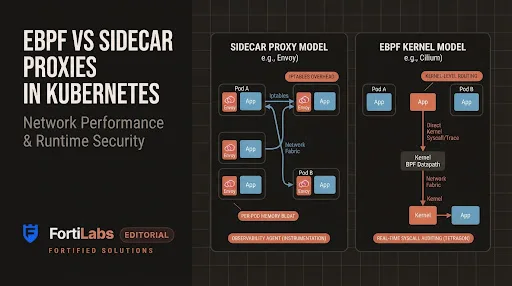
With a traditional sidecar model, an application request can be intercepted and passed through a local Envoy process before reaching its destination. The destination sidecar can then perform another round of proxy processing.
With an eBPF-based datapath such as Cilium, the node’s kernel can apply networking operations using eBPF programs and maps. Cilium assigns security identities to workloads and uses those identities to make policy decisions as Pods are created, deleted, and rescheduled.
This avoids making a separate Envoy process mandatory for basic Layer 3 and Layer 4 networking operations. It can also reduce dependence on large collections of IP-address-based rules that need to change as workloads move around the cluster.
What Cilium does
Cilium is an eBPF-based Kubernetes networking, security, and observability platform. Its capabilities include:
- Container networking through the Kubernetes CNI model.
- Identity-aware Layer 3 and Layer 4 network policy.
- Extended Layer 7 policy capabilities for supported protocols.
- Service load balancing and Kubernetes service routing.
- Optional kube-proxy replacement using eBPF.
- Network visibility through Hubble.
- Integration with service-mesh and proxy-based functionality where required.
Cilium does not simply eliminate every proxy. Its architecture can use eBPF for efficient Layer 3 and Layer 4 processing while relying on Envoy for selected application-layer functions.
What Tetragon does
Tetragon is a separate eBPF-based runtime security and observability project. It monitors security-relevant kernel and process activity, including process execution, system-call activity, file access, and network-related events.
It can associate events with Kubernetes-aware identities such as Pods and namespaces. This lets security teams investigate behavior in the context of a workload rather than relying only on a host-level process name or IP address.
Cilium and Tetragon therefore address complementary layers:
- Cilium: How workloads communicate, how traffic is routed, and which network interactions are allowed.
- Tetragon: What processes and workloads do at runtime, which security-sensitive operations occur, and which configured behaviors should trigger enforcement.
Architecture comparison: Envoy sidecars vs eBPF-based networking
| Area | Sidecar proxy model | eBPF-based model |
|---|---|---|
| Primary execution location | User-space Envoy process associated with each participating Pod. | Linux kernel hooks and maps on Kubernetes nodes. |
| Traffic interception | Commonly uses iptables-based redirection into the proxy. | Uses kernel-level networking and socket hooks, depending on the feature and datapath. |
| Resource allocation | Proxy CPU and memory are allocated per injected workload. | Networking programs and maps are managed at node level; agents and supporting components still consume resources. |
| L3/L4 networking | Handled through proxy processing and underlying networking. | Can be implemented directly in the kernel. |
| Advanced L7 traffic management | Mature Envoy HTTP and gRPC proxy capabilities. | May use an integrated or external proxy for advanced application-layer processing. |
| Network visibility | Proxy metrics, access logs, and tracing integrations. | Kernel-derived flow visibility and workload-aware network telemetry. |
| Runtime syscall monitoring | Not a core responsibility of the network proxy. | Possible through a runtime security component such as Tetragon. |
| Typical operational trade-off | More proxy resources and configuration, with rich L7 control. | Less dependence on per-Pod proxies for networking, with greater kernel and platform operational responsibility. |
These are architectural tendencies, not absolute rules. Some service meshes use shared proxies, ambient dataplanes, or hybrid models rather than injecting one Envoy sidecar into every application Pod.
Network performance: throughput, latency, CPU, and memory
Performance is often the main reason platform teams investigate eBPF. Removing unnecessary user-space processing from the network path can reduce CPU consumption and latency, especially in clusters with high east-west traffic volumes and large numbers of small services.
However, an eBPF datapath is not automatically faster in every environment. Routing mode, encapsulation, encryption, host networking, kernel version, network interface capabilities, policy complexity, and application traffic patterns all influence the result.
Throughput degradation in sidecar architectures
When traffic passes through Envoy, the proxy must receive, process, and forward it. Depending on configuration, that can involve TLS termination or origination, HTTP parsing, connection pooling, routing decisions, retries, telemetry filters, and buffering.
These operations have a cost. At high request rates, CPU scheduling, memory allocation, connection handling, and proxy worker saturation can become limiting factors. When traffic passes through both source and destination sidecars, additional processing is involved at each end.
This does not mean every request experiences a dramatic throughput reduction. Persistent connections, efficient proxy configuration, appropriate CPU allocation, and workload characteristics can make the overhead manageable. The point is that proxy processing is real work and must be included in capacity planning.
How eBPF can improve the data path
Cilium can use eBPF for service load balancing, policy enforcement, and routing. Its eBPF host-routing capability can bypass parts of the traditional host network stack, including netfilter processing, under supported configurations.
This can reduce unnecessary packet-processing steps. Cilium’s documentation also makes clear that some optimizations require particular combinations of kernel capabilities, kube-proxy replacement, masquerading, routing modes, and network configuration.
A cluster that runs Cilium but still uses legacy host routing or retains dependencies on netfilter hooks may not receive the same benefits as a carefully configured eBPF host-routing deployment.
CPU and memory trade-offs
An eBPF architecture avoids the requirement to run a dedicated sidecar for every workload when those workloads only need kernel-level networking and policy. This can reduce aggregate per-Pod memory consumption and proxy CPU allocation.
But the resource cost does not disappear. Cilium agents, operator components, Hubble, Tetragon, maps, event buffers, and any required Envoy or gateway components still consume CPU and memory.
The relevant comparison is total cluster overhead at equivalent functionality—not sidecar memory versus an imaginary zero-cost kernel.
What to benchmark before migrating
- Throughput: Measure TCP and HTTP throughput under representative request sizes and concurrency.
- Latency: Compare median, p95, and p99 latency for service-to-service calls.
- CPU: Track node CPU, proxy CPU, application CPU, and networking-agent CPU separately.
- Memory: Compare total Pod memory requests and actual working-set consumption.
- Connection scale: Test concurrent connections, connection churn, and short-lived request patterns.
- Policy overhead: Measure behavior with the actual network-policy and observability rules enabled.
- Failure recovery: Test node restarts, agent restarts, endpoint churn, and rolling deployments.
Compare architectures with equivalent security, encryption, routing, and telemetry features enabled. Comparing an Envoy deployment with mTLS and tracing against an eBPF deployment with those features disabled does not produce a meaningful performance result.
Zero-instrumentation observability: what eBPF can and cannot trace
One of eBPF’s most attractive capabilities is the ability to observe network behavior without requiring every application team to add custom instrumentation to its source code.
Cilium’s Hubble uses information from the Cilium datapath to provide visibility into network flows. Teams can investigate communication between workloads, identify dropped traffic, inspect supported Layer 7 information, and associate network activity with Kubernetes identities.
What Hubble can reveal without application changes
- Which workloads communicate with one another.
- Which source and destination identities are involved in a flow.
- Whether network policy allowed or dropped traffic.
- Relevant protocol and connection metadata.
- Supported Layer 7 request and response information when the required visibility is configured.
- Unexpected communication patterns between namespaces and services.
This is valuable for platform teams investigating service dependencies, network-policy failures, lateral movement, and unexpected outbound connections.
Network-flow visibility is not full distributed tracing
Distributed tracing answers a different question: how did a particular request travel across application boundaries, which operations consumed time, and where did a transaction encounter an error?
A network flow event does not necessarily contain the application-level trace context, span hierarchy, business operation, or internal function timing required to reconstruct an end-to-end trace.
eBPF-based observability can provide valuable network and process context without source-code changes, but full distributed tracing may still require OpenTelemetry instrumentation, supported automatic instrumentation, proxy telemetry, or application-generated trace context.
How to combine Hubble and OpenTelemetry
A practical observability stack can use Hubble for network-level visibility and OpenTelemetry for application-level traces, metrics, and logs.
- Use Hubble to identify which services communicate and where traffic is dropped.
- Use OpenTelemetry to understand request execution across application services.
- Use trace IDs and service identity to correlate application requests with relevant network and infrastructure events where available.
- Send telemetry to a centralized backend with retention and access controls appropriate to its sensitivity.
- Apply sampling and filtering to prevent high-volume telemetry from overwhelming storage and processing pipelines.
The result is a more complete picture: application traces explain request behavior, while eBPF-derived network telemetry helps explain the infrastructure path around it.
Runtime security: real-time syscall auditing and intrusion detection
Network policy can restrict which services communicate, but it cannot explain every action a compromised process performs after it starts running.
A container may have legitimate network access while attempting to execute an unexpected binary, access a sensitive file, change its privileges, or interact with a kernel interface it should never use.
This is where runtime security complements network security.
Tetragon: observe security-relevant kernel activity
Tetragon attaches eBPF programs to relevant kernel functions and events to observe process execution, system-call activity, and file or network operations.
Its Kubernetes awareness helps security teams associate events with workload identity, including Pod and namespace context. This can make alerts more actionable than a host-only event containing a process ID and executable name.
Examples of runtime detections
- Unexpected shell execution: A production application container starts an interactive shell or launches a binary outside its normal execution profile.
- Sensitive file access: A process attempts to read protected files or access unexpected credential paths.
- Privilege changes: A workload attempts an unexpected privilege escalation or changes its process capabilities.
- Suspicious process behavior: A service starts an executable that is not part of its expected runtime behavior.
- Unexpected network activity: A process opens connections that conflict with its intended workload behavior.
- Container escape indicators: Security teams monitor selected kernel and namespace operations associated with suspicious attempts to cross container boundaries.
Detection versus enforcement
Runtime monitoring and runtime prevention are different operating modes. An alert tells a security team that an event occurred. Enforcement attempts to prevent or terminate an operation according to a configured policy.
Tetragon supports enforcement mechanisms such as overriding the return value of supported operations and sending signals to processes. These actions have different semantics. For example, terminating a process with SIGKILL does not guarantee that an operation already in progress has been prevented.
Teams should test enforcement policies in observation mode first, understand the exact event semantics, and introduce blocking gradually. A broad rule that kills processes based on an incomplete assumption can interrupt legitimate production workloads.
Runtime security is not a replacement for container hardening
eBPF-based monitoring should complement—not replace—least-privilege containers, seccomp, Linux capabilities, read-only filesystems, Pod Security Standards, admission policies, image scanning, secrets controls, and Kubernetes audit logs.
Runtime visibility is most useful when the environment already has a clear baseline of expected workload behavior and an incident-response process for investigating deviations.
Linux kernel requirements, hardware, and compatibility
eBPF depends on Linux kernel functionality. The availability of a particular networking or runtime-security feature is determined by the kernel version, configuration, distribution backports, architecture, and supported attachment points—not merely by whether the machine runs Linux.
Is Linux kernel 5.4+ enough?
Not as a universal production requirement. Kernel 5.4 is an important long-term-support release, and some eBPF tools or features can operate on it. However, current Cilium requirements are generally higher.
The current Cilium 1.20 documentation lists Linux kernel 5.10 or later as the general requirement when using its container image, with a documented equivalent of 4.18 on RHEL 8.10. Individual features require newer kernel capabilities.
Tetragon documents a minimum kernel version of 4.19, but explicitly warns that not all features work on older kernels. It requires BTF support, and its documentation recommends newer kernels for fuller functionality. For arm64, it recommends kernel 5.10 or later for full functionality because of older-kernel issues affecting some features.
Kernel compatibility by feature
| Component or feature | Documented requirement | Important qualification |
|---|---|---|
| Cilium 1.20 baseline | Linux 5.10+ generally. | RHEL 8.10 kernel 4.18 is a documented equivalent. |
| Tetragon baseline | Linux 4.19+. | BTF is required; not all features work on older kernels. |
| Cilium IPv6 BIG TCP | Linux 5.19+. | Requires additional datapath and hardware conditions. |
| Cilium IPv4 BIG TCP | Linux 6.3+. | Requires supported routing and network-interface configuration. |
| Cilium netkit device mode | Linux 6.8+. | Requires netkit kernel configuration and eBPF host routing. |
These versions are not interchangeable guarantees. Always check the requirements for the exact Cilium or Tetragon release, enabled features, Linux distribution, and Kubernetes platform.
Hardware requirements
Standard eBPF networking does not require a dedicated SmartNIC, FPGA, or specialized network accelerator. It can run on supported general-purpose Linux servers with compatible kernels and network drivers.
Hardware capabilities become important when enabling particular acceleration paths, especially XDP and high-performance packet processing. Driver support, NIC features, CPU architecture, interrupt handling, and network configuration can determine which optimizations are available.
For production planning, verify:
- Supported CPU architecture and Linux distribution.
- Kernel version and required configuration options.
- BTF availability for features that depend on it.
- eBPF JIT support and required kernel permissions.
- Network driver compatibility for XDP or other hardware-sensitive paths.
- Available CPU and memory for node agents, maps, and event processing.
- Cloud-provider restrictions and managed Kubernetes limitations.
Cilium agents need privileged access to install and manage kernel eBPF programs. This makes the node agent part of the cluster’s trusted infrastructure and requires strict control over who can modify it.
Multi-tenant Kubernetes security: eBPF is powerful, but the kernel remains shared
Multi-tenant clusters introduce a different security question: can one tenant’s workload interfere with another tenant’s network policy, runtime visibility, or host-level security controls?
eBPF provides powerful kernel-level enforcement, but it does not create a separate kernel for every namespace. Containers on the same node share the host kernel, and the eBPF programs installed by privileged infrastructure components operate within that shared kernel environment.
Identity-aware network isolation
Cilium can enforce workload-aware policies using identities derived from Kubernetes labels. This is useful when tenant workloads move between nodes or when Pod IP addresses change frequently.
Teams can use Kubernetes NetworkPolicy, CiliumNetworkPolicy, and CiliumClusterwideNetworkPolicy to define ingress and egress restrictions. These policies can establish default-deny boundaries and permit only expected communication between tenant workloads.
Namespace labels, service identities, and carefully managed policy selectors help prevent a workload in one tenant namespace from freely communicating with another tenant’s services.
Runtime security and privileged infrastructure
Tetragon and Cilium agents require elevated privileges because they interact with the host kernel. These agents should not be treated as ordinary tenant workloads.
Restrict access to their Pods, service accounts, configuration resources, tracing policies, and associated Kubernetes custom resources. A user who can modify security policy or access privileged agent containers may be able to undermine cluster-wide enforcement.
eBPF does not replace strong tenant boundaries
Kubernetes namespaces are useful administrative and policy boundaries, but they are not equivalent to separate kernels or independent clusters.
For high-risk tenants, evaluate stronger isolation models such as dedicated node pools, sandboxed runtimes, virtual-machine-backed containers, or separate clusters. These approaches can reduce the impact of a shared-kernel compromise, although they introduce additional operational cost.
The appropriate model depends on tenant trust, regulatory requirements, workload privileges, data sensitivity, and the consequences of a node-level compromise.
Use eBPF to strengthen network and runtime controls, but do not present it as a substitute for kernel isolation. The node’s privileged agents, host operating system, Kubernetes control plane, and tenant workloads must remain separate security concerns.
Why hybrid eBPF and Envoy architectures often make the most sense
The choice between eBPF and sidecars is frequently framed as a binary decision. In practice, many production systems benefit from using each technology where it is strongest.
Use eBPF for the networking foundation
- Pod connectivity and service routing.
- Identity-aware Layer 3 and Layer 4 policy.
- Efficient service load balancing.
- Network-flow visibility and policy troubleshooting.
- Selected host-routing and packet-processing optimizations.
Use Envoy where application-layer processing is required
- Advanced HTTP and gRPC routing.
- Traffic splitting and canary deployments.
- Protocol-aware retries and circuit breaking.
- Application-layer authentication and authorization integrations.
- Proxy-based telemetry and selected Layer 7 controls.
Use Tetragon for runtime security
- Process execution monitoring.
- Selected syscall and kernel-event auditing.
- Workload-aware runtime detection.
- Configured enforcement against suspicious operations.
One important compatibility consideration: Cilium’s eBPF host-routing mode has documented limitations when used with Istio. Cilium’s integration guidance recommends retaining kube-proxy for the least disruptive Istio configuration, or using specific settings when kube-proxy replacement is required.
This is why platform teams should validate the complete combination of Cilium routing mode, service-mesh dataplane, network policy, encryption, and cloud networking before enabling advanced optimizations in production.
Decision framework: when should platform teams choose eBPF or sidecars?
Prioritize eBPF when…
- You operate large clusters with high east-west traffic volume.
- Per-Pod proxy memory and CPU overhead are material capacity concerns.
- You need identity-aware network policies and efficient service routing.
- Network-flow visibility without application instrumentation is valuable.
- You want kernel-level runtime monitoring through a component such as Tetragon.
- Your node kernels and network platforms support the required features.
Keep Envoy sidecars when…
- You rely heavily on advanced HTTP and gRPC traffic management.
- Existing routing, retries, circuit breaking, and proxy integrations are important.
- Your team already operates the service mesh reliably.
- Application-layer policy requires proxy capabilities not covered by your selected eBPF deployment.
- The measured sidecar overhead is acceptable for the workload.
- A migration would create more operational risk than the expected savings.
A practical migration strategy
- Establish a baseline: Measure sidecar CPU, memory, request latency, throughput, and connection behavior before changing the dataplane.
- Map existing dependencies: Identify which workloads require advanced Envoy features, mTLS, L7 authorization, retries, traffic splitting, and proxy telemetry.
- Validate kernel compatibility: Check distribution kernels, BTF, required eBPF configuration, NIC drivers, and managed Kubernetes restrictions.
- Introduce Cilium carefully: Validate networking, policy enforcement, routing mode, service load balancing, and compatibility with the existing service mesh.
- Enable visibility: Deploy Hubble and verify that network events are useful, correctly attributed, and retained appropriately.
- Introduce runtime detection: Deploy Tetragon in observation mode, establish workload baselines, and tune detection policies.
- Test enforcement: Move selected policies into enforcement after validating false positives and failure behavior.
- Compare equivalent workloads: Run controlled benchmarks with comparable security and observability features enabled.
- Retain proxies where needed: Remove sidecars only from workloads whose required functionality has been replaced and validated.
The practical verdict
eBPF is a strong foundation for Kubernetes networking and runtime visibility when platform teams need scalable identity-aware policy enforcement, efficient packet processing, and kernel-level security telemetry.
Envoy remains a mature and capable choice for sophisticated application-layer traffic management. Removing it from every workload is not automatically an architectural improvement.
Cilium and Tetragon make the distinction especially clear: one can secure and observe workload communication, while the other can monitor and enforce selected runtime behaviors. Together with Envoy where needed, they provide a layered architecture rather than a forced either-or choice.
The right migration target is not zero proxies at any cost. It is the minimum set of components required to deliver the network, application, and runtime security controls your workloads actually need.
Frequently asked questions
Is eBPF faster than Envoy sidecars in Kubernetes?
eBPF can reduce processing overhead for networking operations that can be performed efficiently in the kernel, especially Layer 3 and Layer 4 routing and policy enforcement. Envoy performs additional user-space processing for advanced Layer 7 functionality. Actual performance depends on the workload, configuration, kernel, and enabled features.
Does eBPF completely replace Envoy?
No. eBPF is not a direct replacement for every Envoy feature. Cilium can use eBPF for networking and policy while retaining Envoy for selected Layer 7 operations. Teams that need advanced HTTP and gRPC routing may still require a proxy.
Does Cilium eliminate iptables?
Not automatically. Cilium can replace kube-proxy and use eBPF for networking, but the actual use of netfilter and iptables depends on routing mode, configuration, and other platform requirements. Its eBPF host-routing mode can bypass parts of the traditional host network stack when the required features are enabled.
Can Hubble replace OpenTelemetry distributed tracing?
No. Hubble provides network-flow visibility and useful workload-aware context without requiring application instrumentation for those observations. Complete distributed traces generally require trace context and application or supported automatic instrumentation. Hubble and OpenTelemetry complement each other.
Can Tetragon detect system-call activity?
Yes. Tetragon can observe security-relevant process and system-call activity using eBPF. It can associate events with Kubernetes workload context and enforce selected policies. Feature availability depends on the kernel and its configuration.
Is Linux kernel 5.4 sufficient for Cilium?
Do not assume so. Current Cilium documentation generally requires Linux 5.10 or later, with documented distribution-specific equivalents such as RHEL 8.10’s 4.18 kernel. Individual features have their own requirements, so check the documentation for the exact release and configuration.
Does eBPF require specialized hardware?
Standard eBPF functionality can run on supported general-purpose Linux servers. Specialized NIC capabilities and compatible drivers may be necessary for certain acceleration features, such as particular XDP modes. Hardware requirements should be checked feature by feature.
Is eBPF safe for multi-tenant Kubernetes clusters?
eBPF can strengthen workload-aware network isolation and runtime monitoring, but it does not give each tenant a separate kernel. Privileged node agents and shared-kernel risks must be controlled. High-risk tenants may require dedicated nodes, sandboxed runtimes, or separate clusters.
What is the difference between Cilium and Tetragon?
Cilium focuses on Kubernetes networking, service routing, network policy, and flow observability. Tetragon focuses on runtime security observability and enforcement, including process execution, system-call activity, and other kernel events.
Should platform teams migrate away from Istio sidecars?
Only when the required functionality, compatibility, and operational benefits justify it. Some workloads can use eBPF networking without per-Pod proxies, while others still need Envoy’s Layer 7 capabilities. A measured hybrid migration is often safer than a complete replacement.
Technical references
This article uses official project documentation for architecture, performance, compatibility, and security behavior. Version-specific requirements should be rechecked before implementation.
- Cilium: Introduction to Cilium and Hubble
- Cilium: System requirements
- Cilium: Performance tuning
- Cilium: Service mesh
- Cilium: Security threat model
- Cilium: Network policy enforcement
- Tetragon: Overview
- Tetragon: Kernel requirements FAQ
- Tetragon: Runtime enforcement
- Istio: Performance and scalability
- Istio: Sidecar and ambient dataplane modes
- Istio: Security best practices
- eBPF: What is eBPF?
- eBPF: Verifier