TECH LAB NETWORK SECURITY ZERO TRUST
Zero Trust Network Access Architecture: Tailscale vs Twingate for Engineering Teams
A practical architecture comparison for engineering teams securing private staging VPCs, production Kubernetes clusters, internal dashboards, and privileged infrastructure without extending broad corporate network access to every developer device.
The short answer
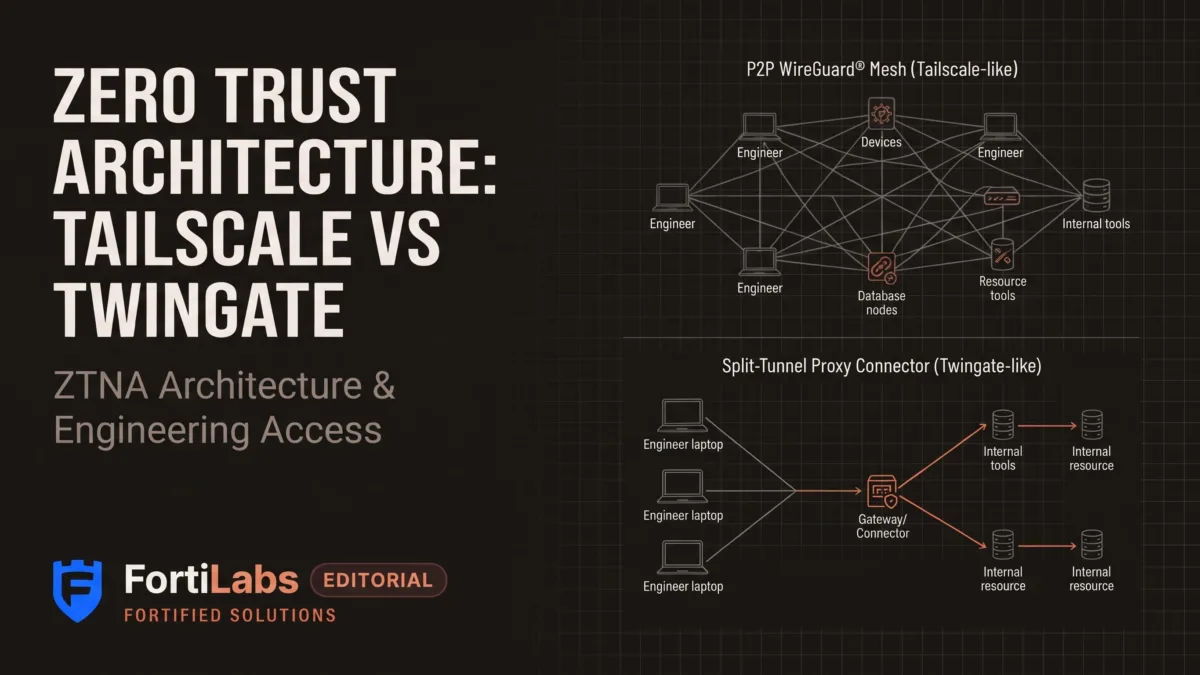
Tailscale is generally the stronger fit when engineering teams need secure connectivity between developer devices, servers, Kubernetes nodes, and private networks through an identity-aware WireGuard overlay. Its direct peer-to-peer connections, subnet routers, application connectors, and policy-as-code capabilities make it flexible for infrastructure teams that need more than access to a fixed list of internal applications.
Twingate is generally the stronger fit when the main requirement is controlled access to explicitly defined private resources rather than broad network membership. Its Client-and-Connector architecture allows administrators to publish specific applications, hosts, and services while keeping end-user devices outside the underlying private network.
Neither platform automatically makes an environment zero trust. The result depends on identity lifecycle management, device controls, least-privilege policies, resource segmentation, monitoring, and reliable access revocation.
Why legacy VPN concentrators create friction for engineering teams
Traditional remote-access VPNs commonly authenticate a user and then place the device on a routed network or grant it access to a broad collection of internal routes. This can work for a relatively small office environment, but the model becomes difficult to govern when distributed engineering teams need narrowly scoped access to multiple environments.
Consider a developer who needs to inspect a staging API, read logs from one Kubernetes namespace, connect to a development database, and open an internal deployment dashboard. A conventional VPN design may require the client to connect to a central gateway, receive routes for large internal subnets, and rely on additional firewall rules to restrict what the user can actually reach.
Where the traditional model becomes problematic
- Excessive network reachability: A compromised developer laptop may inherit access to internal address ranges that are much broader than the user’s actual responsibilities.
- Concentrated capacity and availability: VPN concentrators can become throughput bottlenecks and critical infrastructure dependencies as concurrent users, regions, and workloads increase.
- Route and firewall complexity: Overlapping private address ranges, split-tunnel configuration, subnet advertisements, and firewall exceptions create operational overhead.
- Insufficient resource-level intent: Network membership does not inherently express that one engineer may reach a staging database but must not access the production control plane.
- Identity lifecycle gaps: Removing an employee from an identity provider does not automatically guarantee that every VPN account, certificate, device authorization, service credential, and downstream permission has been revoked.
- Inconsistent developer experience: DNS failures, reconnect delays, route conflicts, and regional gateway placement can make ordinary engineering tasks unnecessarily difficult.
The issue is not that every traditional VPN is inherently insecure. A well-designed VPN can still provide encrypted connectivity and strong authentication. The architectural limitation is that broad network access is often the default abstraction, while modern engineering teams increasingly need access decisions at the user, device, application, and resource level.
What changes when engineering teams adopt ZTNA?
Zero Trust Network Access changes the access question from:
Can this device join the corporate network?
to:
Is this user, on this device, authorized to reach this specific resource under the current policy?
A ZTNA architecture typically combines identity verification, resource-level authorization, encrypted connectivity, and contextual access controls. Depending on the platform, device posture and other risk signals can also influence access decisions.
For engineering environments, this means separating access to resources such as:
- Staging APIs and internal development services.
- Production Kubernetes API endpoints.
- Internal Grafana, Prometheus, and observability dashboards.
- Private databases and administrative interfaces.
- SSH-accessible hosts and infrastructure management endpoints.
- CI/CD management systems and internal developer platforms.
ZTNA does not replace cloud IAM, Kubernetes RBAC, database permissions, host firewalls, or application authentication. It controls an important layer of the access path, but the destination service must still enforce its own authorization.
Tailscale vs Twingate: understanding the architecture
The most useful distinction is not simply “mesh VPN versus proxy.” It is the default connectivity model and the unit of access administration.
Tailscale builds an identity-aware network between enrolled devices and routed resources. Twingate provides access to explicitly defined private Resources through Clients and Connectors, without making the user’s device a general member of the remote network.
How Tailscale builds an identity-aware WireGuard overlay
Tailscale creates a private network called a tailnet. Devices run the Tailscale client and establish encrypted WireGuard connections to other authorized devices. A coordination service distributes peer and network configuration, while the data path is selected dynamically according to network conditions.
Tailscale supports three connection types:
- Direct connection: Devices use NAT traversal to establish a peer-to-peer UDP connection where network conditions permit. This is generally the preferred path for throughput and latency.
- Peer relay: If a direct connection cannot be established, a configured device inside the same tailnet can relay traffic. This is an optional capability that teams must configure.
- DERP relay: If direct connectivity and an available peer relay are not possible, encrypted packets can be relayed through Tailscale’s DERP infrastructure.
DERP also participates in connection discovery and negotiation. It is not accurate to say that all Tailscale traffic continuously passes through DERP servers. Connections initially use relay-assisted negotiation and may upgrade to a direct path when NAT traversal succeeds.
All three connection types use end-to-end WireGuard encryption. A relay forwards encrypted packets; it does not need access to the plaintext application traffic.
Subnet routers and application connectors
Not every private server needs a Tailscale client installed directly. A subnet router can advertise selected private routes into the tailnet, allowing authorized devices to reach systems on a VPC or internal subnet.
Application connectors provide another option for exposing selected services. This can be preferable when the goal is to publish a particular application instead of making a large private network reachable.
These mechanisms make Tailscale flexible, but they also create an important governance responsibility: a broadly advertised route combined with an overly permissive policy can recreate the lateral-movement exposure that a VPN replacement was intended to reduce.
How Twingate uses Clients, Connectors, and Resources
Twingate uses a resource-centric ZTNA architecture. Its core components are the Client, Controller, Connector, and Relay infrastructure.
- Client: Runs on the user’s device, authenticates the user, receives access configuration, and intercepts requests for protected Resources.
- Controller: Coordinates identity, access policy, Resource configuration, and Connector configuration.
- Connector: Runs inside the private network, maintains outbound connectivity, and forwards authorized traffic to private destinations.
- Relay: Provides a connectivity fallback when a direct Client-to-Connector path cannot be established.
Administrators define Resources and assign access to users or groups. A Resource can represent an internal application, hostname, IP address, or service endpoint, depending on the supported configuration.
Twingate attempts direct peer-to-peer connectivity between the Client and Connector. If network conditions prevent a direct path, its Relay infrastructure can provide a fallback.
This is an important distinction: Twingate should not be described as routing every user packet through a central cloud proxy. The Connector is deployed inside the private network and reaches the destination resource; the Relay is a fallback connectivity mechanism, not the mandatory path for every session.
The user device does not need to become a general member of the remote private subnet. Access is centered on the Resources explicitly assigned to that user.
| Architecture area | Tailscale | Twingate |
|---|---|---|
| Primary model | Identity-aware WireGuard overlay network. | Resource-centric ZTNA using Clients and Connectors. |
| Access abstraction | Devices, tagged nodes, routes, and application capabilities governed by policy. | Explicit Resources assigned to users and groups. |
| Preferred data path | Direct peer-to-peer WireGuard connection where possible. | Direct Client-to-Connector connection where possible. |
| Relay fallback | Configured peer relay, then DERP when necessary. | Twingate Relay infrastructure. |
| Private network access | Subnet routers, application connectors, or clients on destination systems. | Connectors deployed inside the relevant private networks. |
| Default administrative focus | Tailnet membership, device identity, routes, and grants. | Resources, remote networks, Connectors, and group assignments. |
| Typical fit | Infrastructure connectivity across devices, servers, and networks. | Narrow access to a curated set of private applications and services. |
Identity integration: Okta, Google Workspace, and device trust
Identity is central to both platforms. Each can integrate with established identity providers, including Okta and Google Workspace, but their provisioning, group synchronization, and plan-specific capabilities should be checked against the current product documentation before procurement.
Tailscale identity integration
Tailscale delegates user authentication to an identity provider rather than maintaining a separate Tailscale password system. Its documented native identity providers include Google Workspace and Okta, alongside other providers. It also supports custom OpenID Connect configurations.
A user’s identity is associated with enrolled devices, allowing tailnet policies to distinguish users and nodes. For infrastructure systems that should not belong to an individual employee, administrators can use device tags and controlled authorization workflows.
This is useful for engineering environments where a developer laptop, a production subnet router, a CI runner, and a Kubernetes administration host should not all inherit the same access simply because they belong to the same organization.
Twingate identity integration
Twingate integrates with identity providers including Google Workspace and Okta. Its documentation distinguishes provider availability by plan: Google Workspace is available across plans, while several enterprise identity integrations are associated with Business and Enterprise plans. Verify current entitlements before designing around a specific integration.
Twingate can synchronize users and groups from supported identity providers. Administrators can use those groups to assign access to Resources, making it possible to align internal application permissions with existing organizational roles.
Identity integration is not the same as complete authorization
A successful SSO login proves that the identity provider authenticated the user. It does not prove that the user should access every production subnet, database, or Kubernetes cluster.
For either platform, implement a complete joiner-mover-leaver workflow:
- Provision users through the organization’s identity source rather than creating unnecessary duplicate accounts.
- Assign access through role-based groups instead of accumulating individual exceptions.
- Apply appropriate device controls to privileged resources, using supported device posture and endpoint-management capabilities.
- Test group changes and offboarding end to end, including active sessions, device authorization, service accounts, and downstream cloud permissions.
- Review privileged access periodically and record who approved exceptions.
- Verify that contractor access expires when the engagement ends.
Private DNS and split-DNS handling
DNS is often one of the most overlooked parts of a remote-access migration. Developers expect internal names such as grafana.internal.example, staging-api.corp.example, and cluster-admin.service.example to resolve consistently without sending every public DNS query through the corporate network.
Tailscale: MagicDNS and restricted nameservers
Tailscale provides MagicDNS for tailnet device names and supports restricted nameservers for split DNS. Administrators can direct queries for selected search domains to the resolver responsible for those zones while leaving unrelated lookups to the device’s normal DNS configuration.
For example, a team can configure a private DNS resolver for corp.example while public domains continue to use the device’s normal resolver path.
DNS configuration must be designed alongside subnet routing and resolver reachability. A client may have a route to a private IP address but still fail to resolve its hostname if the correct resolver is unavailable, the search domain is incorrect, or operating-system DNS behavior conflicts with the intended configuration.
Twingate: resource-aware DNS interception and Connector resolution
Twingate uses a different model for protected Resources. The Client intercepts DNS requests for defined Resources and directs the connection through its protected access path. The Connector then resolves the original hostname using DNS available inside the private network and forwards traffic to the resulting destination.
This means the end-user device does not need direct access to the private DNS resolver. It can be useful when internal hostnames should resolve through the protected access path rather than exposing the private resolver to remote clients.
Correct Resource definitions and Connector-side DNS reachability remain essential. A Resource that the Connector cannot resolve or reach will not become available simply because the user authenticated successfully.
Document private zones, authoritative resolvers, search domains, Resource FQDNs, and fallback behavior before rollout. Test from managed laptops, developer containers, CI runners, and Kubernetes administration workstations. DNS success on one laptop is not proof that every supported client environment behaves identically.
ACL governance as code: GitOps, Terraform, and reviewable access changes
Access policy should be reviewed like application code. A change that grants a developer access to a production database deserves a pull request, a named reviewer, a validation step, and an audit trail—not an undocumented console edit made during an incident.
Tailscale policy files, grants, and GitOps
Tailscale expresses tailnet access policy in HuJSON. Its grants model is the recommended approach for new policies because it supports network-level and application-level permissions. Traditional ACL syntax remains supported.
Policies can define groups, tags, sources, destinations, ports, and other capabilities. Tailscale also supports policy tests so teams can validate intended access and catch unintended permissions before applying a change.
Tailscale documents GitOps workflows that use GitHub Actions, GitLab CI, and Bitbucket to validate and apply policy changes. Its Terraform provider can manage supported tailnet resources, including policy and DNS configuration.
A practical workflow is:
- Store the policy file in a private source-control repository.
- Require pull requests for production policy changes.
- Run policy tests and review the effective access changes.
- Require an additional reviewer for privileged production access.
- Apply approved changes through the controlled GitOps pipeline.
- Retain commit history and investigate unexpected policy drift.
Twingate API and Terraform automation
Twingate provides an Admin API and Terraform integration for automating supported configuration. Teams can manage remote networks, Connectors, Resources, groups, and access assignments through infrastructure-as-code workflows.
For example, when Terraform provisions a new staging environment, the delivery pipeline can deploy the relevant Connector, define the staging API as a Resource, and assign access to the engineering group that owns it.
The teardown workflow should also remove obsolete Resources and permissions. Otherwise, short-lived development environments can leave behind stale access paths that nobody remembers to review.
| Capability | Tailscale | Twingate |
|---|---|---|
| Policy model | HuJSON tailnet policy, with grants recommended for new policies. | Resource, group, user, and access configuration. |
| GitOps approach | Documented Git-based policy validation and application workflows. | Terraform and API-driven configuration workflows. |
| Terraform use | Supported tailnet policy, DNS settings, keys, and other resources. | Supported remote networks, Connectors, Resources, and access configuration. |
| Primary governance risk | Overly broad grants, uncontrolled tags, or accidental route exposure. | Stale Resources, excessive group assignments, or Connector sprawl. |
Infrastructure as code does not automatically make an access model secure. Protect state files and API credentials, separate staging and production workflows, require approvals for privileged changes, and run validation in CI. Treat emergency manual changes as temporary drift that must be reconciled back into source control.
Connection establishment, latency, and real-world performance
Neither architecture guarantees a fixed latency advantage. Actual performance depends on client and Connector placement, NAT behavior, UDP reachability, firewall policy, cloud routing, geographic distance, destination response time, and whether the connection is direct or relayed.
Tailscale connection behavior
Tailscale generally prefers direct WireGuard connections because they avoid an intermediate relay. When direct connectivity cannot be established, an available peer relay can be used; otherwise, traffic can fall back to DERP.
A relayed path may add latency and reduce throughput compared with a direct connection. Strict NAT, blocked UDP traffic, restrictive firewalls, and certain cloud network configurations can make direct connectivity more difficult.
Twingate connection behavior
Twingate also attempts a direct Client-to-Connector connection first. If direct connectivity is unavailable, Relay infrastructure provides a fallback.
Connector placement matters. A Connector deployed far from the private workload, in an overloaded network segment, or without appropriate redundancy can introduce unnecessary latency or availability risk.
What engineering teams should measure
Avoid choosing a platform based on a vendor’s isolated latency claim. Measure the experience developers actually encounter:
- Time from client launch to an authenticated, usable session.
- Time to the first successful connection to a private Resource after login.
- Median and p95 latency to representative staging and production endpoints.
- Throughput for large artifact transfers, database exports, and remote debugging.
- Recovery time after laptop network changes, sleep and resume, or a Connector restart.
- Percentage of sessions using direct versus relayed paths, where the platform exposes that information.
- Failure rates from restrictive networks, mobile hotspots, and remote office connections.
Run tests from the networks developers actually use: home broadband, mobile hotspots, office networks, restrictive hotel Wi-Fi, and cloud-hosted development environments.
Do not publish a universal “X milliseconds faster” claim without a reproducible test design, comparable network conditions, and representative measurements.
Headscale: a self-hosted control-plane option, with important limitations
Headscale is an open-source, self-hosted implementation of the Tailscale control server. It is relevant to teams that want to operate their own coordination plane for a lab, personal environment, or smaller organization.
However, Headscale should not be presented as a fully supported, feature-identical self-hosted edition of the commercial Tailscale service.
Its documented design goal is narrower: it provides a self-hosted alternative to the Tailscale control server for self-hosters, hobbyists, and smaller organizations. It implements a subset of Tailscale functionality, and teams must verify the exact client features, identity integrations, policy capabilities, and operational requirements they depend on.
What self-hosting changes
Operating your own control server transfers additional responsibility to your engineering team:
- Control-server availability and disaster recovery.
- Secure deployment, public exposure, and TLS configuration.
- Backups and state recovery.
- Version upgrades and compatibility testing.
- Monitoring, alerting, and incident response.
- Identity and device lifecycle integration.
- Validation of required features against the current Headscale release.
Self-hosting the coordination plane does not eliminate the need to secure endpoints, the network data path, identity providers, or access policies.
How this compares with Twingate
Twingate’s standard architecture is a managed service with customer-deployed Connectors inside private networks. Organizations evaluating it should assess the service dependency, Connector placement, redundancy, API access, contractual requirements, and the controls available under their selected plan.
The decision is therefore not simply about whether one product is self-hosted. It is about which control-plane responsibilities the organization wants to operate itself and which it is prepared to delegate to a managed service.
Practical deployment patterns for staging, Kubernetes, and internal admin panels
A useful proof of concept should represent real engineering access requirements rather than testing only whether a laptop can connect to a single private web server.
Pattern A: Tailscale for infrastructure connectivity
- Integrate the tailnet with the organization’s identity provider.
- Define separate groups for engineering, platform, SRE, contractors, and privileged administrators.
- Enroll managed developer devices and apply controlled tags to infrastructure nodes.
- Deploy subnet routers only for private routes that are genuinely required.
- Use application connectors or host-level clients where narrower access is preferable to exposing a large subnet.
- Write grants that separate staging from production and restrict sensitive destinations by identity and capability.
- Expose Kubernetes API endpoints only to the platform or approved engineering groups.
- Store access policies in a private Git repository, validate changes, and require review.
- Monitor route advertisements, device enrollment, and unexpected access-policy changes.
Pattern B: Twingate for explicit private-resource access
- Connect the organization’s identity provider and synchronize the groups responsible for engineering resources.
- Deploy redundant Connectors inside each required remote network.
- Define separate Resources for staging dashboards, internal APIs, production administration tools, and approved SSH targets.
- Assign each Resource to the smallest appropriate group.
- Apply stronger device and access controls to sensitive production destinations where supported.
- Use Connector-side private DNS resolution for internal hostnames.
- Validate that each Connector can resolve and reach every defined destination.
- Provision Resources and permissions through Terraform or the Admin API.
- Remove obsolete Resources and permissions when environments are decommissioned.
Kubernetes access requires more than a protected network path
Whichever platform you choose, network access to a Kubernetes API endpoint is only the first authorization layer.
Kubernetes authentication, RBAC, admission controls, namespace boundaries, workload identity, secrets management, and audit logging remain necessary. Do not grant every developer cluster-admin simply because the network path is protected.
A stronger model gives developers access only to the clusters and namespaces required for their responsibilities, while production administrative operations remain restricted to designated platform or SRE roles.
Decision framework: when should engineering teams choose Tailscale or Twingate?
Choose Tailscale when…
- You need secure connectivity between many devices, servers, and private networks.
- Direct peer-to-peer WireGuard paths and flexible routing are important.
- Your platform team is comfortable governing a tailnet with grants, tags, subnet routes, and policy-as-code.
- You need connectivity for infrastructure systems that do not fit neatly into a small list of application Resources.
- You want to evaluate a self-hosted control-plane option through Headscale and accept its narrower scope and operational burden.
Choose Twingate when…
- You want to grant access to specific internal Resources without placing user devices on broad private subnets.
- Private DNS resolution through an in-network Connector fits your environment.
- Your team prefers resource-centric administration and Terraform/API automation.
- You can deploy and monitor Connectors in every required remote network.
- You want to manage access to internal applications through identity-based Resource assignments.
The practical verdict
Tailscale is a compelling choice for engineering organizations that need a flexible identity-aware connectivity fabric across infrastructure. Its WireGuard overlay, direct connectivity, subnet routing, application connectors, and grants model provide a broad set of networking capabilities.
Twingate is compelling when the primary control objective is to publish a curated set of private Resources to defined users and groups. Its Client-and-Connector model can make resource-level access easier to understand and govern without making remote devices members of private subnets.
For teams with both requirements, a proof of concept should test the actual workflows rather than forcing every use case into one abstraction.
Start with the same identity groups, two private DNS zones, one staging VPC, one production Kubernetes API, and one internal admin panel. Test contractor expiry, device loss, DNS failure, relay fallback, Connector unavailability, policy rollback, and user offboarding.
The better platform is the one your team can operate securely under real failure conditions—not simply the one that is fastest to install.
Frequently asked questions
Is Tailscale a ZTNA solution or a mesh VPN?
Tailscale is an identity-aware networking platform built around WireGuard connectivity. It is often described as a mesh VPN, but its identity, policy, routing, and application capabilities can support ZTNA-style access patterns. The security outcome depends on restrictive policies and endpoint governance.
Is Twingate traffic always routed through a central proxy?
No. Twingate attempts a direct connection between the Client and Connector. Relay infrastructure is used as a fallback when direct connectivity cannot be established. The Connector is deployed inside the private network and forwards authorized traffic to the destination Resource.
Does Tailscale send all traffic through DERP?
No. Tailscale uses DERP for connection negotiation and as a fallback relay. When NAT traversal succeeds, devices communicate directly over an encrypted WireGuard connection. If direct connectivity fails, a configured peer relay can be used before DERP.
Can Tailscale and Twingate integrate with Okta and Google Workspace?
Both document support for Okta and Google Workspace. Tailscale delegates authentication to its configured identity provider. Twingate supports identity-provider integrations and user or group synchronization, with some provider capabilities depending on the selected plan.
Which platform handles private DNS better?
They use different models. Tailscale supports MagicDNS and restricted nameservers for split DNS. Twingate intercepts DNS requests for protected Resources and has the Connector resolve the original private hostname from inside the remote network. The better fit depends on whether your team wants tailnet DNS configuration or resource-specific access through Connectors.
Can Headscale completely replace Tailscale?
Not as a guaranteed feature-for-feature replacement. Headscale is a self-hosted implementation of the Tailscale control server with a narrower documented scope. Validate required features and accept the operational responsibility before using it for production access.
Which platform is better for production Kubernetes access?
Either can provide a protected network path to a Kubernetes API endpoint. Neither replaces Kubernetes authentication or RBAC. Choose based on whether you need broader infrastructure connectivity or tightly defined Resource access through Connectors, then enforce least privilege inside the cluster.
Does adopting ZTNA mean an organization can remove every VPN?
Not necessarily. Some organizations retain VPN access for legacy systems, specialized network protocols, or migration periods. A phased rollout can reduce risk while teams validate application compatibility, access policies, DNS behavior, and operational readiness.
Technical references
Architecture and capability details were checked against official product documentation. Product behavior, supported integrations, and plan availability can change; verify current documentation before implementation.
- Tailscale: Connection types
- Tailscale: Device connectivity
- Tailscale: DERP servers
- Tailscale: Peer relays
- Tailscale: Grants and access control
- Tailscale: GitOps
- Tailscale: Terraform provider
- Tailscale: Supported identity providers
- Tailscale: DNS and split DNS
- Twingate: Architecture
- Twingate: How DNS works
- Twingate: Identity providers
- Twingate: Admin API
- Twingate: Terraform documentation
- Headscale: Official documentation