Programmatic advertisers can lose budget to Made-for-Advertising (MFA) websites, automated traffic, hidden ad refreshes and increasingly sophisticated bot activity. The solution is not simply to block suspicious websites after a campaign has run. Advertisers need a layered verification strategy that filters risky opportunities before bidding, measures delivered impressions after the auction, and feeds confirmed fraud intelligence back into future buying decisions.
Short answer: Pre-bid verification helps a DSP avoid paying for suspicious inventory in the first place. Post-bid verification identifies invalid impressions and suspicious delivery after the auction, supporting reporting, billing adjustments and future exclusions. DoubleVerify (DV) and Integral Ad Science (IAS) offer established verification capabilities, while specialist providers such as HUMAN and Pixalate offer additional fraud-focused tools. For sophisticated invalid traffic, evaluate both stages and check the exact MRC accreditation scope rather than relying on a vendor’s overall accreditation claim.
The practical recommendation: Combine pre-bid IVT and MFA controls with post-bid measurement, supply-path analysis and independent reconciliation. Treat MFA quality and invalid traffic as related but separate problems: a real human can visit a low-value MFA site, while a sophisticated bot can generate fraudulent activity on an otherwise legitimate publisher.
1. Why are MFA websites and automated traffic a programmatic problem?
Made-for-Advertising websites are built primarily to monetize advertising rather than provide a genuinely useful content experience. They often attract visitors through inexpensive paid traffic, sensational headlines, generic articles or clickbait, then maximize advertising revenue through high ad density, intrusive placements and frequent refreshes.
The problem is not limited to whether a website is technically legitimate. A real person can visit an MFA website, generate a valid page view and still deliver little commercial value to an advertiser. Conversely, automated traffic can imitate human browsing behavior, generate artificial impressions and clicks, or manipulate engagement signals on otherwise legitimate websites.
How large is the documented MFA problem?
The ANA’s 2023 Programmatic Media Supply Chain Transparency Study found that MFA websites represented 21% of impressions and 15% of advertising spend in its study. These findings were an important warning about inventory quality, but they should not be interpreted as a universal, current percentage for every advertiser or exchange.
Later ANA benchmark reporting documented a reduction in MFA spending among participating advertisers. Its 2024 benchmark, reported in January 2025, showed MFA spending falling from 15% in the 2023 study to 6.2% in the 2024 study. A later 2025 benchmark also showed substantial progress, while identifying advertisers that continued to allocate significant portions of their budgets to MFA inventory.
The takeaway is not that every campaign loses a fixed percentage of its budget. It is that MFA exposure varies considerably by buying strategy, supply path, inventory definition and advertiser controls. A campaign-level audit is more useful than applying an industry-wide estimate to every media plan.
Sources: ANA 2023 study findings, WFA’s summary of the 2024 benchmark, and the ANA 2025 Programmatic Transparency Benchmark.
Why MFA inventory can look legitimate in campaign reports
- Low CPMs: Cheap inventory can make campaigns appear cost-efficient even when the audience has limited commercial value.
- High ad density: A page can contain numerous advertising placements relative to its useful content.
- Frequent refreshes: Some publishers repeatedly reload or replace ad slots, generating additional impressions without a meaningful increase in audience attention.
- Paid traffic arbitrage: Publishers may purchase inexpensive traffic and monetize it through higher-value advertising inventory.
- Misleading engagement: Automated or low-quality traffic can distort impressions, clicks, viewability and conversion signals.
These patterns require different detection methods. MFA classification evaluates the quality and monetization behavior of a publishing environment. IVT detection evaluates whether the activity behind an impression or interaction is valid. Treating both as one fraud score creates blind spots.
2. Pre-bid vs post-bid verification: What is the difference?
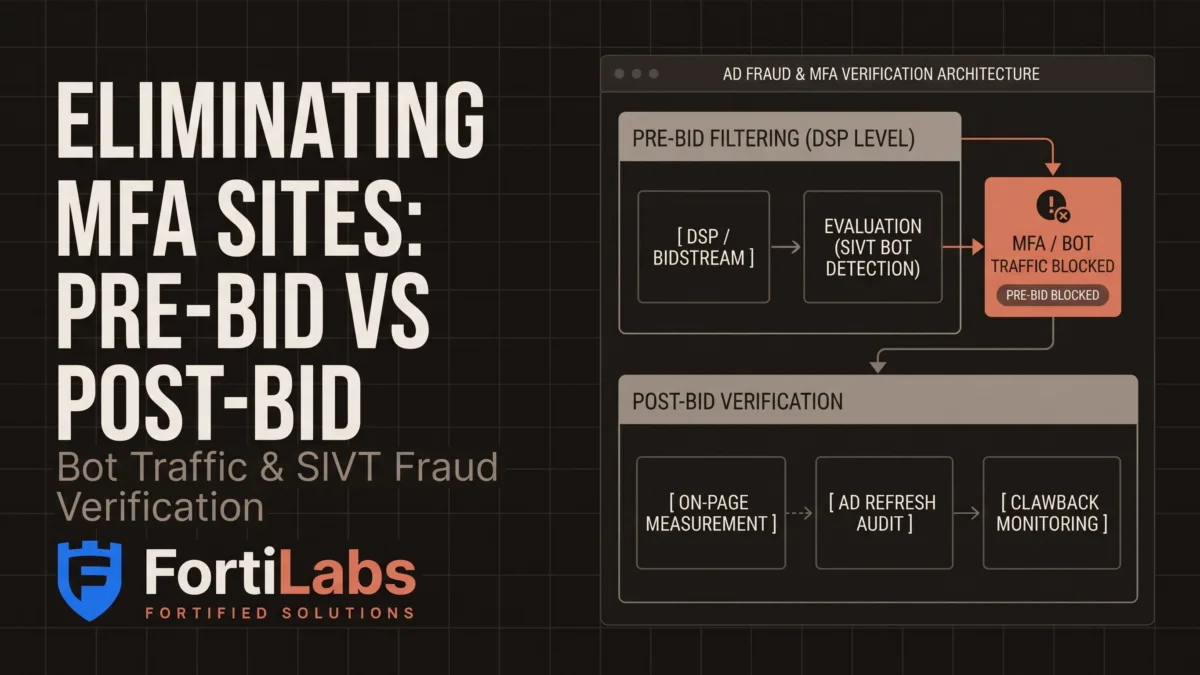
Pre-bid and post-bid verification operate at different points in the programmatic transaction. Pre-bid systems evaluate a bid opportunity before the DSP decides whether to participate. Post-bid systems examine the resulting ad delivery and its surrounding signals after an impression has been served or rendered.
| Factor | Pre-bid verification | Post-bid verification |
|---|---|---|
| Timing | Before the DSP submits a bid | After the bid and subsequent ad delivery |
| Primary purpose | Avoid risky opportunities | Measure and identify problematic delivery |
| Typical signals | Bid-request metadata, domain, IP, user agent, reputation and available supply signals | Rendered impression data, browser behavior, device signals, page context and interaction patterns |
| Main advantage | Prevents some wasted bids and impressions | Provides deeper evidence and campaign-level measurement |
| Main limitation | Cannot inspect every signal that only exists after rendering | Detection happens after the transaction and may require billing remediation |
| Best application | Real-time avoidance and inventory filtering | Fraud measurement, investigation, reconciliation and feedback |
How does pre-bid filtering work?
In a typical OpenRTB workflow, a publisher or supply-side platform sends a bid request to a DSP. The request may contain information such as the domain, app identifier, device details, IP address, user agent, placement and available supply-chain data.
The DSP can consult its own risk engine or an integrated verification provider. That provider evaluates the available signals and returns a risk classification or eligibility decision. The DSP then decides whether to bid.
- A publisher makes an advertising opportunity available.
- The SSP sends a bid request through the programmatic supply chain.
- The DSP evaluates the opportunity using pre-bid verification signals.
- Risky opportunities are excluded according to campaign policy.
- The DSP bids only when the opportunity meets its eligibility requirements.
For example, if a bid request comes from a domain classified as high-risk MFA inventory or an IP associated with known automated traffic, the DSP can avoid the opportunity rather than paying for an impression that is unlikely to meet campaign standards.
However, pre-bid decisions are limited by the information available at that moment. A bid request does not necessarily reveal the final rendered page, the exact number of advertisements visible, or the behavior that occurs after the ad loads.
How does post-bid verification work?
Post-bid verification examines the impression after the auction. Depending on the integration and format, a verification tag, server-side event stream or other measurement mechanism collects additional information about the delivery environment.
- The DSP wins an auction and serves the advertisement.
- The verification system measures the impression and available delivery signals.
- Detection models classify activity as valid, GIVT, SIVT or another risk category.
- Campaign reports identify suspicious domains, placements, devices and traffic patterns.
- Advertisers investigate flagged impressions, apply contractual billing procedures and update future buying controls.
Post-bid measurement is particularly useful for detecting behavior that cannot be established from a bid request alone. It can reveal suspicious browsing patterns, hidden automation, rendered-page characteristics and discrepancies between declared and observed delivery environments.
Importantly, post-bid detection does not automatically mean that an advertiser receives money back. Billing credits, deductions and clawbacks depend on the contract, measurement rules, evidence, reporting deadlines and the buying platform’s reconciliation process.
Why should advertisers use both?
Pre-bid filtering and post-bid monitoring solve different parts of the problem. If an advertiser uses only pre-bid filtering, it may miss new fraud patterns or activity that becomes visible after rendering. If it uses only post-bid measurement, it may identify waste after the advertiser has already participated in the auction.
A closed-loop approach uses post-bid findings to improve future pre-bid decisions. This creates a continuous feedback process rather than treating verification as a report generated at the end of a campaign.
3. GIVT vs SIVT: What does MRC accreditation actually prove?
Invalid traffic (IVT) is not a single category. The Media Rating Council (MRC) distinguishes between General Invalid Traffic (GIVT) and Sophisticated Invalid Traffic (SIVT). Understanding the difference is essential when comparing verification vendors.
What is General Invalid Traffic (GIVT)?
GIVT generally includes traffic that can be identified through routine or list-based methods. Examples include known crawlers, declared bots, certain data-center traffic, non-browser user agents and other recognizable automated activity.
GIVT is important because it can often be detected through established lists, parameter checks and straightforward filtering rules. However, a low GIVT rate does not prove that a campaign is free from more advanced fraud.
What is Sophisticated Invalid Traffic (SIVT)?
SIVT requires more advanced analysis, corroboration across multiple signals or investigation. Examples can include:
- Hijacked devices and compromised environments.
- Automated browsing designed to imitate human activity.
- Manipulated ad tags or injected advertisements.
- Domain or app misrepresentation.
- Malware-related traffic and other evasive automation.
- Coordinated activity that attempts to evade ordinary bot filters.
A sophisticated bot may use residential IP addresses, realistic browser fingerprints, human-like timing and simulated interactions. A basic IP blocklist or user-agent check may therefore be insufficient.
| Characteristic | GIVT | SIVT |
|---|---|---|
| Detection approach | Routine checks and known lists | Advanced analytics and corroborated signals |
| Typical examples | Known crawlers, declared bots and non-browser agents | Hijacked devices, injected ads and evasive automation |
| Detection difficulty | Generally lower | Higher and continuously evolving |
| Why it matters | Removes recognizable invalid activity | Finds more complex fraud that routine filtering can miss |
Does MRC accreditation mean a vendor blocks every fraudulent impression?
No. MRC accreditation is tied to specific measurement or detection processes, metrics and environments. It is not a guarantee that every type of fraud will be detected, that every impression will be blocked before a bid, or that all vendor products carry the same accreditation.
For example, the MRC’s current digital accreditation directory lists DoubleVerify’s Quality Analytics Platform for SIVT detection and filtration across desktop, mobile web, mobile in-app and CTV. Its pre-bid IVT accreditation is also listed, with scope notes explaining availability by customer arrangement.
IAS is listed for SIVT detection and filtration across desktop, mobile web, mobile in-app and CTV. Its pre-bid IVT accreditation has a narrower description: avoidance based on specified IP and user-agent segments and a Fraud IP List.
These distinctions matter. An advertiser should check the actual accreditation letter, format, device environment, metric and stage of measurement before treating two providers as equivalent.
Reference: MRC Digital Accreditation Directory.
4. DoubleVerify vs IAS vs specialist anti-fraud platforms
DoubleVerify and Integral Ad Science are established independent verification providers with capabilities spanning fraud, media quality and brand suitability. Specialist platforms such as HUMAN and Pixalate provide additional options for organizations that need deeper traffic analysis, platform-level protection or more granular fraud intelligence.
The right choice depends on the buying environment, DSP integrations, format coverage, reporting requirements and the specific fraud problem being addressed. A vendor’s overall product description is not a substitute for verifying its current accreditation and technical scope.
DoubleVerify (DV)
DoubleVerify provides advertising verification capabilities covering invalid traffic, brand suitability, viewability and media quality. Its fraud offering is designed to operate across the media transaction, including pre-bid avoidance and post-bid monitoring.
DV describes its fraud coverage as including GIVT and SIVT, with examples such as bot fraud, hijacked devices and injected advertisements. Its DV Authentic Ad metric combines several quality conditions, including the opportunity to be seen by a human in a brand-suitable environment and the intended geography.
For buyers, the practical advantage is the ability to combine fraud controls with broader media-quality reporting rather than managing every verification category in a separate workflow.
Evaluate DV for:
- Pre-bid IVT avoidance through supported DSP integrations.
- Post-bid GIVT and SIVT detection and reporting.
- Media-quality measurement alongside fraud analysis.
- Brand suitability and viewability controls.
- Supply-refinement workflows and MFA-related inventory controls, subject to the selected product and integration.
What to verify: Ask which pre-bid segments are available for your DSP, whether filtering operates at the domain, placement or impression level, and which reporting fields are available for post-bid reconciliation. Confirm whether the exact product and media environment are included in the current MRC accreditation scope.
Official reference: DoubleVerify Fraud Verification.
Integral Ad Science (IAS)
Integral Ad Science offers fraud and media-quality protection through pre-bid and post-bid processes. IAS describes its pre-bid fraud avoidance as using bid-request information such as URLs, app bundle identifiers and available IP information to help DSP partners decide whether to bid.
Its post-bid measurement can collect additional signals from the rendered advertising environment. IAS explains that its post-bid approach can inspect information that may not have been available in the original bid request.
This distinction is important for sophisticated fraud: a pre-bid decision can use reputation and request-level signals, while post-bid analysis can evaluate the delivered impression using a wider set of observations.
Evaluate IAS for:
- Pre-bid IVT avoidance through supported DSP integrations.
- Post-bid GIVT and SIVT measurement.
- Viewability and broader media-quality controls.
- Fraud analysis across supported display, video, mobile and CTV environments.
- Integration with existing campaign measurement and reporting processes.
What to verify: Ask for the exact pre-bid segment definitions, supported DSPs, IP and user-agent requirements, post-bid tag coverage, reporting latency and current MRC accreditation documentation. Do not assume that every post-bid detection capability is also available as a pre-bid exclusion.
Official reference: IAS’s multi-tiered approach to combating ad fraud.
HUMAN Security
HUMAN is particularly relevant when sophisticated automated traffic is a central concern. Its advertising protection architecture pairs MediaGuard for pre-bid prediction with FraudSensor for post-bid detection.
MediaGuard evaluates OpenRTB bid-object information to estimate whether an opportunity is likely to represent invalid traffic. FraudSensor analyzes delivered impressions using detection tags and additional device, network and behavioral signals. HUMAN documents a feedback loop in which post-bid findings help refine pre-bid predictions.
This architecture is useful because advanced bot activity can evade basic lists. A detection system needs to learn from observed behavior, not simply rely on a static collection of known bad IP addresses.
Evaluate HUMAN for:
- Pre-bid prediction and filtering of suspicious bid requests.
- Post-bid detection of sophisticated invalid traffic.
- Feedback between observed impressions and future pre-bid decisions.
- Platform and supply-side fraud protection use cases.
What to verify: Confirm the current accreditation scope for the relevant HUMAN products, channels and environments. Also determine whether the integration is designed for an advertiser’s DSP, a publisher, an SSP or a programmatic platform; these deployment models are not interchangeable.
Official references: MediaGuard overview and FraudSensor overview.
Pixalate
Pixalate provides fraud analytics, blocking and supply-quality intelligence across digital advertising environments. Its platform is relevant for buyers that need detailed IVT classifications, risk information and analysis of suspicious inventory.
Its published IVT reason-code documentation includes categories such as auto-refresh fraud, fraudulent user agents, invalid prefetch traffic and other irregular patterns. This is particularly useful when an advertiser wants to investigate the behavior behind a flagged impression rather than rely only on a broad fraud percentage.
Evaluate Pixalate for:
- Post-bid IVT and SIVT analytics.
- Pre-bid blocking and risk-based inventory controls.
- Detailed fraud reason codes and supply-quality analysis.
- Investigation of auto-refresh and other irregular traffic patterns.
- Desktop, mobile, in-app and CTV use cases, subject to the relevant product scope.
What to verify: Confirm whether the required reason codes are available in the chosen product, how risk scores are generated, how blocking lists are refreshed and which metrics are independently accredited for the environments being purchased.
Official references: Pixalate Ad Fraud Protection and Pixalate’s IVT reason-code API update.
Vendor comparison at a glance
| Provider | Pre-bid capabilities | Post-bid capabilities | Best evaluation focus |
|---|---|---|---|
| DoubleVerify | IVT avoidance and supported quality segments | GIVT, SIVT and media-quality measurement | Combined verification and media-quality workflows |
| IAS | IP- and user-agent-based IVT avoidance through supported integrations | GIVT, SIVT and broader impression verification | Layered fraud detection and rendered-impression analysis |
| HUMAN | MediaGuard bid-request risk prediction | FraudSensor impression-level detection | Sophisticated bot and automated traffic defense |
| Pixalate | Risk-based blocking and fraud intelligence | IVT/SIVT analytics and reason-code reporting | Granular fraud investigation and supply-quality analysis |
Important: This is a capability-oriented comparison, not a performance ranking. Product availability, DSP integrations, pricing, supported formats and accreditation status can change. Confirm current documentation and contractual coverage before selecting a provider.
5. MFA detection, ad refresh manipulation and ad clutter scoring
IVT detection alone cannot identify every low-quality advertising environment. MFA classification requires a separate assessment of publisher behavior, content quality, monetization patterns and the advertising experience.
How do verification systems identify MFA websites?
MFA detection typically combines multiple signals rather than relying on one domain label. Depending on the vendor and product, relevant indicators can include:
- High advertising density compared with useful editorial content.
- Large volumes of low-quality or repetitive content.
- Unusually high reliance on paid or low-quality referral traffic.
- Frequent advertising refreshes and aggressive monetization behavior.
- Low-value page experiences, intrusive placements and poor navigation.
- Traffic and monetization patterns that suggest arbitrage rather than an audience-led publishing business.
No single indicator proves that a website is MFA. A legitimate publisher may have a high advertising load on a particular page, while an MFA publisher may operate pages that appear normal in a superficial review. Classification should use a documented methodology and allow for human review and advertiser-specific exclusions.
What is ad refresh manipulation?
Ad refresh occurs when an advertising placement is refreshed or replaced with another advertisement while a page remains open. Refreshing is not automatically fraudulent. Publishers may use legitimate refresh policies when placements remain viewable and comply with applicable platform and industry rules.
The problem arises when refresh behavior artificially inflates impression volume or creates repeated monetization opportunities without a meaningful user experience. Examples include:
- Refreshing slots too frequently.
- Refreshing placements that are not viewable.
- Generating repeated impressions from inactive or unattended pages.
- Using automation to trigger refresh events.
- Misrepresenting refresh behavior or failing to disclose it accurately.
Detection can combine timestamp patterns, impression sequences, page visibility, viewability signals, interaction history and traffic-source reputation. Pixalate, for example, publishes an IVT reason-code taxonomy that includes auto-refresh fraud. Buyers should ask vendors whether refresh detection is classified as GIVT, SIVT or another risk category in each particular case; the classification depends on the behavior and detection method.
What is ad clutter scoring?
Ad clutter scoring evaluates how crowded or intrusive an advertising environment is. It can consider the number of advertising placements, their size, their proximity to content, competing elements and the overall advertising load on a page.
For example, a page with several large advertisements, overlapping units, sticky placements and repeated refreshes may offer a poor user experience even if its impressions are technically valid.
Ad clutter is therefore a media-quality concern, not automatically an IVT classification. It should be evaluated alongside viewability, MFA risk and brand suitability.
What should advertisers demand from MFA and clutter scoring?
- Transparent definitions: Request the indicators and thresholds behind each score.
- Domain and placement detail: Ask whether reporting is available at domain, page, placement and impression level.
- Refresh intelligence: Request refresh frequency, visibility and suspicious sequence indicators where available.
- Independent validation: Distinguish proprietary quality scores from MRC-accredited IVT measurement.
- Actionable controls: Confirm that flagged inventory can be excluded through the DSP or buying platform.
- False-positive review: Establish an appeal and reclassification process for legitimate publishers.
A vendor may provide an MFA classification, clutter score or supply-refinement segment without that score itself being an MRC-accredited metric. Accreditation for IVT measurement should not be treated as independent validation of every proprietary inventory-quality score.
6. Can verification tools detect agentic AI bots and sophisticated automation?
Automated traffic is evolving beyond simple scripts that repeatedly request a page or click an advertisement. More capable automation can use browser automation, realistic interaction timing, changing network identities and AI-driven workflows to imitate human browsing.
The term agentic AI bot describes systems that can plan and execute multi-step tasks with limited human supervision. In advertising, such systems may create traffic patterns that are harder to classify using static rules alone. However, not every AI agent is fraudulent. Legitimate crawlers, accessibility tools, testing agents and user-authorized automation should not automatically be classified as invalid traffic.
Why can traditional bot filters fail?
Basic detection methods often depend on recognizable indicators such as known bot IP addresses, unusual user-agent strings or data-center network ranges. More advanced automation can vary these signals or use legitimate-looking devices and networks.
For this reason, effective detection requires several layers of evidence:
- Device intelligence: Identify suspicious device characteristics and inconsistent browser environments.
- Network reputation: Evaluate IP, proxy, hosting and connection patterns without treating any single signal as definitive.
- Behavioral analysis: Examine interaction timing, navigation sequences, repeated patterns and unrealistic engagement.
- Impression integrity: Verify whether the advertising event occurred in the expected environment.
- Cross-event correlation: Identify repeated patterns across impressions, clicks, domains, devices and campaigns.
- Post-bid feedback: Use confirmed detections to improve future pre-bid decisions.
Why is behavioral evidence important?
A single impression may look legitimate when inspected in isolation. A larger sequence may reveal that thousands of devices are performing nearly identical actions, navigating pages in unnatural patterns or generating repeated advertising events without credible human engagement.
Behavioral analysis and correlation help distinguish suspicious automation from ordinary traffic. This is one reason post-bid measurement remains important even when a campaign already uses pre-bid blocking.
HUMAN’s documented MediaGuard and FraudSensor architecture illustrates this relationship: pre-bid predictions evaluate opportunities using bid-request information, while post-bid analysis provides additional evidence from delivered impressions. That evidence can feed back into future detection models.
Reference: HUMAN’s pre-bid and post-bid feedback architecture.
Implementation principle: Do not attempt to block every unusual automated request. Use evidence-based risk scoring, distinguish legitimate automation from fraudulent behavior, and document the reason for each exclusion.
7. How to build a layered programmatic verification architecture
A reliable fraud-prevention strategy combines DSP-side controls, independent verification, publisher-quality intelligence and post-bid reconciliation. The exact architecture depends on whether the organization is an advertiser, agency, DSP, SSP or publisher.
Layer 1: Establish inventory standards before buying
Define what acceptable inventory means for the campaign. Establish rules for MFA exposure, IVT, brand suitability, viewability, ad clutter and supply-path transparency.
Use inclusion lists for high-priority campaigns where suitable inventory can be identified in advance. Exclusion lists are still useful, but they cannot cover every low-quality domain or newly created fraud source.
Layer 2: Apply pre-bid controls inside the DSP
Integrate verification segments or risk signals with the DSP and define which opportunities should be excluded. Apply different thresholds for different campaign objectives rather than using a universal risk setting for every advertiser.
For example, a campaign focused on broad reach may tolerate more inventory diversity than a campaign with strict suitability requirements. Fraud prevention should remain mandatory, but inventory-quality decisions can reflect the campaign’s objectives.
Layer 3: Measure delivered impressions independently
Deploy post-bid measurement using supported tags, integrations or server-side methods. Collect sufficient detail to investigate suspicious delivery, including the campaign, publisher, placement, device environment, timestamp and available supply-chain information.
Where possible, retain log-level data so that advertisers can reconcile vendor reports with DSP and SSP records. Aggregate percentages alone are not sufficient for investigating individual domains or disputed transactions.
Layer 4: Analyze MFA and page-quality signals separately
Use inventory-quality intelligence to assess content, ad density, refresh behavior and publisher monetization patterns. Keep these classifications separate from IVT reporting so that legitimate human traffic on low-quality inventory is not incorrectly labeled as bot fraud.
Layer 5: Create a fraud feedback loop
Feed confirmed post-bid detections into future buying decisions. Depending on the available integration, this can involve updated domain exclusions, publisher-level restrictions, IP or device risk signals and revised DSP targeting rules.
Maintain a review process for new exclusions. Automatically blocking every domain with one suspicious impression can create false positives and remove legitimate inventory unnecessarily.
Layer 6: Reconcile billing and enforce contractual remedies
Establish a process for reviewing invalid impression reports, submitting disputes, documenting evidence and requesting credits where the contract permits. Define reporting deadlines, accepted measurement providers, treatment of GIVT and SIVT, and the process for resolving disagreements between measurement systems.
| Stage | Control | Expected output |
|---|---|---|
| Planning | Define MFA, IVT and media-quality policies | Campaign inventory standards |
| Pre-bid | DSP verification segments and risk checks | Eligible bid opportunities |
| Delivery | Independent impression measurement | Observed delivery records |
| Analysis | GIVT, SIVT, MFA and clutter investigation | Classified quality findings |
| Optimization | Update exclusions and risk models | Improved future buying decisions |
| Reconciliation | Review invalid impressions and contractual credits | Documented billing adjustments |
8. How should advertisers measure fraud prevention and recovered spend?
A low reported IVT percentage does not automatically mean a campaign is clean. It may reflect effective prevention, incomplete measurement coverage, different vendor definitions or a change in the mix of purchased inventory.
Advertisers should track several measures together and compare them across campaigns, DSPs, supply paths and reporting periods.
Key metrics to monitor
- Pre-bid avoidance rate: The share of evaluated opportunities excluded by pre-bid rules. This measures filtering activity, not necessarily confirmed fraud.
- Post-bid GIVT rate: The proportion of measured impressions classified as general invalid traffic.
- Post-bid SIVT rate: The proportion of measured impressions classified as sophisticated invalid traffic.
- MFA spend share: The portion of advertising spend allocated to domains classified as MFA under the chosen methodology.
- Ad refresh anomaly rate: The proportion of measured activity showing suspicious refresh behavior.
- Ad clutter exposure: The share of impressions delivered in environments that exceed the advertiser’s clutter thresholds.
- Viewability: The share of impressions meeting the applicable viewability measurement criteria.
- Invalid impression cost: The estimated spend associated with confirmed invalid impressions, using the agreed measurement and billing methodology.
- Dispute recovery rate: The proportion of eligible disputed spend successfully credited or otherwise resolved.
How do you calculate invalid traffic cost?
A simple estimate can be calculated using the measured invalid impression volume and the effective media cost per impression.
Estimated invalid traffic cost =
  (Invalid impressions / 1,000) × Effective CPM
For example, if a campaign records 100,000 confirmed invalid impressions at an effective CPM of $5:
(100,000 / 1,000) × $5 = $500This is an illustrative media-cost estimate, not an automatic refund entitlement. The amount eligible for a credit depends on the contract, invoice methodology, measurement provider and whether the impressions qualify under the agreed invalid-traffic policy.
How should recovered spend be reported?
Separate three outcomes in reporting:
- Prevented spend: Estimated spend avoided because a pre-bid system excluded an opportunity. This is generally modeled rather than a cash refund.
- Detected invalid spend: Spend associated with impressions identified as invalid after delivery.
- Recovered spend: Actual credits, refunds or billing deductions confirmed by the relevant buying or selling partner.
Combining these numbers into one savings figure can exaggerate financial performance. Report estimated prevention separately from confirmed cash or invoice recovery.
How can advertisers compare verification providers fairly?
Run a controlled comparison using the same campaign, buying environment, inventory scope and measurement period. Compare each provider’s coverage, classifications, false-positive review process, reporting detail and integration reliability.
Do not assume that two vendors’ IVT percentages are directly comparable. Different tags, environments, measurement windows, filtration rules and accreditation scopes can produce different results. Reconcile definitions before interpreting a difference as superior detection performance.
9. Vendor evaluation checklist: What should buyers ask?
Before selecting a verification provider, request a technical demonstration and written documentation covering the following areas.
Accreditation and detection coverage
- Is the specific product currently MRC-accredited for the metric being evaluated?
- Does the accreditation cover GIVT, SIVT or both?
- Does it apply to desktop, mobile web, mobile apps and CTV?
- Is pre-bid detection accredited, and what exact traffic categories does it cover?
- Can the vendor provide the latest accreditation letter and scope limitations?
Pre-bid integration
- Which DSPs and programmatic environments support the integration?
- Does the system evaluate bid requests in real time?
- Which bid-request fields are required?
- Are decisions available at the impression, domain, publisher or supply-path level?
- What happens when the verification service is unavailable or times out?
- Can advertisers review excluded opportunities and their reason codes?
Post-bid verification and reporting
- Which signals are collected after the ad renders?
- How are GIVT and SIVT separated in reports?
- Can reports identify suspicious domains, placements and refresh patterns?
- Are impression-level records or log-level exports available?
- How quickly are findings available?
- Can reports be reconciled with DSP and SSP delivery records?
MFA and ad-quality controls
- How does the vendor define an MFA website?
- Does its methodology account for content quality, traffic sourcing and ad density?
- Can the system detect suspicious ad refresh behavior?
- Are ad clutter and MFA scores independently accredited or proprietary?
- Can advertisers configure thresholds and review false positives?
- Can the system block inventory before bidding, or does it only provide post-bid reporting?
Commercial and operational requirements
- Is pricing based on impressions, media spend, seats, platform access or a combination?
- Are pre-bid segments and post-bid measurement charged separately?
- Who owns the billing dispute and credit-request process?
- What are the contractual deadlines for reporting invalid traffic?
- How are disagreements between verification vendors resolved?
- Can the provider demonstrate measurable improvements in the advertiser’s actual buying environment?
10. The right strategy is prevention, measurement and accountability
Programmatic fraud cannot be solved with one blocklist, one MFA score or a single verification tag. MFA websites, ad refresh manipulation and sophisticated bots represent different inventory-quality and traffic-integrity problems. They need to be measured separately and addressed through coordinated controls.
DoubleVerify and IAS are strong candidates for organizations seeking established verification workflows that combine fraud measurement with broader media-quality controls. HUMAN deserves evaluation where sophisticated bot activity and pre-bid/post-bid feedback are central requirements. Pixalate is worth assessing when detailed fraud reason codes, supply-quality intelligence and refresh-related analysis are important.
The strongest architecture combines pre-bid avoidance, post-bid GIVT and SIVT measurement, MFA and clutter analysis, supply-path transparency and a documented billing-reconciliation process.
Ultimately, the goal is not simply to report fewer invalid impressions. It is to ensure that more of the advertising budget reaches genuine audiences in useful, measurable and brand-appropriate environments.
Frequently asked questions
What is the difference between pre-bid and post-bid fraud detection?
Pre-bid fraud detection evaluates an advertising opportunity before the DSP submits a bid, allowing it to avoid suspicious inventory. Post-bid detection analyzes delivered impressions and identifies invalid traffic after the auction. Pre-bid prevents some waste, while post-bid provides measurement, investigation and evidence for potential billing adjustments.
What does MFA mean in programmatic advertising?
MFA stands for Made for Advertising. It describes websites built primarily to generate advertising revenue, often through low-value content, paid traffic, high ad density and aggressive monetization. MFA inventory can receive genuine human visits, so MFA classification is not the same as bot or IVT detection.
What is the difference between GIVT and SIVT?
GIVT is general invalid traffic that can often be identified through routine checks and known lists, such as declared bots and recognized crawlers. SIVT is more sophisticated invalid traffic that requires advanced analytics, corroborated signals or investigation, such as hijacked devices, injected advertisements and evasive automation.
Are DoubleVerify and IAS MRC-accredited?
Both providers are listed in the MRC’s digital accreditation directory for specified measurement and invalid-traffic processes. However, accreditation is tied to particular products, metrics, environments and detection stages. Buyers should review the latest MRC directory and accreditation letters instead of assuming every product or feature is covered.
Which is better for ad fraud detection: DoubleVerify or IAS?
Neither is universally better. Both offer pre-bid and post-bid verification capabilities, but their integrations, segment availability, reporting and accreditation scope differ. Compare them using the same DSP, campaign formats, measurement definitions and reporting requirements.
Can pre-bid filtering detect sophisticated bots?
Pre-bid systems can identify some sophisticated invalid traffic using available bid-request information, reputation signals and predictive models. However, not every behavioral signal is available before an impression renders. Post-bid analysis remains important for identifying new or evasive activity.
Does ad refresh automatically mean advertising fraud?
No. Ad refresh can be legitimate when it follows applicable platform and measurement requirements. It becomes problematic when refresh behavior is manipulated to inflate impression volume or generate repeated monetization opportunities without genuine visibility or engagement.
What is ad clutter scoring?
Ad clutter scoring evaluates how crowded or intrusive advertising is within a page or placement. It may consider ad density, placement size, proximity to content and competing elements. It is a media-quality signal and should not automatically be treated as proof of invalid traffic.
Can post-bid verification recover advertising spend?
Post-bid verification can identify invalid impressions and provide evidence for billing disputes. Actual refunds, credits or deductions depend on the advertiser’s contracts, accepted measurement methodology, reporting deadlines and the buying partner’s reconciliation process.
Can AI bots bypass traditional IVT detection?
Some advanced automation can imitate browser behavior and evade simple IP or user-agent filters. Behavioral analysis, device intelligence, network reputation, cross-event correlation and post-bid feedback help identify more sophisticated activity. Legitimate automation should still be distinguished from fraudulent traffic.
Editorial note: Product capabilities, DSP integrations and MRC accreditation scopes can change. This comparison is based on publicly available vendor documentation and the MRC digital accreditation directory. It is not a controlled performance benchmark or an endorsement of any provider.