AdTech · Retail Media Infrastructure
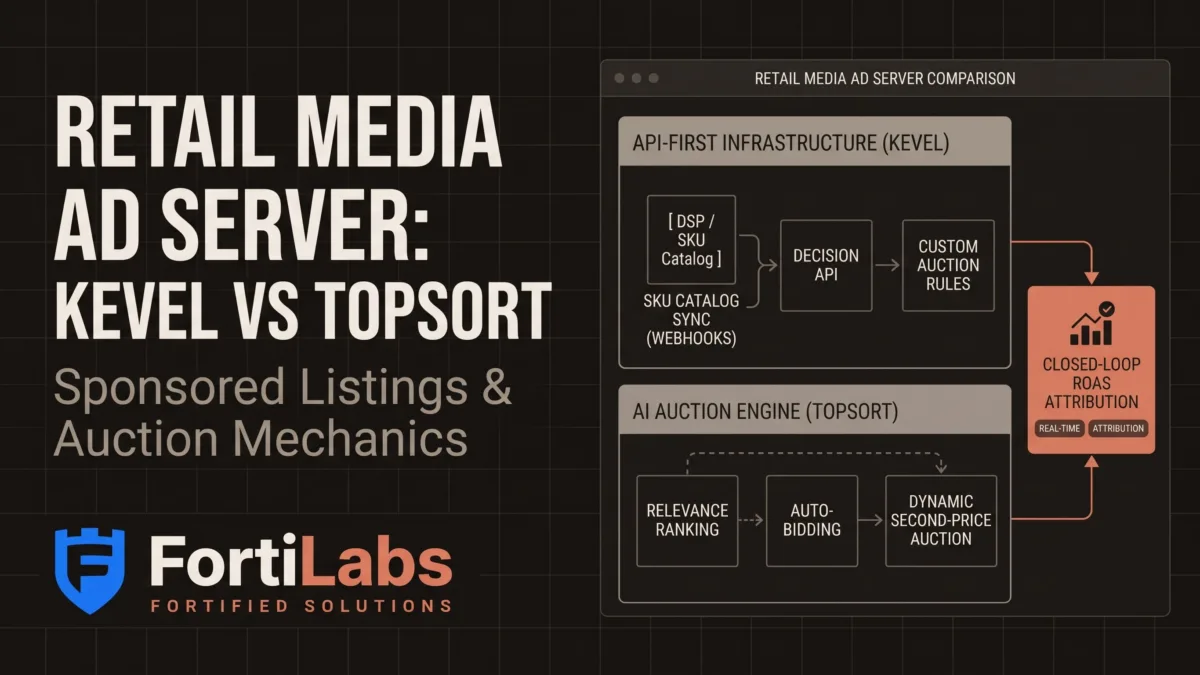
Building a retail media ad server requires more than placing sponsored products inside search results. Retailers and e-commerce marketplaces need a real-time auction engine, product catalog synchronization, advertiser campaign management, purchase attribution, and privacy-safe audience activation. Kevel and Topsort approach this challenge differently: Kevel provides configurable, API-first ad-serving infrastructure, while Topsort offers commerce-native auction and optimization capabilities designed around product relevance, bidding, and retail media workflows.
Quick answer: Kevel is worth evaluating when your engineering team wants to build and control a highly customized advertising platform using configurable APIs. Topsort is worth evaluating when you want a more commerce-specific auction, relevance, pacing, and measurement stack with less decisioning infrastructure to assemble yourself. Neither choice removes the need to integrate your product catalog, checkout events, advertiser systems, and data governance controls.
What is a retail media ad server?
A retail media ad server is the infrastructure that allows an e-commerce retailer, marketplace, delivery platform, or commerce business to sell and deliver advertising placements using its own shopping experiences and first-party commerce data.
For example, when a shopper searches for wireless headphones, a retailer can display sponsored products from brands competing for premium positions. The ad server determines which eligible products can participate, evaluates their bids, applies relevance and quality rules, selects winners, and returns the sponsored listings to the storefront.
Unlike a conventional display ad server, a retail media platform must understand commerce-specific objects and events:
- Products: SKUs, product identifiers, titles, brands, categories, prices, and availability.
- Vendors: Advertisers, marketplace sellers, brand accounts, and their permissions.
- Campaigns: Budgets, bidding strategies, product eligibility, targeting, and schedules.
- Placements: Search results, category pages, product detail pages, homepages, and off-site inventory.
- Shopper interactions: Ad requests, impressions, clicks, add-to-cart events, and completed purchases.
- Measurement: Attributed orders, revenue, advertising spend, return on ad spend, and incrementality.
Why are retailers building their own advertising networks?
Retailers have a valuable combination of high-intent shopping traffic, product-level behavioral signals, first-party purchase information, and direct relationships with brands and marketplace sellers.
Instead of relying exclusively on third-party advertising networks, they can monetize their own search, browse, product, and discovery experiences. Advertisers gain access to shoppers closer to purchase, while retailers create a new revenue stream around their existing commerce infrastructure.
Retail media can also extend beyond a retailer’s website or app. An off-site advertising program can use eligible retailer audiences to activate campaigns across external media channels, subject to partner integrations, platform capabilities, and privacy permissions.
The infrastructure challenge: a successful retail media network must connect the ad auction to the actual commerce transaction. If a sponsored product wins an auction but is unavailable, irrelevant, incorrectly priced, or impossible to attribute to a purchase, the advertising system is not delivering its full value.
What architecture powers sponsored product advertising?
A typical sponsored listings architecture contains several interconnected services. The ad server or auction platform is only one component.
Core services a retailer needs
| Component | Responsibility | Integration requirement |
|---|---|---|
| Catalog service | Maintains products, categories, brands, and availability. | Product information management (PIM), commerce database, or product feed. |
| Campaign management | Controls advertiser accounts, budgets, bids, and targeting. | Advertiser portal, campaign APIs, and billing systems. |
| Auction engine | Selects eligible ads and determines sponsored placements. | Real-time decision API and ranking logic. |
| Ad rendering | Displays sponsored products in the storefront. | Frontend components, placement contracts, and creative templates. |
| Event collection | Captures impressions, clicks, and purchases. | Client-side events and server-side order events. |
| Attribution and reporting | Connects ad interactions to purchases and calculates performance. | Identity mapping, attribution rules, and financial reconciliation. |
| Audience activation | Builds and activates eligible shopper segments. | Consent-aware customer data, clean rooms, and media integrations. |
The most important architectural decision is determining which platform owns each responsibility. A retailer may use one vendor for auctions, another for audience management, and its own warehouse for financial reporting. Alternatively, it may prefer a more consolidated platform to reduce integration overhead.
Kevel vs Topsort: how do the retail media platforms differ?
Kevel and Topsort both provide infrastructure for building commerce advertising products, but their underlying approaches are different.
Kevel: API-first ad-serving infrastructure
Kevel provides ad-serving APIs and retail media capabilities that technical teams can use to build customized advertising products.
Its core architecture is organized around three API groups:
- Management API: Manages inventory, campaigns, targeting rules, and advertising configuration.
- Decision API: Receives ad requests, evaluates matching rules, and returns suitable advertising results.
- Reporting API: Provides access to advertising performance and reporting data.
For retail media, Kevel provides Catalog functionality for sponsored listings, configurable ad decisioning, first- and second-price auction options, and purchase attribution. Its platform also offers tools such as Autobid for optimizing advertiser bids toward target ROAS.
This architecture is useful when a retailer wants control over its advertising experience, campaign workflows, integrations, and product-specific rules. The trade-off is that the engineering team must design and maintain more of the surrounding business logic.
Official technical guide: Kevel Retail Media Guide.
Topsort: commerce-native auctions and optimization
Topsort positions its infrastructure around commerce media, combining sponsored listings, auction decisioning, relevance, campaign management, optimization, and measurement.
Its platform exposes APIs for:
- Sponsored listing and banner auctions.
- Product, category, and vendor catalog management.
- Campaign creation, targeting, and bid management.
- Shopper interaction and conversion event reporting.
- Campaign and product-level reporting.
- Audience and off-site advertising workflows.
Topsort also offers optimization capabilities around relevance, quality scoring, bidding, pacing, and commerce performance. Its product suite includes AI-oriented decisioning and commerce intelligence capabilities.
This approach can reduce the amount of commerce-specific auction infrastructure a retailer needs to assemble. However, the retailer still needs to implement catalog synchronization, event tracking, storefront integration, business rules, and data governance.
Official technical resources: Topsort API documentation and Topsort core platform.
Side-by-side platform comparison
| Evaluation area | Kevel | Topsort |
|---|---|---|
| Core approach | Configurable ad-serving APIs and custom infrastructure. | Commerce-native retail media and auction infrastructure. |
| Sponsored listings | Supported through Catalog, ad templates, and decisioning. | Native sponsored listing auction workflows. |
| Auction control | Configurable first- and second-price auction options. | Real-time commerce auctions with platform decisioning and optimization. |
| Product catalog | Catalog supports product feeds and ad creation. | Catalog APIs support product, category, and vendor data. |
| Ranking and relevance | Custom targeting, rules, and configurable ranking logic. | Commerce-oriented relevance, ranking, quality scoring, and optimization. |
| Autobidding | Autobid functionality supports target-ROAS optimization. | AI-oriented bidding and optimization capabilities are part of its commerce media proposition. |
| Purchase attribution | Catalog-backed attribution with purchase events and configurable lookback windows. | Commerce event and purchase attribution workflows. |
| Off-site media | Supported through its broader retail media and audience capabilities. | Off-site advertising and audience activation are part of its commerce media platform. |
| Customization | Strong fit for teams building custom workflows and ad products. | API-driven integration within a more commerce-specific platform model. |
| Engineering responsibility | More responsibility for custom decisioning and surrounding workflows. | More built-in commerce workflows, with integration and configuration still required. |
Important: this comparison describes documented product positioning and capabilities, not a guarantee that every feature is included in every commercial package. Availability, API limits, pricing, service-level commitments, and integration requirements should be confirmed in a current vendor proposal.
First-price vs second-price auctions: how should retailers choose?
The auction model determines how much a winning advertiser pays for a sponsored placement. Two important approaches are first-price and second-price auctions.
How does a second-price auction work?
In a simplified second-price auction, the highest eligible bidder wins but pays an amount based on the next-highest competing bid rather than automatically paying its full submitted bid.
For example, suppose three advertisers submit the following maximum CPC bids:
| Advertiser | Maximum CPC bid | Outcome |
|---|---|---|
| Brand A | $2.00 | Winner |
| Brand B | $1.50 | Runner-up |
| Brand C | $1.10 | Third place |
In a simplified second-price implementation, Brand A might pay approximately $1.50 plus the minimum increment required to beat the second-highest bid, subject to the auction’s floor and pricing rules.
Real implementations may use reserve prices, quality adjustments, multiple slots, bid modifiers, and other rules. Therefore, the amount paid is not necessarily the raw second-highest bid.
How does a first-price auction work?
In a first-price auction, the winning advertiser pays its own submitted bid, subject to the platform’s pricing and billing rules.
Using the same bids, Brand A wins at $2.00 CPC. This creates a more direct relationship between the submitted bid and the auction payment.
Advertisers may respond by bidding more strategically or shading their bids to avoid overpaying. The retailer must balance auction competitiveness with advertiser confidence and campaign performance.
What is generalized first-price (GFP)?
A generalized first-price auction extends first-price mechanics to multiple sponsored positions. Each winning advertiser pays its own submitted bid for the slot it wins, subject to the platform’s rules.
For example, a search results page may have three sponsored positions. Several advertisers compete, and the auction assigns the highest-ranked eligible advertisers to the available slots. The payment for each winner is based on its own bid rather than the next advertiser’s bid.
Retailers should not confuse a multi-slot auction with a generalized second-price auction. The number of available positions and the pricing rule are separate design decisions.
What changes when product relevance is included?
Pure bid ranking can create poor shopping experiences. A product with a high bid may be unrelated to the shopper’s search or unavailable for purchase.
Retail media systems therefore often use eligibility rules and relevance signals before or during ranking. A simplified conceptual scoring model might look like this:
Ad Score =
  Bid Value
  × Relevance Factor
  × Quality Factor
This is an illustrative model, not a published formula for either Kevel or Topsort. The actual scoring logic and auction settlement rules depend on the platform configuration.
Potential ranking signals include:
- Search-query and product-title relevance.
- Category and brand compatibility.
- Product availability and delivery eligibility.
- Advertiser bid and remaining campaign budget.
- Historical click-through and conversion performance.
- Product quality and shopper experience constraints.
How do Kevel and Topsort approach auctions?
Kevel documents support for first- and second-price auctions, giving retailers flexibility to configure their preferred auction mechanics. Its decision engine can be combined with custom targeting, ranking, and Autobid functionality.
Topsort emphasizes commerce-oriented real-time auctions, relevance, quality scoring, budget enforcement, and optimization. Its auction API returns ranked winners for listing and banner placements.
Neither description should be reduced to a simplistic claim that one platform is always first-price and the other always second-price. Before procurement, request a written explanation of:
- The supported auction formats for the exact product and placement.
- Whether bids are raw CPC, CPM, or transformed scoring inputs.
- How quality and relevance affect ranking.
- How floors and minimum bids are applied.
- How winning prices are calculated.
- How multiple sponsored positions are allocated.
- How tie-breaking, budget exhaustion, and pacing are handled.
- How auction outcomes are exposed for advertiser billing and reporting.
Selection principle: choose the auction model that produces sustainable advertiser economics, competitive retailer yield, and relevant shopper experiences. A higher gross auction price is not automatically a better retail media outcome if it reduces conversions or advertiser retention.
How should product relevance and auction ranking work?
A sponsored listing should be eligible to compete because it is relevant to the shopper’s context—not simply because the advertiser has the largest budget.
Consider a shopper searching for “wireless noise-cancelling headphones.” The auction should first identify products that satisfy the query and the retailer’s merchandising rules. Only then should eligible campaigns compete for the sponsored positions.
Separate eligibility from ranking
A robust implementation has two distinct stages:
- Eligibility filtering: Remove products that are unavailable, discontinued, outside the targeted category, disallowed by campaign rules, or otherwise unsuitable.
- Auction ranking: Rank the remaining eligible candidates using bids, relevance, quality, budget, and placement-specific rules.
This prevents an advertiser from purchasing a sponsored position for an unavailable or irrelevant product simply by increasing its bid.
Define quality and relevance signals
- Query-to-product semantic relevance.
- Brand and category compatibility.
- Product availability and inventory status.
- Price competitiveness and promotion eligibility.
- Historical shopper engagement.
- Conversion probability, where sufficiently reliable data exists.
- Campaign-level and marketplace-level constraints.
Machine-learning optimization can help predict relevance, conversion likelihood, and bid efficiency. However, retailers should retain policy controls for restricted categories, sponsored placement limits, product quality, and customer experience.
Prevent sponsored ads from overwhelming organic results
Retail media revenue should not come at the expense of product discovery. Define the maximum number of sponsored placements per page, enforce separation or labeling rules, and monitor whether sponsored listings reduce organic product engagement.
Measure not only advertising revenue but also search abandonment, add-to-cart rate, conversion rate, average order value, and repeat shopper behavior.
How does SKU catalog synchronization work with webhooks?
The product catalog is one of the most important integrations in a retail media ad server. The auction engine needs accurate product information to decide which sponsored items can compete for each placement.
A retailer may have hundreds of thousands or millions of SKUs, with product information changing throughout the day. Prices, stock levels, product status, category assignments, and vendor relationships can change independently.
What product fields should be synchronized?
| Field | Purpose | Update importance |
|---|---|---|
product_id |
Stable internal product or SKU identifier. | Critical |
title |
Product name used for search relevance and display. | High |
brand_id |
Brand relationship and campaign eligibility. | High |
category_ids |
Category targeting and relevance. | High |
vendor_id |
Marketplace seller or supplier identity. | High |
price |
Current selling price. | High |
availability |
Whether the product can currently be purchased. | Critical |
image_url |
Product image used in sponsored placements. | Medium |
product_status |
Active, discontinued, blocked, or unpublished status. | Critical |
updated_at |
Timestamp for change detection and reconciliation. | High |
Use an initial catalog load followed by incremental updates
A reliable synchronization design normally uses two processes:
- Initial load: Export the current product catalog, validate the records, and import the product dataset into the advertising platform.
- Incremental updates: Send changes when products are created, updated, discontinued, repriced, or moved between categories.
For example, a product availability change should update the advertising eligibility state so that an out-of-stock product does not continue winning sponsored positions.
What role do webhooks play?
Webhooks notify a receiving system when an event occurs. Instead of repeatedly downloading the entire catalog, the integration can receive a notification that a product or related record has changed and then synchronize the affected data.
A typical event-driven flow looks like this:
Design webhook handling for production reliability
- Idempotency: Process the same event more than once without creating duplicate products or corrupting catalog state.
- Signature verification: Verify the sender’s webhook signature before accepting an event.
- Retry handling: Use retry policies and a dead-letter queue for failed deliveries.
- Event ordering: Use event timestamps or source versions to avoid applying stale updates after newer ones.
- Batching: Group product updates where supported to reduce API overhead.
- Reconciliation: Periodically compare the source catalog with the advertising platform’s catalog.
- Deletion handling: Ensure discontinued or removed SKUs no longer qualify for sponsored auctions.
Topsort documents catalog APIs for upserting, updating, retrieving, and deleting products, categories, and vendors. Its webhook documentation also describes event delivery, retry behavior, and HMAC-based signature verification. A retailer should check which events are available in its actual integration and should not assume that every product-catalog change is automatically synchronized by a webhook.
Kevel’s Catalog supports product-feed-based sponsored listings. The retailer should confirm the feed ingestion and update cadence, available synchronization mechanisms, and operational limits for its specific implementation.
Technical references: Topsort product catalog API, Topsort webhook usage, and Kevel Catalog documentation.
How does closed-loop conversion attribution calculate retail media ROAS?
Closed-loop attribution connects an advertising interaction to a completed transaction inside the retailer’s commerce environment.
This is one of retail media’s most valuable advantages: the retailer can connect ad delivery data with actual purchase records rather than relying only on clicks, estimated conversions, or external measurement.
Which events must the retailer collect?
- Ad request: A shopper loads a search or product page and triggers an auction.
- Ad impression: The sponsored product is rendered and meets the platform’s impression-counting definition.
- Ad click: The shopper interacts with the sponsored product.
- Add to cart: The shopper adds a product to the basket.
- Order completed: The retailer’s backend confirms a purchase.
- Order adjustment: The retailer processes cancellations, refunds, or returns where required for net-revenue reporting.
The most important event for closed-loop purchase attribution is the confirmed transaction from the retailer’s server or order-management system. Browser-only conversion tracking can be lost through blocked scripts, navigation interruptions, or tracking restrictions.
How are ad interactions matched to purchases?
The advertising system needs a consistent identifier that can connect the ad interaction to the later purchase event. Depending on the implementation, this may be a retailer-controlled user key, a pseudonymous identifier, or another approved matching mechanism.
For example:
{
  "event": "purchase",
  "order_id": "ORDER-90021",
  "user_key": "pseudonymous-user-123",
  "timestamp": "2026-11-11T10:30:00Z",
  "currency": "USD",
  "items": [
    {
      "product_id": "SKU-10045",
      "quantity": 1,
      "unit_price": 129.99
    }
  ]
}
This is an illustrative event schema, not a vendor-specific API payload. A production integration must follow the exact endpoint, required fields, authentication, currency, and event semantics documented by the selected platform.
What is an attribution window?
An attribution window is the period during which a qualifying click or impression can receive credit for a later purchase.
For example, a retailer may choose a seven-day post-click window and a one-day post-view window. A purchase outside those periods would not receive credit under that particular configuration.
The appropriate windows depend on product type, shopper behavior, and campaign objectives. A low-consideration grocery purchase and a high-value appliance purchase may require different measurement approaches.
Understand attribution models
| Model | How credit is assigned | Best use |
|---|---|---|
| Last click | Credits the last qualifying click before conversion. | Direct-response campaigns where clicks are the primary signal. |
| Last touch | Credits the last qualifying interaction, according to configured click or view rules. | Simple operational reporting and consistent campaign comparisons. |
| Multi-touch | Distributes credit across multiple qualifying interactions. | Journeys involving several advertising exposures. |
| Incrementality testing | Estimates additional sales caused by advertising versus a control group. | Understanding whether advertising generated new demand. |
Attribution is not the same as incrementality. A last-touch model can assign a purchase to an ad that was already likely to convert without advertising. Retailers should therefore supplement operational ROAS reporting with controlled lift studies when they need to understand causal advertising impact.
How is ROAS calculated?
Return on ad spend compares attributed revenue with the advertising cost:
ROAS =
  Attributed Revenue / Advertising Spend
Suppose an advertiser spends $5,000 and receives $20,000 in attributed product sales:
ROAS = $20,000 / $5,000
ROAS = 4.0x
This represents $4 in attributed revenue for every $1 of advertising spend. It does not automatically mean $4 in profit. Product margins, fulfillment costs, discounts, returns, and other expenses must be considered separately.
Why product-level attribution matters
A shopper may click a sponsored product but purchase a different size, color, or related product from the same brand. A retailer needs to decide how these transactions should be classified.
Useful match types include:
- Same product: The purchased SKU exactly matches the advertised SKU.
- Same category: The purchased product belongs to the same configured category.
- Same brand: The purchase comes from the same brand as the promoted product.
These classifications should be reported separately. A same-brand purchase is not the same as a direct purchase of the exact advertised SKU.
How do Kevel and Topsort handle measurement?
Kevel documents a purchase-event-based attribution workflow. Its Catalog supports product-level attribution, configurable match types, and lookback windows. The purchase data stream is matched against prior ad interactions using the configured user key and attribution rules.
Topsort exposes event reporting and commerce-oriented purchase attribution, with reporting capabilities for campaigns, products, vendors, and marketplace performance. Retailers should confirm the exact attribution rules, identity matching, refund handling, and reporting definitions available in their contracted setup.
Official references: Kevel Conversion Tracking, Kevel Retail Media Guide, and Topsort event reporting API.
How can retailers extend sponsored listings into off-site audience advertising?
On-site retail media monetizes the retailer’s own search, category, product, and discovery surfaces. Off-site retail media uses eligible retailer audience signals to support advertising beyond those owned properties.
For example, a shopper who has browsed or purchased running shoes may belong to an eligible audience segment that a retailer can activate through an approved external advertising partner.
How does an off-site audience workflow operate?
- Collect first-party signals: Capture consented shopping behavior, transactions, and relevant loyalty interactions.
- Define audience segments: Build useful groups such as recent purchasers, category shoppers, or lapsed customers.
- Apply privacy and eligibility controls: Exclude users who have opted out or do not meet the required permissions.
- Prepare audience activation: Use approved identifiers, partner integrations, or privacy-safe matching workflows.
- Activate through external media: Deliver the segment to a supported DSP or advertising platform.
- Measure outcomes: Reconcile campaign exposure with eligible retailer transactions and agreed attribution rules.
Which audiences are useful?
- Recent category purchasers.
- High-value customers.
- Shoppers who viewed a product but did not purchase.
- Customers who abandoned a shopping cart, where activation is permitted.
- Brand buyers and category enthusiasts.
- Customers eligible for cross-sell or replenishment campaigns.
Off-site activation should not expose raw customer records or unrestricted purchase histories to advertisers. Use platform-supported audience controls, approved identifiers, data minimization, and contractual restrictions.
Topsort documents off-site advertising and audience workflows as part of its broader commerce media platform. Kevel offers retail media and audience capabilities that can be integrated into broader activation workflows. Confirm the supported DSP destinations, segment transfer methods, identity requirements, and measurement coverage during technical evaluation.
How do Snowflake and AWS Clean Rooms support privacy-safe retail media?
Retailers and brands often want to combine their data to understand customer overlap, build audiences, and measure campaign performance. However, sharing raw customer records or identifiable purchase histories may create unnecessary privacy and governance risks.
Data clean rooms provide a controlled environment in which participating organizations can run approved analyses without giving every party unrestricted access to the underlying datasets.
Snowflake Data Clean Rooms
Snowflake Data Clean Rooms support controlled data collaboration through governed analysis templates and permissioned access.
A retailer could make eligible transaction and product-category data available to an approved clean-room collaboration. A brand could contribute its own campaign or customer data. The parties could then run permitted queries to calculate audience overlap, campaign performance, or aggregated purchase insights.
Snowflake’s architecture allows data providers to control which analyses are permitted and how results can be exposed or activated. Depending on the configuration, collaborators can receive approved aggregated insights without unrestricted access to the raw underlying records.
AWS Clean Rooms
AWS Clean Rooms enables organizations to analyze and collaborate on shared datasets without directly exposing the underlying data to one another.
It supports privacy-enhancing controls such as analysis rules, query restrictions, differential privacy options, and audit capabilities. Participants can collaborate using datasets stored in supported AWS environments and other connected data sources.
For example, a retailer and an advertiser could create a collaboration to measure the overlap between eligible customer groups and campaign exposure records. The analysis can be constrained to approved queries and output rules.
Example retail media clean-room architecture
Does Kevel or Topsort automatically provide a native Snowflake or AWS Clean Rooms connection?
Do not assume so. A clean-room platform and a retail media ad server solve different parts of the architecture. The existence of a Snowflake or AWS Clean Rooms environment does not prove that a particular Kevel or Topsort product includes a turnkey connector for every clean-room workflow.
A retailer can design an integration using its data warehouse, event pipelines, supported APIs, and approved audience activation mechanisms. Before selecting a vendor, request written confirmation of:
- Supported Snowflake and AWS data exchange patterns.
- Available APIs and export formats.
- Audience ingestion and activation capabilities.
- Identifier matching and pseudonymization requirements.
- Consent, opt-out, and deletion propagation.
- Aggregated reporting and minimum audience thresholds.
- Data retention, regional processing, and access controls.
- Whether the integration is native, partner-built, or custom-developed.
A clean room does not automatically make data processing lawful or eliminate privacy obligations. The retailer and its partners remain responsible for appropriate consent, contractual controls, purpose limitation, security, and applicable privacy requirements.
Technical references: Snowflake Data Clean Rooms documentation and AWS Clean Rooms documentation.
How to build a practical retail media ad server integration
Whether the retailer selects Kevel, Topsort, or a custom stack, a reliable implementation should separate commerce operations from advertising decisioning.
1. Establish the source of truth for product data
Choose the system that owns the canonical product identifier and product state. This may be the commerce platform, product information management system, or marketplace catalog service.
Define stable identifiers for products, brands, categories, vendors, and placements. Avoid allowing the ad platform to become an independent source of truth for stock availability or checkout prices.
2. Create the advertiser and campaign model
Build an advertiser account structure that supports brand ownership, marketplace sellers, billing contacts, campaign permissions, and operational approval.
Each campaign should define:
- Advertiser and vendor identifiers.
- Campaign budget and schedule.
- Bid strategy and maximum bid constraints.
- Eligible products and categories.
- Search terms or placement targeting.
- Geography and audience restrictions where applicable.
- Creative and product-image requirements.
- Measurement and attribution settings.
3. Integrate the real-time auction
When a shopper opens a search or browse page, the storefront or backend sends the auction context to the decision platform.
A simplified request might contain:
{
  "placement": "search_results_top",
  "query": "wireless headphones",
  "category_id": "electronics_audio",
  "page_size": 2,
  "currency": "USD",
  "context": {
    "marketplace_id": "marketplace_01"
  }
}
This is an illustrative integration contract, not a vendor-specific request format. The actual request must follow the selected platform’s API schema.
The auction service returns eligible winners and the information required to render the sponsored placement. The retailer should preserve the platform’s auction and tracking identifiers for later event reporting.
4. Render sponsored products responsibly
The frontend should clearly identify sponsored results, render the correct product information, and avoid presenting unavailable or invalid products.
Do not cache auction winners as if they were static catalog content. Auction results should be generated according to the vendor’s request and caching requirements, and the platform’s documentation should be followed for each page view.
5. Record impression and click events
Capture ad interactions with enough information to connect them to the campaign, product, placement, and auction. An impression should be recorded according to the agreed rendering and viewability definition rather than simply assuming that an auction response means an ad was seen.
6. Send purchase events from the order system
After checkout is confirmed, send the appropriate purchase events to the attribution system. Use the order-management system as the authoritative source for completed purchases, and implement deduplication so retries do not create duplicate conversions.
7. Reconcile reports with finance
Compare ad platform reporting with the retailer’s order, refund, and financial systems. Define how cancellations, partial refunds, taxes, shipping charges, and currency conversion affect attributed revenue.
Advertisers should be able to distinguish media spend, attributed sales, product-level purchases, and any adjustments made after the original conversion.
What performance, security, and privacy controls are essential?
Keep auction latency predictable
Sponsored product auctions operate inside a shopping experience. A slow decision can delay search results, increase page latency, and reduce conversion opportunities.
Measure:
- Auction API latency at p50, p95, and p99.
- Catalog lookup and eligibility evaluation time.
- Timeout and empty-auction rates.
- Event delivery delay.
- Catalog synchronization lag.
- Ad rendering failures and fallback behavior.
Set explicit timeout budgets. If the ad service is unavailable, the storefront should still return useful organic results rather than allowing the advertising integration to break shopping.
Protect campaign and commerce APIs
- Keep API credentials on trusted server-side systems.
- Use separate credentials and permissions for catalog ingestion, auction calls, and reporting.
- Validate webhook signatures and reject invalid deliveries.
- Rate-limit sensitive campaign and account operations.
- Maintain audit logs for campaign changes and billing adjustments.
- Use idempotency keys or equivalent deduplication controls for event ingestion.
- Encrypt sensitive data in transit and at rest.
Apply privacy controls to shopper data
Retailer purchase and loyalty data can be commercially valuable and personally sensitive. Collect only the data needed for the defined advertising and measurement purposes.
Implement consent and opt-out handling, purpose restrictions, retention schedules, deletion workflows, and access controls. Pseudonymous identifiers are still potentially personal data when they can be linked to an individual or household.
Audience activation and clean-room analysis must follow the applicable privacy laws, platform policies, and agreements with advertisers and partners.
Prevent revenue and reporting inconsistencies
Define a single reporting contract for each metric. For example, impressions, clicks, spend, purchases, attributed revenue, and ROAS should have documented counting rules.
Without shared definitions, a retailer may report a different ROAS from the advertiser even when both systems are functioning correctly. Differences can arise from attribution windows, time zones, currency, refunds, deduplication, and product match rules.
Which platform should a retailer choose: Kevel or Topsort?
The best platform depends on the retailer’s engineering capacity, existing commerce systems, monetization strategy, and desired ownership of auction and optimization logic.
Choose Kevel when…
- Your engineering team wants to build a highly customized retail media product.
- You prefer configurable ad-serving APIs and control over the surrounding architecture.
- You have specific auction, targeting, or campaign-management requirements.
- You want to integrate advertising into an existing internal platform or workflow.
- You have the technical resources to build and maintain custom decisioning and business logic.
Choose Topsort when…
- You want commerce-specific auction and sponsored listing infrastructure.
- You value integrated relevance, ranking, quality scoring, and optimization capabilities.
- You want a platform that brings more retail media workflows together.
- You need APIs for catalog, auctions, campaign operations, events, and reporting.
- You want to expand from on-site advertising into broader commerce media and off-site activation.
What should be included in a vendor proof of concept?
Do not select a platform based only on a feature presentation. Run the same realistic use case through each vendor and compare results.
| Test | What to validate |
|---|---|
| Catalog ingestion | Bulk import, incremental updates, product deletion, stock changes, and catalog reconciliation. |
| Auction performance | Decision latency, ranking correctness, floors, multiple slots, and empty-auction behavior. |
| Advertiser workflow | Campaign creation, budgets, billing, permissions, and self-service requirements. |
| Attribution | Purchase-event matching, SKU-level reporting, attribution windows, and refunds. |
| Optimization | Autobidding, pacing, relevance, and quality controls. |
| Off-site activation | Supported partners, audience transfer, privacy controls, and measurement coverage. |
| Clean-room workflow | Data exchange, identity matching, approved queries, and activation architecture. |
| Commercial model | Platform fees, usage charges, support costs, implementation, and contractual commitments. |
| Operational resilience | Service-level agreements, incident response, retries, observability, and fallback behavior. |
Practical recommendation: If your primary challenge is building a custom advertising product around existing commerce systems, begin by evaluating Kevel’s API architecture. If your priority is launching a commerce-native sponsored listing and auction operation with integrated optimization workflows, give Topsort a detailed proof of concept. Compare both against the same catalog, traffic sample, auction rules, and purchase events before committing.
Retail media launch roadmap: from first sponsored listing to off-site advertising
A retailer should not attempt to launch every advertising format and audience workflow simultaneously. A staged implementation reduces integration risk and makes it easier to prove revenue impact.
Phase 1: Build the on-site foundation
- Define sponsored search and category placements.
- Connect the product catalog.
- Establish advertiser accounts and campaign rules.
- Implement auction requests and sponsored product rendering.
- Track impressions and clicks.
Phase 2: Introduce closed-loop attribution
- Integrate the order-management purchase stream.
- Define user-key and event-matching rules.
- Configure attribution windows and product match types.
- Reconcile attributed sales with the retailer’s financial records.
- Launch advertiser-facing ROAS reports.
Phase 3: Scale advertiser operations
- Introduce self-service campaign creation where appropriate.
- Automate budget, invoice, and payment workflows.
- Implement campaign pacing and bid optimization.
- Expand sponsored placements to product detail pages and discovery surfaces.
- Build advertiser support and account-management processes.
Phase 4: Expand into off-site and privacy-safe collaboration
- Define consented audience segments.
- Connect eligible media activation partners.
- Evaluate Snowflake or AWS Clean Rooms for multi-party measurement and collaboration.
- Implement privacy-aware audience activation and deletion workflows.
- Measure off-site outcomes against the retailer’s agreed attribution and incrementality methodology.
Use a gradual migration strategy. Keep the existing ad-serving path available during the pilot, compare auction decisions and reporting, and move placements in controlled stages. This makes it easier to isolate issues before expanding the network.
Frequently asked questions about retail media ad servers
What is a retail media ad server?
A retail media ad server is a system that manages advertiser campaigns, selects eligible sponsored products, runs auctions, serves placements, tracks interactions, and connects advertising activity to retailer purchases. It allows retailers and marketplaces to monetize their own shopping experiences.
What is the difference between Kevel and Topsort?
Kevel focuses on configurable ad-serving APIs and customizable advertising infrastructure. Topsort focuses on commerce-native retail media infrastructure with auctions, relevance, optimization, catalog, campaign, and measurement workflows. The better choice depends on how much custom infrastructure the retailer wants to own.
Does Kevel support sponsored product listings?
Yes. Kevel supports sponsored listings through its Catalog and ad decisioning capabilities. Product information can be used to create and target sponsored product campaigns, with configurable auction and attribution functionality.
Does Topsort provide a real-time auction API?
Yes. Topsort documents an auctions API for sponsored listings and banners. The API supports auction requests with configurable placements and slots and returns ranked winners when eligible campaigns match the request.
What is the difference between first-price and second-price auctions?
In a first-price auction, the winner pays its own submitted bid. In a simplified second-price auction, the winner pays an amount based on the next-highest eligible bid, subject to floors and platform rules. Both can be used in multi-placement advertising systems, but the pricing and ranking rules must be clearly defined.
What is generalized first-price advertising?
Generalized first-price is a multi-slot auction model in which each winning advertiser pays its own submitted bid for the position it wins. It is different from generalized second-price, where pricing is based on the next competitor’s bid and the auction’s settlement rules.
How do retailers synchronize SKU catalogs with an ad server?
Retailers typically perform an initial product-feed import followed by incremental updates through APIs, event pipelines, or webhooks. Synchronization should include product identifiers, category, brand, price, availability, status, and vendor information. Periodic reconciliation helps detect missing or stale records.
Why are webhooks important for retail media?
Webhooks notify connected systems when relevant changes occur, such as product updates or campaign changes. They can reduce the need for repeated full catalog imports. Reliable implementations require signature verification, idempotency, retries, event ordering, and reconciliation.
What is closed-loop attribution in retail media?
Closed-loop attribution connects ad impressions or clicks with completed purchases inside the retailer’s commerce system. Server-side purchase events and consistent identifiers allow the advertising platform to measure attributed orders, product sales, and ROAS.
What is retail media ROAS?
Retail media ROAS is attributed revenue divided by advertising spend. For example, $20,000 in attributed sales from $5,000 in advertising spend produces a 4.0x ROAS. It measures attributed revenue, not profit or incremental sales.
Can retail media platforms support off-site advertising?
Yes. Retail media networks can use eligible first-party audience segments to activate advertising across external channels through supported integrations. The retailer must validate partner compatibility, audience matching, consent, activation controls, and measurement.
What is a data clean room in retail media?
A data clean room is a controlled environment where retailers, advertisers, and partners can run approved analyses on combined datasets without granting unrestricted access to each other’s underlying records. It can support audience overlap, segmentation, and campaign measurement.
Can Snowflake and AWS Clean Rooms be used with Kevel or Topsort?
They can form part of a retailer’s broader data and privacy architecture, but a turnkey native connection should not be assumed. The retailer must verify available connectors and APIs or design an integration for governed data exchange, audience activation, and reporting.
Should a retailer build a custom ad server or use a managed platform?
A custom build can provide maximum control but requires engineering resources for auctions, campaign management, catalog synchronization, attribution, and operations. A managed platform can reduce the infrastructure burden but introduces vendor dependencies, integration requirements, and commercial costs. Compare both against the retailer’s actual requirements and long-term ownership strategy.
Build retail media around commerce, not just ad delivery
Launching a retail media network requires a connected system for product discovery, auction decisioning, advertiser management, catalog synchronization, purchase attribution, and audience activation.
Kevel offers a configurable API-first foundation for retailers that want to build custom ad-serving workflows and control more of their infrastructure. Topsort offers a commerce-native platform focused on auctions, relevance, optimization, and retail media operations.
The most important evaluation criteria are not simply the number of features in a vendor presentation. They are the quality of the auction decisions, the accuracy of the product catalog, the reliability of purchase attribution, the performance of the storefront, and the ability to prove advertiser value.
Start with a measurable sponsored listings pilot, connect it to real purchase events, and validate the commercial results. Once the on-site foundation is reliable, expand into off-site audience activation and privacy-safe data collaboration.
Technical references and further reading
- Kevel: Retail Media Guide — ad-serving APIs, sponsored listings, Catalog, auctions, attribution, and reporting.
- Kevel: Conversion Tracking — purchase-event attribution and conversion tracking methods.
- Kevel: Sponsored Listings — sponsored product formats and auction options.
- Topsort: Developer Documentation — API references, catalog, auctions, events, and reporting.
- Topsort: Running Auctions — auction requests, slots, and winner responses.
- Topsort: Upsert Products — product catalog API.
- Topsort: Webhook Event Payloads — webhook event structure and delivery examples.
- Topsort: Core Platform — commerce media, sponsored listings, auctions, and measurement.
- Snowflake: Data Clean Rooms — controlled multi-party data collaboration.
- AWS: Clean Rooms Documentation — privacy-enhancing controls and data collaboration.